Market Watch
Why Portuguese Corporate Bonds May Be Europe's Most Overlooked Income Opportunity

For years, the Portuguese investment industry has been associated with private equity, venture capital and large-scale real estate developments. These strategies undoubtedly have their place, and many have delivered impressive returns.
But if the objective is not simply maximizing returns, but preserving capital while generating attractive and predictable income, there is another asset class quietly playing a central role in many successful investment strategies.
Portuguese corporate bonds.
Not exactly the most glamorous topic.
No unicorn startups. No luxury developments. No artificial intelligence revolution.
Just established businesses generating cash, paying interest and returning capital.
► Why Portugal has become an increasingly attractive destination for international investors
While diversification is often regarded as one of investing's fundamental principles, many international investors are surprised to discover that some Portuguese investment funds allocate between 60% and 70% of their portfolios to Portuguese corporate bonds.
At first glance, such a significant allocation to a relatively small economy may seem counterintuitive. In reality, it can represent a highly deliberate portfolio construction decision.
The explanation lies in a combination of factors that many international investors rarely consider: internationally diversified Portuguese corporate champions, attractive yields relative to comparable European issuers, a liquidity premium associated with a smaller market and a decade-long transformation in Portugal's sovereign and corporate credit profile.
Portugal is home to a number of businesses with strong balance sheets, recurring revenues and, in several cases, investment-grade credit ratings. These companies operate primarily in sectors such as banking, insurance, utilities and energy infrastructure, industries where cash flows tend to be considerably more predictable than in many growth-oriented sectors. Importantly, a Portuguese issuer is not necessarily a business whose fortunes depend solely on the Portuguese economy.
Many of the country's leading companies generate revenues across Europe, Africa, Latin America and other international markets. Their operations, customers and cash flows are often geographically diversified, meaning investors are gaining exposure to multinational businesses headquartered in Portugal rather than purely domestic companies.
This distinction is frequently overlooked.
A portfolio with a meaningful allocation to Portuguese corporate bonds should not automatically be viewed as concentrated solely on Portugal's economy.
► Latest Portuguese economic outlook
Portugal is a smaller market than Germany or France. Bond issues are generally smaller, trading volumes lower and analyst coverage more limited. As a result, investors often demand a modest additional yield to compensate for lower secondary-market liquidity.
For short-term traders, this may represent a disadvantage. For long-term investors following a buy-and-hold approach, however, it can become an opportunity.
Lower liquidity does not, by itself, imply weaker credit quality. It may lead to wider bid-offer spreads or make bonds less suitable for investors who expect to trade frequently, but it does not automatically increase the probability of default. In selected cases, investors may therefore earn an additional yield premium driven more by market structure than by a proportionate deterioration in the issuer's underlying credit quality. In today's fixed-income markets, where many of Europe's largest issuers are extensively researched and efficiently priced, opportunities of this nature deserve attention.
That Portugal no longer exists.
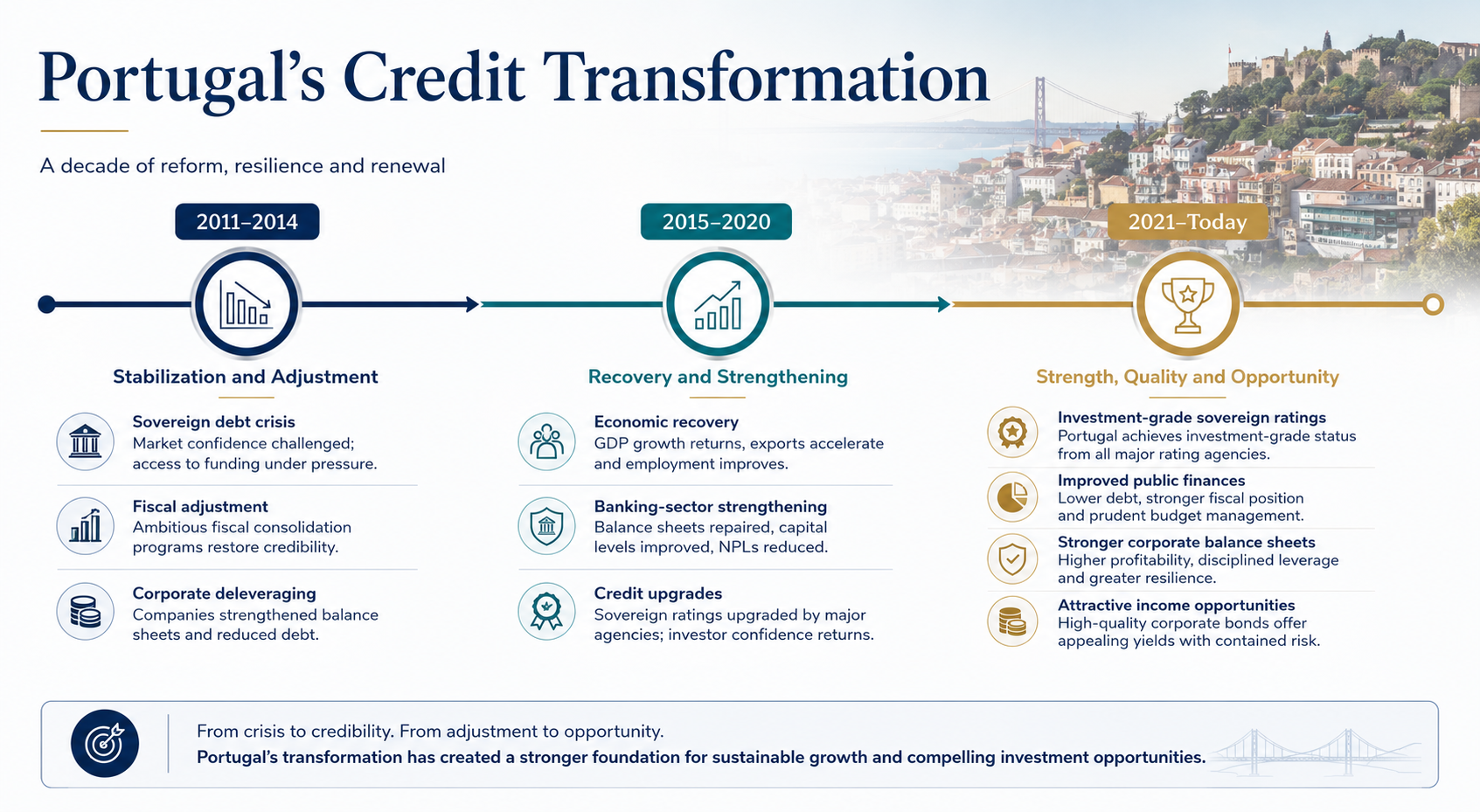
Over the past decade, the country has undergone a remarkable fiscal and economic transformation. Public finances have strengthened, government debt has declined as a share of GDP and international rating agencies have progressively upgraded Portuguese sovereign debt back into investment-grade territory.
Corporate balance sheets have evolved alongside the sovereign. Many Portuguese companies used the post-crisis years to reduce leverage, strengthen governance, improve operational efficiency and expand internationally. Today, some of Portugal's strongest issuers are considerably more resilient than they were ten years ago. The result is a credit market that can offer yields associated with smaller European markets while benefiting from the institutional stability of the eurozone.
► Portugal's improving economic fundamentals
The answer depends entirely on how the portfolio is constructed.
A professionally managed fixed-income portfolio is rarely concentrated in a single issuer or sector. Instead, it is diversified across multiple companies, industries, maturities and credit profiles, while continuously monitoring issuer fundamentals and overall portfolio risk. In other words, a significant allocation to Portuguese corporate bonds should not be confused with indiscriminate home-country bias. It is an active allocation based on the view that this segment of the market offers an attractive balance between income, credit quality and risk-adjusted returns.
They are entrepreneurs, professionals, retirees and families looking to preserve wealth while generating sustainable long-term returns. Many are investing capital that took decades to accumulate.
► Portugal Golden Visa
Their primary objective is not necessarily achieving spectacular performance. More often, it is avoiding permanent losses while maintaining the potential for steady long-term growth.
This is one reason why high-quality fixed-income strategies have become increasingly relevant within the Portuguese asset management industry. Corporate bonds can provide recurring income, reduce portfolio volatility and create a stable foundation upon which other growth-oriented investments can be built.

The greatest risk is not temporary price fluctuations. It is a permanent loss of capital.
A portfolio that declines during periods of market stress but ultimately recovers has experienced volatility. A portfolio that permanently destroys capital has experienced risk. This distinction is particularly important for investors pursuing long-term wealth preservation.
High-quality corporate bonds remain one of the most effective tools available for reducing that risk.
► Learn more about 3 Comma Capital fund solutions: Portugal Golden Income Fund & Atlantic Bond Fund
They may never dominate financial headlines. They may never double in value overnight. But they can provide predictable income, contractual cash flows and an important source of portfolio resilience. In many investment strategies, bonds are not expected to outperform every other asset class. They are expected to provide the stability that allows investors to remain invested through changing market cycles.
Within both the Portugal Golden Income Fund and the Atlantic Bond Fund, Portuguese corporate bonds represent a core component of the fixed-income allocation.
This reflects our conviction that selected Portuguese issuers offer an attractive combination of income generation, improving credit fundamentals and long-term capital preservation characteristics.
The precise allocation evolves over time as market conditions change, but the underlying investment philosophy remains consistent: identify high-quality issuers capable of providing resilient cash flows while building portfolios designed to balance income, stability and long-term growth.
Portuguese corporate bonds may never attract the same attention as venture capital, luxury real estate or the latest technology trend. That is precisely why they deserve a closer look. For investors willing to look beyond the headlines, Portugal's corporate credit market offers a combination of income, improving fundamentals and institutional stability that remains relatively underappreciated within Europe.
► Investors seeking a broader perspective on portfolio diversification and fixed income may also enjoy our article: Why Fixed Income Is Back: Income, Selectivity and the New Bond Market Regime
The most valuable asset in a portfolio is not always the one generating the most excitement. Sometimes, it is the one quietly providing the stability that allows every other investment to fulfil its purpose.
For long-term investors seeking income, capital preservation and portfolio resilience, they deserve far more attention than they typically receive.
But if the objective is not simply maximizing returns, but preserving capital while generating attractive and predictable income, there is another asset class quietly playing a central role in many successful investment strategies.
Portuguese corporate bonds.
Not exactly the most glamorous topic.
No unicorn startups. No luxury developments. No artificial intelligence revolution.
Just established businesses generating cash, paying interest and returning capital.
► Why Portugal has become an increasingly attractive destination for international investors
While diversification is often regarded as one of investing's fundamental principles, many international investors are surprised to discover that some Portuguese investment funds allocate between 60% and 70% of their portfolios to Portuguese corporate bonds.
At first glance, such a significant allocation to a relatively small economy may seem counterintuitive. In reality, it can represent a highly deliberate portfolio construction decision.
The explanation lies in a combination of factors that many international investors rarely consider: internationally diversified Portuguese corporate champions, attractive yields relative to comparable European issuers, a liquidity premium associated with a smaller market and a decade-long transformation in Portugal's sovereign and corporate credit profile.
Key Takeaways
- Portuguese corporate bonds can offer attractive income from established companies operating in resilient sectors.
- Many Portuguese issuers generate substantial revenues internationally, reducing their dependence on the domestic economy.
- Portugal's smaller bond market can create a liquidity premium for long-term investors.
- Portugal's sovereign and corporate credit quality has improved significantly over the past decade.
- Higher yields do not automatically imply materially higher default risk, although careful issuer selection remains essential.
- High-quality corporate bonds can provide recurring income, portfolio stability and capital preservation.Active management is particularly valuable in a less researched credit market
The Hidden Strength of Portuguese Corporate Champions
When international investors think about Portugal, they often think about tourism, wine, beaches and quality of life. What they often overlook are the companies operating behind the scenes.Portugal is home to a number of businesses with strong balance sheets, recurring revenues and, in several cases, investment-grade credit ratings. These companies operate primarily in sectors such as banking, insurance, utilities and energy infrastructure, industries where cash flows tend to be considerably more predictable than in many growth-oriented sectors. Importantly, a Portuguese issuer is not necessarily a business whose fortunes depend solely on the Portuguese economy.
Many of the country's leading companies generate revenues across Europe, Africa, Latin America and other international markets. Their operations, customers and cash flows are often geographically diversified, meaning investors are gaining exposure to multinational businesses headquartered in Portugal rather than purely domestic companies.
This distinction is frequently overlooked.
A portfolio with a meaningful allocation to Portuguese corporate bonds should not automatically be viewed as concentrated solely on Portugal's economy.
► Latest Portuguese economic outlook
The Yield Premium Few Investors Talk About
One of the most interesting characteristics of the Portuguese bond market is what institutional investors often describe as a liquidity premium.Portugal is a smaller market than Germany or France. Bond issues are generally smaller, trading volumes lower and analyst coverage more limited. As a result, investors often demand a modest additional yield to compensate for lower secondary-market liquidity.
For short-term traders, this may represent a disadvantage. For long-term investors following a buy-and-hold approach, however, it can become an opportunity.
Lower liquidity does not, by itself, imply weaker credit quality. It may lead to wider bid-offer spreads or make bonds less suitable for investors who expect to trade frequently, but it does not automatically increase the probability of default. In selected cases, investors may therefore earn an additional yield premium driven more by market structure than by a proportionate deterioration in the issuer's underlying credit quality. In today's fixed-income markets, where many of Europe's largest issuers are extensively researched and efficiently priced, opportunities of this nature deserve attention.
Portugal's Quiet Credit Transformation
Many international investors still associate Portugal with the sovereign debt crisis of the early 2010s.That Portugal no longer exists.
Over the past decade, the country has undergone a remarkable fiscal and economic transformation. Public finances have strengthened, government debt has declined as a share of GDP and international rating agencies have progressively upgraded Portuguese sovereign debt back into investment-grade territory.
Corporate balance sheets have evolved alongside the sovereign. Many Portuguese companies used the post-crisis years to reduce leverage, strengthen governance, improve operational efficiency and expand internationally. Today, some of Portugal's strongest issuers are considerably more resilient than they were ten years ago. The result is a credit market that can offer yields associated with smaller European markets while benefiting from the institutional stability of the eurozone.
► Portugal's improving economic fundamentals
Concentration Is Not the Same as Risk
Whenever investors hear that a portfolio allocates 60% or 70% to Portuguese corporate bonds, the natural question is whether this represents excessive concentration.The answer depends entirely on how the portfolio is constructed.
A professionally managed fixed-income portfolio is rarely concentrated in a single issuer or sector. Instead, it is diversified across multiple companies, industries, maturities and credit profiles, while continuously monitoring issuer fundamentals and overall portfolio risk. In other words, a significant allocation to Portuguese corporate bonds should not be confused with indiscriminate home-country bias. It is an active allocation based on the view that this segment of the market offers an attractive balance between income, credit quality and risk-adjusted returns.
Why This Matters for International Investors
Most international investors are not hedge funds.They are entrepreneurs, professionals, retirees and families looking to preserve wealth while generating sustainable long-term returns. Many are investing capital that took decades to accumulate.
► Portugal Golden Visa
Their primary objective is not necessarily achieving spectacular performance. More often, it is avoiding permanent losses while maintaining the potential for steady long-term growth.
This is one reason why high-quality fixed-income strategies have become increasingly relevant within the Portuguese asset management industry. Corporate bonds can provide recurring income, reduce portfolio volatility and create a stable foundation upon which other growth-oriented investments can be built.
A Different Way of Thinking About Risk
Investors often associate risk with volatility. Professional portfolio managers tend to think differently.The greatest risk is not temporary price fluctuations. It is a permanent loss of capital.
A portfolio that declines during periods of market stress but ultimately recovers has experienced volatility. A portfolio that permanently destroys capital has experienced risk. This distinction is particularly important for investors pursuing long-term wealth preservation.
High-quality corporate bonds remain one of the most effective tools available for reducing that risk.
► Learn more about 3 Comma Capital fund solutions: Portugal Golden Income Fund & Atlantic Bond Fund
They may never dominate financial headlines. They may never double in value overnight. But they can provide predictable income, contractual cash flows and an important source of portfolio resilience. In many investment strategies, bonds are not expected to outperform every other asset class. They are expected to provide the stability that allows investors to remain invested through changing market cycles.
The 3 Comma Capital Perspective
At 3 Comma Capital, we believe that fixed income should play a strategic role within a diversified portfolio, particularly for investors whose objective extends beyond simply maximizing returns.Within both the Portugal Golden Income Fund and the Atlantic Bond Fund, Portuguese corporate bonds represent a core component of the fixed-income allocation.
This reflects our conviction that selected Portuguese issuers offer an attractive combination of income generation, improving credit fundamentals and long-term capital preservation characteristics.
The precise allocation evolves over time as market conditions change, but the underlying investment philosophy remains consistent: identify high-quality issuers capable of providing resilient cash flows while building portfolios designed to balance income, stability and long-term growth.
Built to Endure
Markets will always reward innovation, growth and risk-taking at certain moments. But resilient portfolios also need assets capable of generating income, reducing volatility and returning capital according to clearly defined contractual terms.Portuguese corporate bonds may never attract the same attention as venture capital, luxury real estate or the latest technology trend. That is precisely why they deserve a closer look. For investors willing to look beyond the headlines, Portugal's corporate credit market offers a combination of income, improving fundamentals and institutional stability that remains relatively underappreciated within Europe.
► Investors seeking a broader perspective on portfolio diversification and fixed income may also enjoy our article: Why Fixed Income Is Back: Income, Selectivity and the New Bond Market Regime
The most valuable asset in a portfolio is not always the one generating the most excitement. Sometimes, it is the one quietly providing the stability that allows every other investment to fulfil its purpose.
Bottom Line
Portuguese corporate bonds offer more than attractive yields. They provide exposure to established businesses, improving credit fundamentals and a market that continues to benefit from structural opportunities often overlooked by international investors.For long-term investors seeking income, capital preservation and portfolio resilience, they deserve far more attention than they typically receive.
 |
Investments Principal
|
With more than 20 years of experience in financial markets, Duarte specialized in the energy area in the last decade, where he had the opportunity to work with the main European Power and Gas institutions at CIMD Group. Previously, he worked as Market Strategist at IG Markets Iberia.
More about Duarte Caldas


