Golden Visa
Portugal Golden Visa 2026: The Complete Guide for International Investors | 3 Comma Capital

Introduction
For more than a decade, Portugal's Golden Visa programme has been regarded as one of the most attractive residency-by-investment schemes in the world. Since its launch in 2012, the programme has attracted billions of euros in foreign investment and thousands of international families seeking a pathway to European residency and, ultimately, Portuguese citizenship.While the programme has evolved significantly over the years, particularly following the 2023 reforms that removed real estate as a qualifying investment, the Portugal Golden Visa remains fully operational in 2026 and continues to attract investors from the United States, Latin America, the Middle East and Asia.
Today, investment funds have emerged as the preferred route for many investors, offering a combination of regulatory oversight, diversification, professional management and operational simplicity.
This is the most comprehensive guide to Portugal's Golden Visa programme in 2026. Learn about investment funds, residency requirements, investment options, timelines, citizenship considerations, SDIRAs and key developments affecting international investors.
Key Takeaways
- The Portugal Golden Visa remains active in 2026.
- Real estate is no longer an eligible investment route.
- Investment funds have become the most popular pathway for international investors.
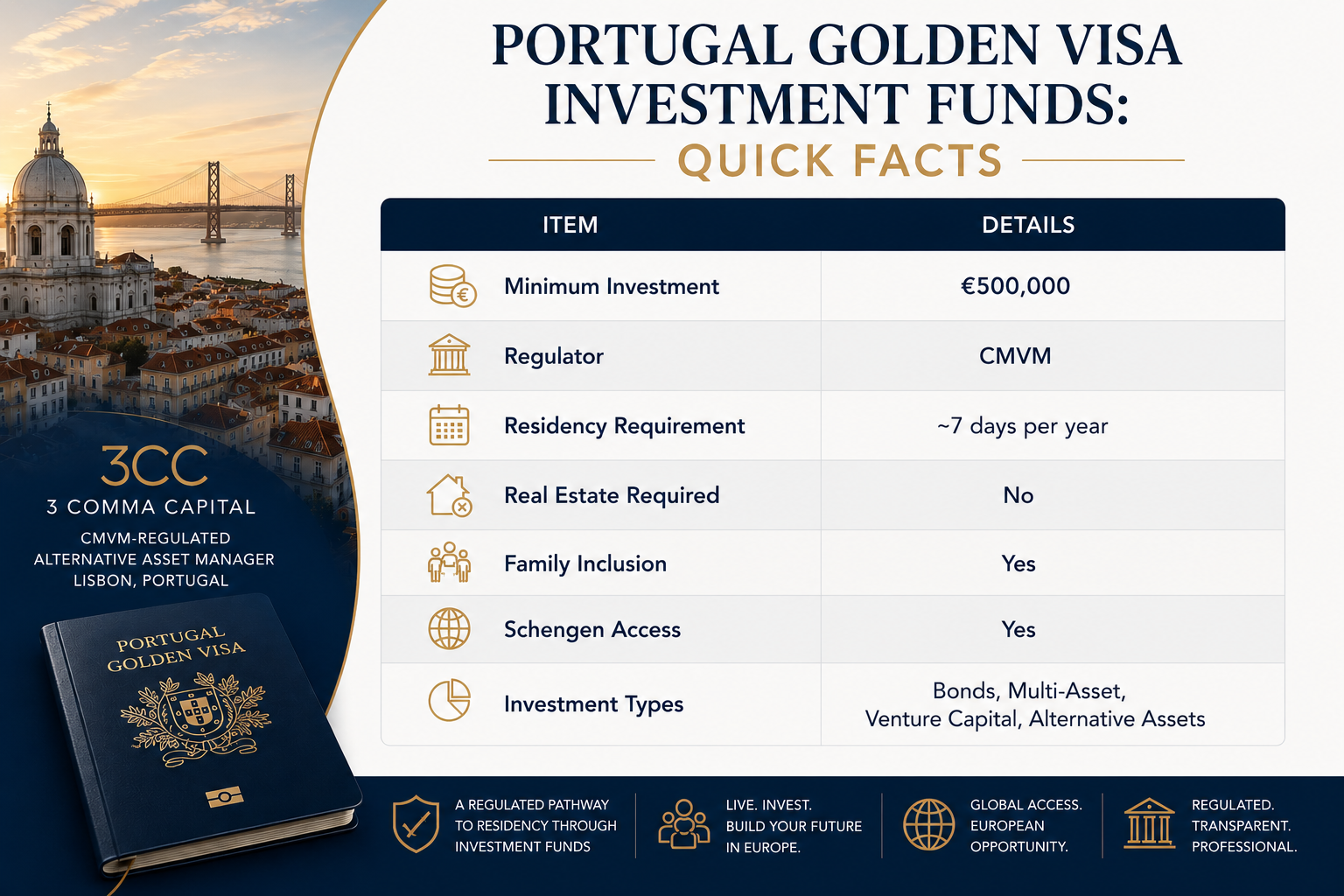
- The minimum qualifying investment ranges from €250,000 to €500,000 depending on the chosen route.
- Investors only need to spend approximately 7 days per year in Portugal to maintain residency.
- Family members can be included under the same application.
- Permanent residency remains available after five years of legal residence.
- Portugal continues to offer one of Europe's most flexible residency-by-investment programmes.
Who This Guide Is For
This guide is designed for:- U.S. investors exploring the Portugal Golden Visa;
- Families seeking European residency;
- International investors evaluating Portuguese investment funds;
- Individuals considering residency-by-investment alternatives.
What Is the Portugal Golden Visa?
The Portugal Golden Visa, officially known as the Residence Permit for Investment Activity (ARI), is a residency-by-investment programme that allows qualifying non-European Union citizens to obtain Portuguese residency through eligible investments.Unlike many other residency programmes, Portugal's Golden Visa does not require investors to relocate permanently or become Portuguese tax residents. Instead, applicants can maintain their existing lifestyles while securing residency rights within the European Union.
Successful applicants receive a renewable residence permit that grants the right to:
- Live in Portugal;
- Work in Portugal;
- Study in Portugal;
- Travel freely throughout the Schengen Area;
- Include qualifying family members under the same programme.
The programme has become particularly attractive for investors seeking greater geographical diversification, enhanced mobility and a long-term European "Plan B".
The Evolution of Portugal Golden Visa Investments
Since its launch in 2012, Portugal’s Golden Visa has granted over 33,000 residency permits, including both investors and their families, highlighting its strong family-oriented appeal. The program has attracted more than €7 billion in foreign investment, making it a key driver of Portugal’s economic growth.Historically, real estate dominated (~90%), but following regulatory changes in 2023, investment funds and financial instruments are now the primary route.
Golden Visa in Portugal: By the Numbers
Why Has the Portugal Golden Visa Become So Popular?
Several factors explain the programme's enduring popularity.Minimal Physical Presence Requirements
One of the most distinctive features of the Portuguese Golden Visa is its flexibility.Unlike many other residency programmes, investors are only required to spend approximately 7 days per year in Portugal on average to maintain their residency status.
This allows investors to continue living and working elsewhere while preserving their pathway to European residency.
Why Portugal is the Best Choice for a Golden Visa
Family Inclusion
A single qualifying investment may extend residency rights to eligible family members, including:- Spouses;
- Dependent children;
- Certain dependent parents.
For many investors, this makes the programme a long-term family planning tool rather than simply an investment decision.
Freedom of Movement
Golden Visa holders enjoy visa-free travel throughout the Schengen Area, providing access to 29 European countries.For internationally mobile families and business owners, this flexibility can be particularly valuable.
Quality of Life
Portugal consistently ranks among the safest countries in the world and offers:- Excellent healthcare;
- High-quality education;
- Modern infrastructure;
- Pleasant climate;
- Strong international community;
- Competitive cost of living relative to other Western European countries.
European Diversification
For many investors, the programme represents more than residency.It provides access to a stable European jurisdiction with strong property rights, political stability and a favourable business environment.
Portugal Approves New Nationality Law: What It Means for Golden Visa Investors
Portugal Golden Visa After the Nationality Reform: Why Sophisticated Investors Still Choose Portugal

Portugal Golden Visa Requirements in 2026
To qualify for the programme, applicants generally must:| Requirements | Details |
|---|---|
| Age | 18+ |
| Nationality | Non-EU / Non-EEA / Non-Swiss |
| Criminal Record | Clean criminal record |
| Investment | Qualifying investment required |
| Residency Requirement | Approximately 7 days per year |
| Documentation | Proof of investment and supporting documentation |
The programme is available to individuals from a wide range of countries, including the United States, Turkey, Canada, the United Kingdom, Brazil, South Africa, China, Singapore, and many others.
Portugal Golden Visa Investment Options in 2026
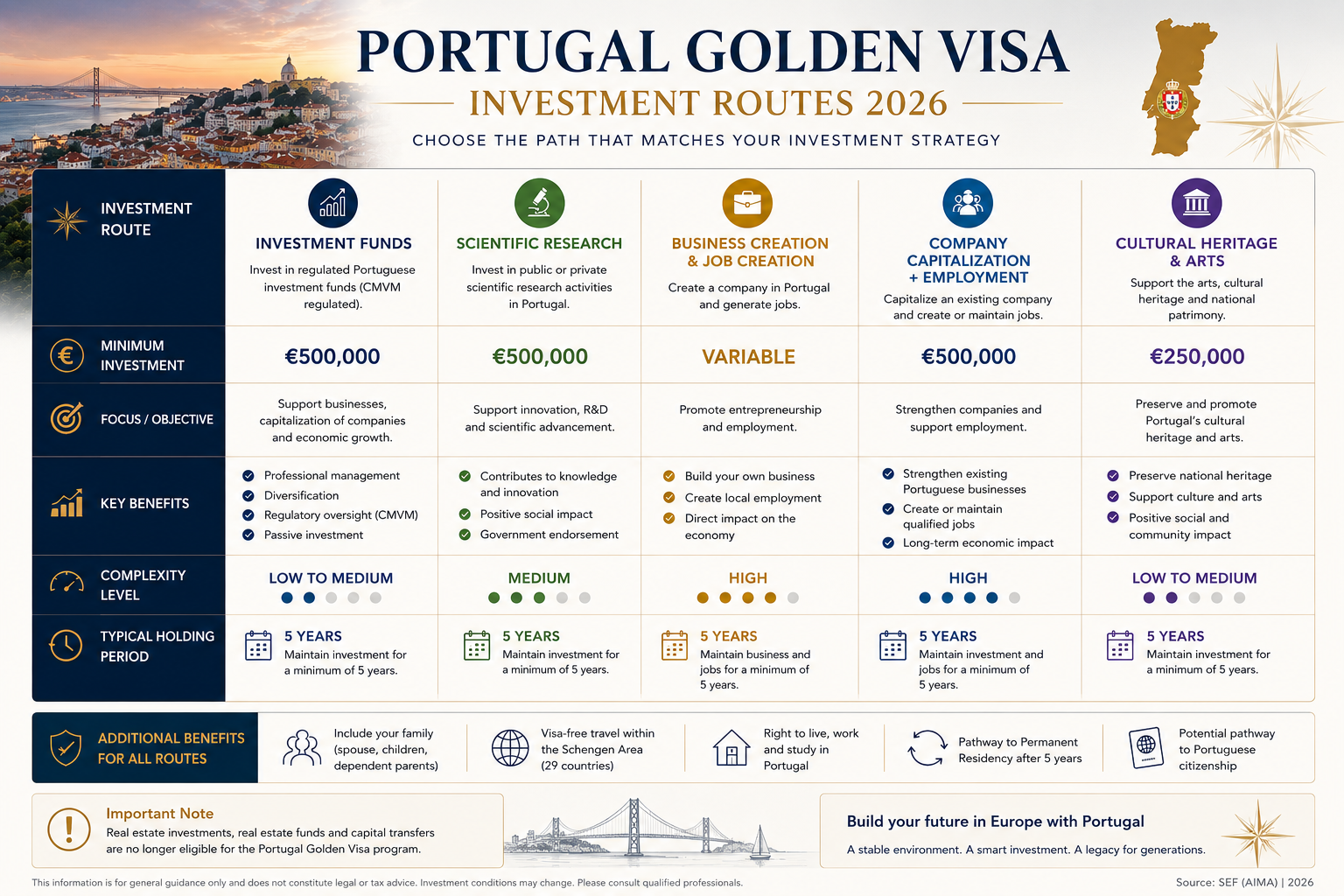
Following the 2023 legislative reforms, the Portuguese Golden Visa programme now focuses on investments intended to support productive sectors of the economy.Eligible Routes
| Investment Route | Minimum Investment |
|---|---|
| Investment Funds | €500,000 |
| Scientific Research | €500,000 |
| Business Creation / Job Creation | Variable |
| Company Capitalization + Employment | €500,000 |
| Cultural Heritage & Arts | €250,000 |
No Longer Eligible
The following routes no longer qualify:❌ Residential Real Estate
❌ Commercial Real Estate
❌ Real Estate Funds
❌ Capital Transfers
This marked a significant shift in the programme's evolution and contributed to the growing importance of investment funds.
Why Investment Funds Have Become the Preferred Route
Since the removal of real estate from the programme, investment funds have become the dominant route chosen by international investors.Several factors explain this shift.
Professional Management
Unlike direct investments, fund managers are responsible for investment selection, monitoring and risk management.Diversification
Funds typically provide exposure to multiple assets, sectors or companies, reducing concentration risk.Operational Simplicity
Investors avoid many of the challenges associated with direct ownership of businesses or properties.Regulatory Oversight
Qualifying investment funds are regulated by the Portuguese Securities Market Commission (CMVM), providing an additional layer of supervision and transparency.Alignment with the Programme
The fund route aligns closely with Portugal's objective of directing capital towards productive economic activity rather than speculative real estate investments.Complete Guide to Portugal Golden Visa Investment Funds
Portugal Golden Visa Through Investment Funds
Not all investment funds follow the same strategy.Understanding the main categories is essential.
Fixed Income Strategies
Fixed income funds focus primarily on bonds and other debt instruments.Their objectives often include:
- Capital preservation;
- Lower volatility;
- Income generation;
- Defensive portfolio positioning.
For investors seeking a more conservative profile, fixed income strategies may provide a compelling alternative. 3 Comma Capital designed the CMVM-regulated Atlantic Bond Fund to respond to the needs of investors searching for more conservative, capital preservation strategies within the Golden Visa path.
Multi-Asset Strategies
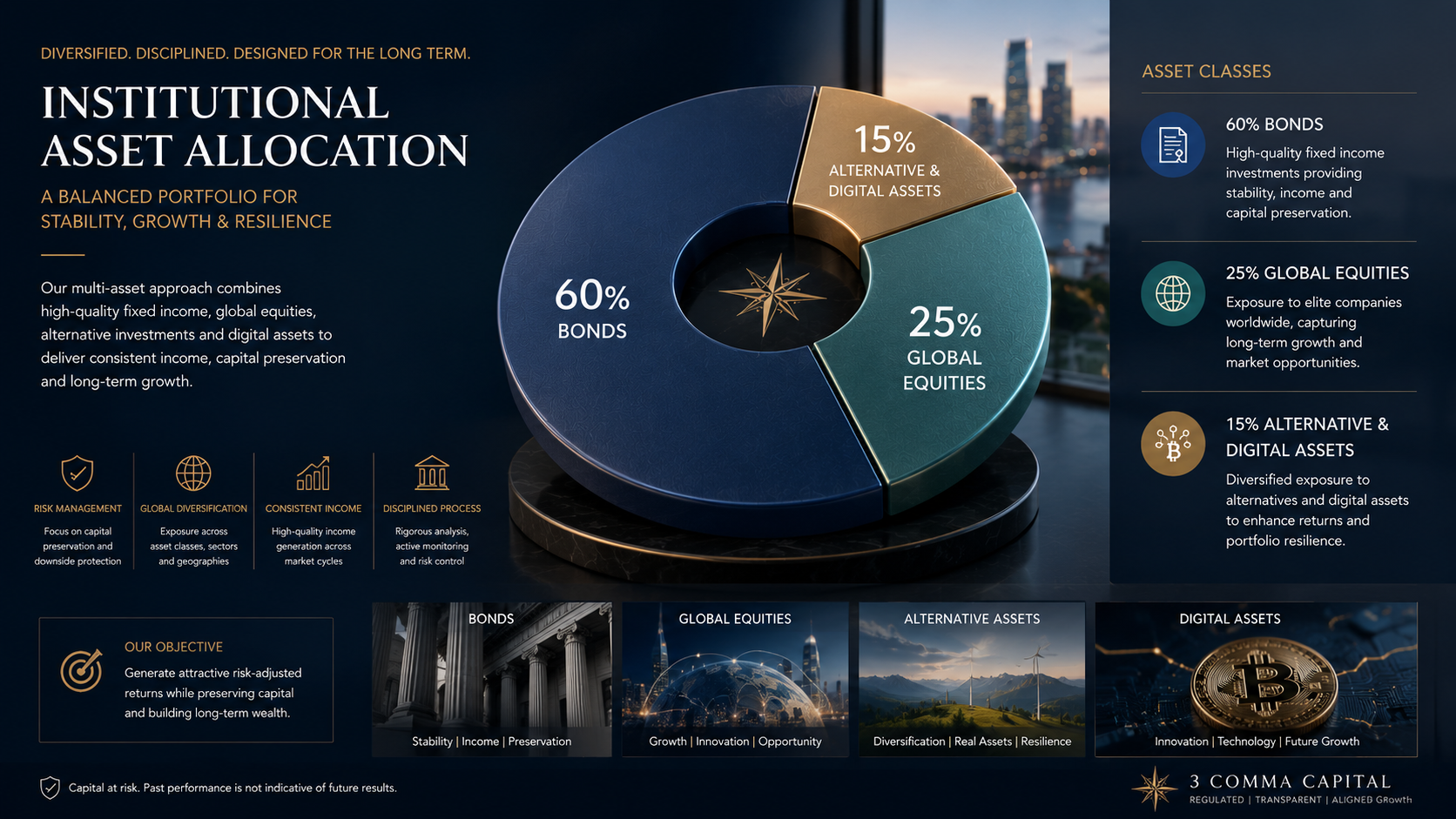
Multi-asset funds combine different asset classes within a single portfolio.These may include:
- Bonds;
- Global equities;
- Alternative investments;
- Precious metals;
- Digital assets.
The objective is often to create more resilient portfolios capable of navigating different market environments.
One example of this approach is the Portugal Golden Income Fund, a CMVM-regulated multi-asset strategy that combines fixed income, global equities and alternative assets within a diversified portfolio.
Venture Capital Strategies
Venture capital funds typically invest in private companies, startups or growth-stage businesses.These strategies generally offer:
- Higher potential returns;
- Longer investment horizons;
- Greater risk profiles.
Many Golden Visa eligible funds currently fall under the venture capital category due to regulatory requirements.
Digital Assets and Emerging Technologies
Digital assets have increasingly entered institutional investment discussions.The emergence of:
- Spot Bitcoin ETFs;
- Institutional custody solutions;
- Regulatory frameworks;
- Blockchain infrastructure;
has accelerated adoption among professional investors. While digital assets remain volatile, some multi-asset strategies incorporate limited exposure as part of broader diversification frameworks.
Portugal Golden Visa Made Smarter with Digital Assets and Fixed Income
Portugal Golden Visa for U.S. Investors
Over the past few years, U.S. citizens have become one of the largest groups of applicants to Portugal's Golden Visa programme.This trend reflects a combination of factors:
- Increased interest in global diversification;
- Access to a European residency option;
- Long-term family planning;
- Enhanced international mobility;
- Geographic diversification of assets.
For many American investors, Portugal offers a compelling combination of political stability, quality of life, favorable residency requirements and access to the European Union.
Unlike many other residency programmes around the world, Portugal does not require investors to relocate permanently. This flexibility allows Americans to continue living and working in the United States while maintaining their residency rights in Portugal.
Self-Directed IRAs (SDIRAs) and Portugal Golden Visa Funds
One of the most interesting developments in recent years has been the growing number of U.S. investors using Self-Directed Individual Retirement Accounts (SDIRAs) to invest in Portugal Golden Visa eligible funds.A Self-Directed IRA allows investors to allocate retirement capital to alternative investments beyond traditional stocks and bonds.
Depending on individual circumstances and custodian approval, some investors may use:
- Traditional IRAs;
- Roth IRAs;
- SEP IRAs;
- Solo 401(k)s;
- Self-Directed IRA Trust structures;
to access qualifying Portuguese investment funds.
This approach can allow investors to maintain the tax advantages associated with retirement accounts while pursuing international diversification.
Because SDIRA investing involves U.S. tax, legal and compliance considerations, investors should always consult qualified advisors before proceeding.
Portugal Golden Visa Through a Self-Directed IRA (SDIRA) | Complete Guide
Using a 401(k) or IRA for a Portugal Golden Visa Investment
Many U.S. investors are surprised to learn that retirement assets may potentially be used to gain exposure to Portugal Golden Visa eligible investment funds.While the process varies depending on the custodian and account structure, it typically involves:
- Establishing a Self-Directed IRA.
- Rolling over existing retirement assets.
- Opening the required investment structure.
- Subscribing to a qualifying Portuguese investment fund.
This has become an increasingly popular route among Americans seeking to diversify retirement assets internationally while preserving liquidity outside their retirement accounts.
Using Your 401(k) or IRA to Fund Your Portuguese Golden Visa Investment
Source of Funds Considerations
One of the most important elements of any Golden Visa application is demonstrating the lawful origin of investment capital.Whether investors use:
- Savings;
- Business proceeds;
- Property sales;
- Investment portfolios;
- Retirement accounts;
they should expect to provide supporting documentation demonstrating the source of funds.
This process forms part of both the investment fund onboarding process and the broader anti-money laundering requirements applicable to regulated financial institutions.
Proper preparation can significantly reduce delays during onboarding and compliance reviews.
Source of Funds Documentation for the Portugal Golden Visa – A Practical Guide for U.S. Investors
Tax Considerations for U.S. Golden Visa Investors
One of the most common misconceptions about Portugal's Golden Visa is that obtaining residency automatically makes an investor a Portuguese tax resident. In reality, residency and tax residency are two separate concepts.For many international investors, understanding this distinction is essential when evaluating the programme.
Does the Golden Visa Make You a Portuguese Tax Resident?
Not necessarily.Portugal generally determines tax residency based on physical presence and residential ties to the country.
In most cases, individuals become Portuguese tax residents if they spend more than 183 days in Portugal during a 12-month period or establish a permanent home that suggests an intention to reside in the country.
Many Golden Visa investors choose to maintain residency rights while remaining tax residents elsewhere.
As a result, obtaining a Golden Visa does not automatically create Portuguese tax obligations on worldwide income.
Tax Treatment for Non-Resident Investors
Golden Visa holders who remain non-residents for Portuguese tax purposes are generally taxed only on Portuguese-source income.Depending on the structure of the investment fund and the investor's country of residence, distributions and capital gains may benefit from exemptions, treaty protection or other favourable tax treatment.
Because tax outcomes vary significantly depending on individual circumstances, investors should always seek independent tax advice before making investment decisions.
Tax Considerations for Portuguese Tax Residents
Individuals who become Portuguese tax residents are generally subject to taxation on their worldwide income.This may include:
- Employment income;
- Dividends;
- Interest;
- Capital gains;
- Investment fund distributions.
The applicable tax treatment depends on the investor's circumstances, residency status and the nature of the income received.
Important Considerations for U.S. Investors
U.S. citizens and tax residents remain subject to U.S. taxation regardless of where they live.As a result, Americans investing in Portugal Golden Visa funds should pay particular attention to:
- PFIC reporting requirements;
- FATCA reporting;
- FBAR obligations;
- Cross-border tax planning.
Many Portuguese investment funds may be classified as Passive Foreign Investment Companies (PFICs) under U.S. tax rules. This can create additional reporting obligations, including the potential filing of IRS Form 8621. In addition, Portuguese bank accounts and certain investment structures may trigger FBAR and FATCA reporting requirements.
Because these rules can be highly complex, U.S. investors should consult qualified tax professionals before making any investment decision.
Portugal Golden Visa After the Nationality Reform: Why Sophisticated Investors Still Choose Portugal
What Does the Portugal Golden Visa Process Look Like?
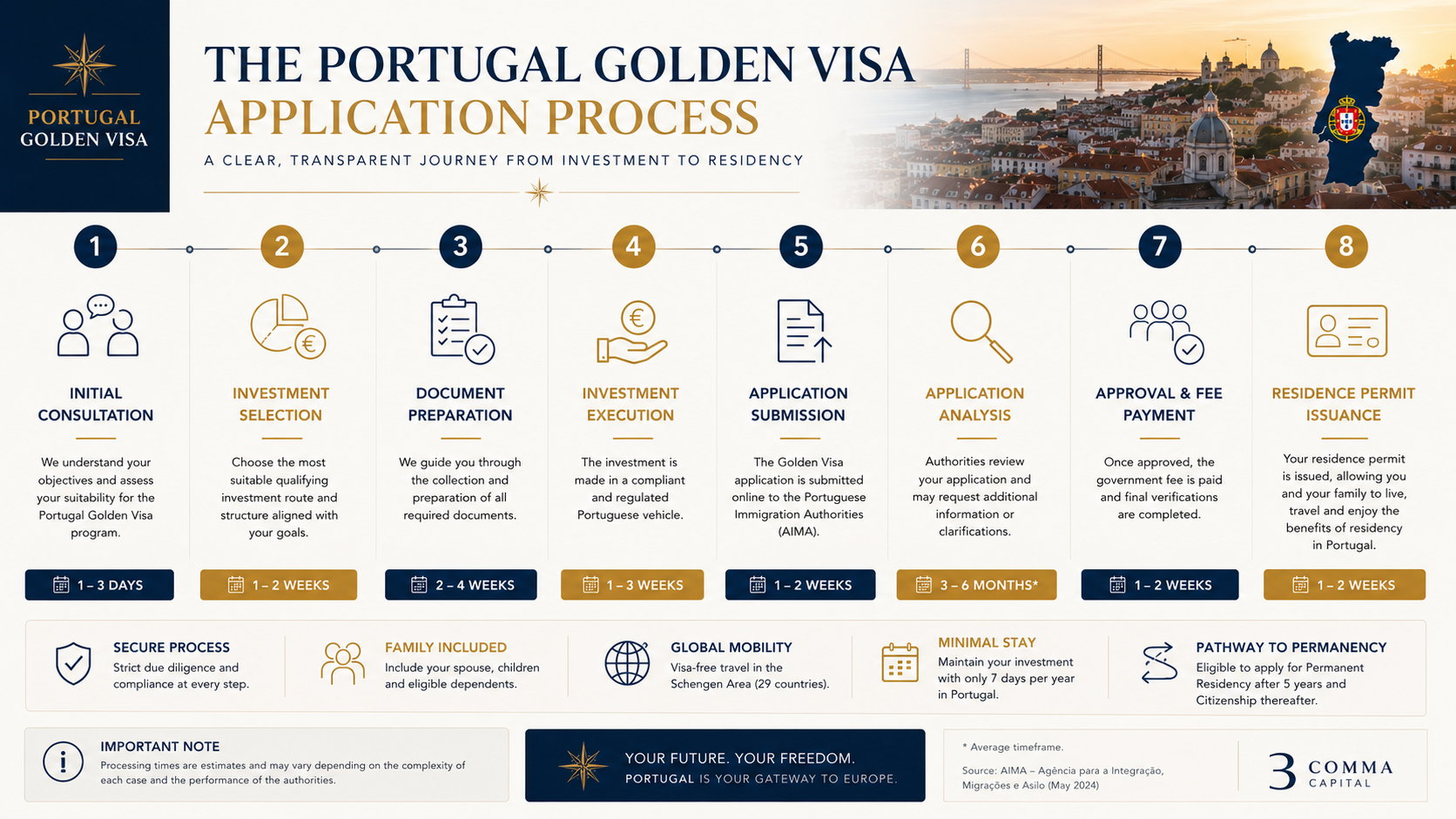
Although each investor's circumstances differ, the overall process follows a relatively predictable structure.Step 1 – Define Your Investment Strategy
Before making any investment, investors should carefully evaluate:- Their objectives;
- Risk tolerance;
- Liquidity requirements;
- Family circumstances;
- Long-term residency plans.
This often begins by selecting the most appropriate Golden Visa investment route.
For many investors today, this means evaluating investment funds.
How to Select the Best Golden Visa Fund
Step 2 – Obtain a Portuguese Tax Number (NIF)
Investors will generally require a Portuguese Tax Identification Number (NIF).The NIF is used for:
- Banking;
- Investments;
- Legal transactions;
- Government interactions.
Most international investors obtain their NIF through a legal representative.
Step 3 – Open a Portuguese Bank Account
A Portuguese bank account is generally required to complete the investment process.Funds are typically transferred into Portugal through this account before being invested.
Step 4 – Complete the Investment
The investor subscribes to the chosen investment vehicle and receives supporting documentation confirming the investment.This documentation will later form part of the Golden Visa application.
Step 5 – Submit the Application
Applications are submitted through Portugal's immigration authorities.Supporting documentation typically includes:
- Passport;
- Criminal record certificates;
- Investment evidence;
- Tax documentation;
- Application forms.
Step 6 – Biometrics Appointment
Applicants and included family members attend an in-person biometrics appointment in Portugal.This step includes:
- Fingerprints;
- Photographs;
- Identity verification.
Step 7 – Approval & Fee Payment
Following approval, residence cards are issued.Step 8 – Residence Permit Issuance
Residence cards are issued.At this stage, applicants become legal residents of Portugal under the Golden Visa programme.
Portugal Golden Visa Timeline
One of the most common questions investors ask is:'How long does the process take?'
While processing times can vary depending on government workload and regulatory developments, the overall structure remains broadly similar.
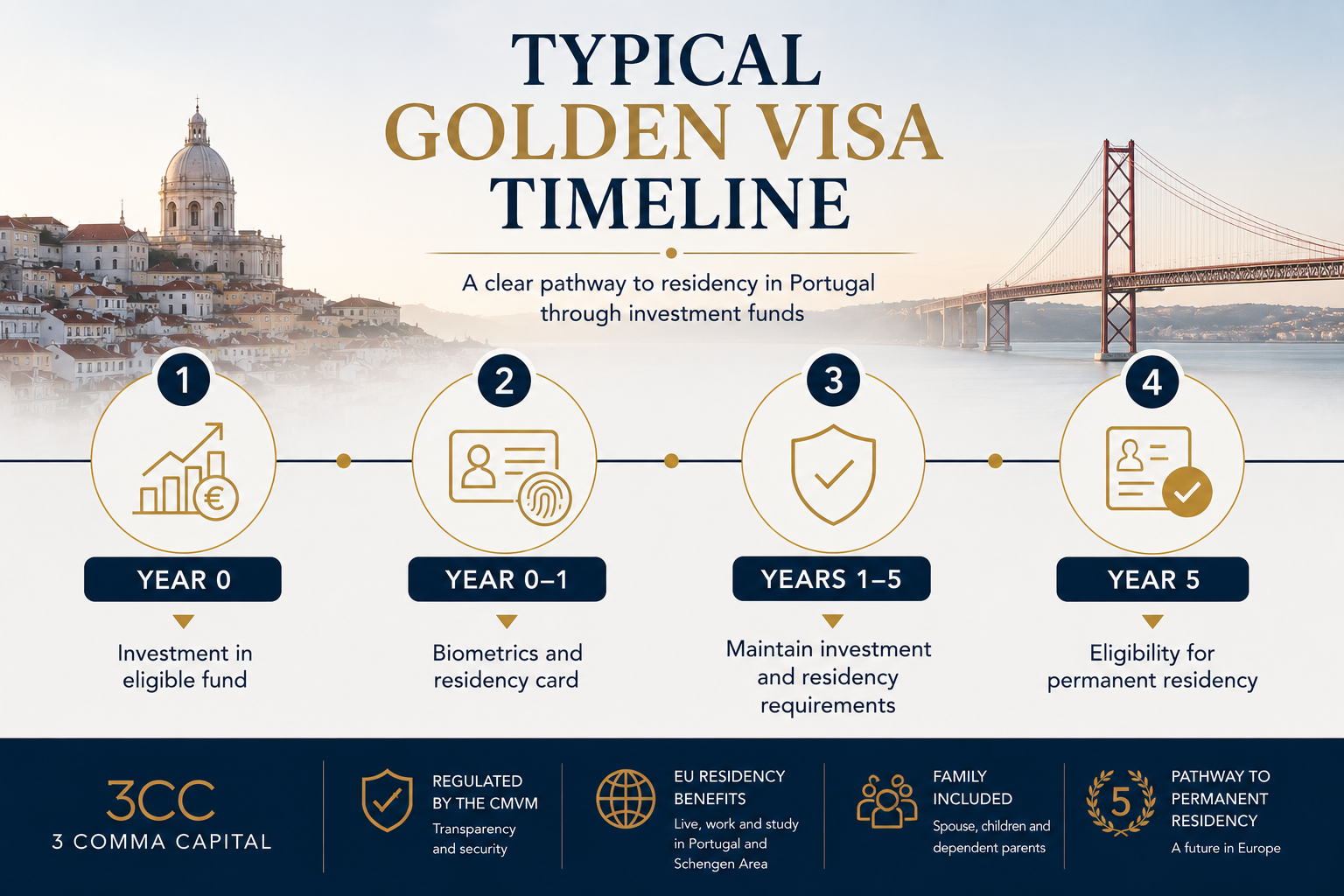
Year 0
InvestmentThe investor completes a qualifying investment and submits the Golden Visa application.
Year 0–1
Biometrics & Residency CardApplicants attend biometrics appointments and receive their initial residence permits.
Years 1–5
Maintain Investment & Residency RequirementsDuring this period investors:
- Maintain the qualifying investment;
- Meet the minimum stay requirements;
- Renew residency documentation as required.
Year 5
Permanent Residency EligibilityFollowing five years of legal residence, Golden Visa holders may become eligible to apply for permanent residency, subject to the legal framework in force at the time.
Costs Associated with the Portugal Golden Visa
Investors should consider several categories of costs.Investment Amount
The largest cost is the qualifying investment itself.Current investment thresholds range from:
- €250,000 (certain cultural routes)
- €500,000 (investment funds and other routes)
Government Fees
Applicants are generally required to pay:- Application fees;
- Residence permit issuance fees;
- Renewal fees.
These fees may change periodically and should always be verified through official sources.
Legal & Administrative Costs
Most investors choose to work with:- Immigration lawyers;
- Fund managers;
- Tax advisors;
- Compliance specialists.
Professional support can simplify the process and reduce administrative risks.
Common Mistakes Investors Should Avoid
Many investors focus exclusively on the investment itself and underestimate the importance of:- Fund selection;
- Source of funds preparation;
- Tax planning;
- Family structuring;
- Long-term objectives.
The most successful applicants tend to view the Golden Visa as part of a broader wealth planning strategy rather than a standalone transaction.
The 10 Most Common Golden Visa Mistakes and How to Avoid Them
Why Proper Fund Selection Matters
Not all Golden Visa investment funds are the same.Investors should evaluate:
- Investment strategy;
- Risk profile;
- Liquidity terms;
- Fund manager experience;
- Diversification;
- Regulatory oversight.
Choosing the right fund can have a significant impact on both investment outcomes and the overall investor experience.
After Choosing the Funds Route, Investors Face a Crucial Decision: How to Select the Best Golden Visa Fund?
Recent Changes to Portugal's Nationality Framework
Portugal's residency and nationality laws continue to evolve, making it essential for investors to stay informed about legislative developments.In recent years, discussions surrounding immigration, nationality and residency policies have attracted significant public and political attention. While the Golden Visa programme itself remains active, changes to nationality legislation may influence the timeline and requirements associated with citizenship applications.
Investors should therefore distinguish between:
Residency Rights
Obtained through a successful Golden Visa application and maintained through compliance with programme requirements.Permanent Residency
Potentially available after five years of legal residence, subject to applicable legislation.Citizenship
A separate legal process that requires an independent application and may be subject to additional requirements, including language proficiency and residency criteria.Because nationality legislation may continue to evolve over time, investors should always seek updated legal advice before making long-term assumptions regarding citizenship timelines.
Portugal Approves New Nationality Law: What It Means for Golden Visa Investors
Frequently Asked Questions
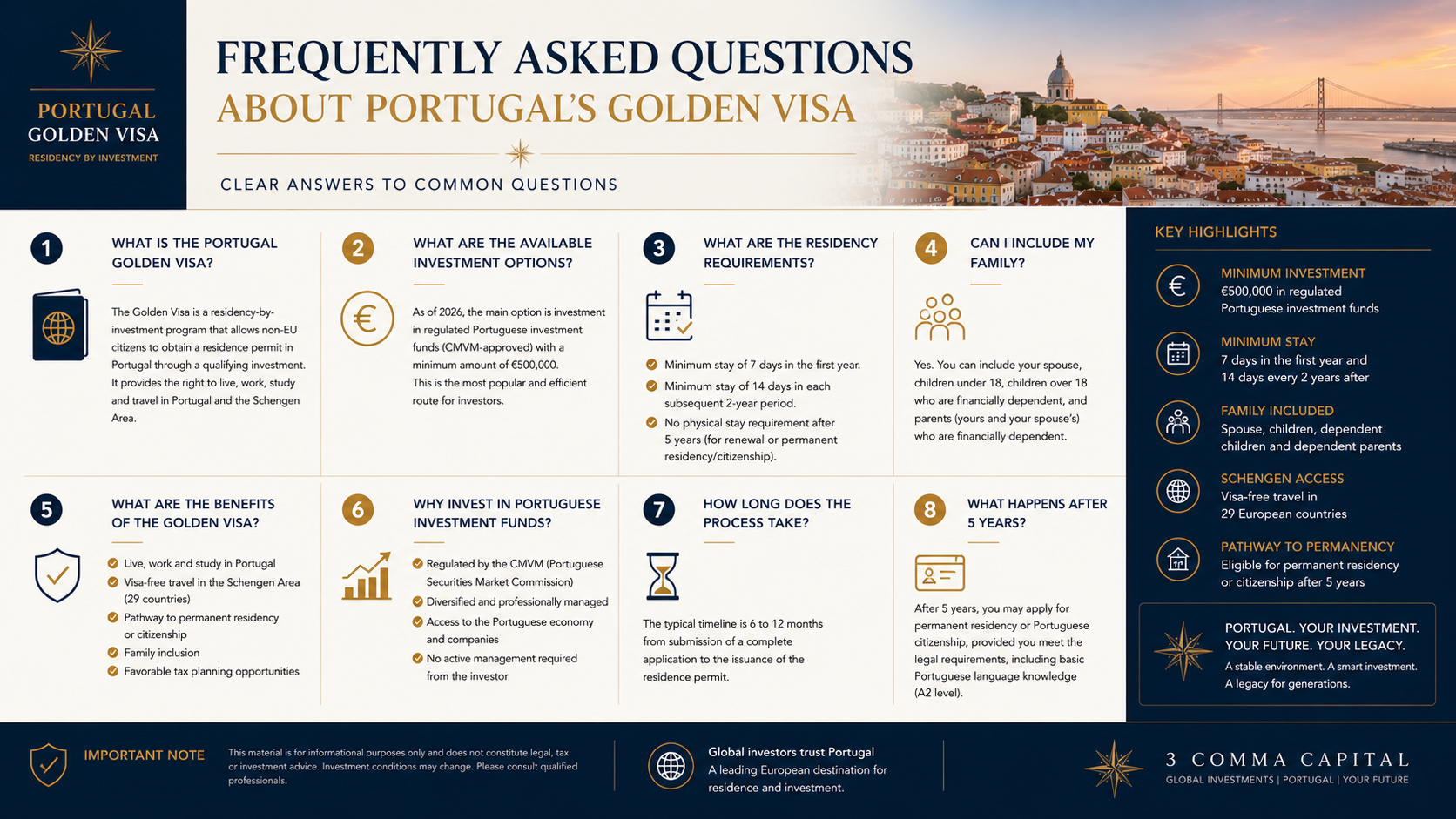
The following FAQs address some of the most common questions international investors ask about Portugal's Golden Visa programme, investment funds, residency requirements and long-term planning considerations.
Is the Portugal Golden Visa Still Available in 2026?
Yes.The programme remains active and continues to accept new applicants under the current legislative framework.
While certain investment routes were removed in 2023, including real estate investments, several qualifying pathways remain available.
Can I Still Obtain a Golden Visa Through Real Estate?
No.Following the reforms introduced in 2023, direct real estate investments and real estate-focused funds no longer qualify for the Portugal Golden Visa programme.
What Is the Most Popular Investment Route Today?
Investment funds have become the preferred route for many international investors.They offer:
- Professional management;
- Diversification;
- Regulatory oversight;
- Operational simplicity.
How Much Do I Need to Invest?
The required investment depends on the chosen route.Current qualifying investments generally range from:
- €250,000 for certain cultural projects;
- €500,000 for investment funds, research and business-related routes.
Can My Family Be Included?
Yes.The programme allows eligible family members to be included under the same application.
This may include:
- Spouse;
- Dependent children;
- Certain dependent parents.
Do I Need to Live in Portugal?
No.One of the programme's key advantages is its limited physical presence requirement.
Investors typically need to spend approximately 7 days per year in Portugal to maintain residency.
Does the Golden Visa Make Me a Portuguese Tax Resident?
Not necessarily.Tax residency is generally determined by the amount of time spent in Portugal and other factors.
Many Golden Visa investors maintain residency rights without becoming Portuguese tax residents.
Professional tax advice is strongly recommended.
Can U.S. Citizens Apply?
Absolutely.In recent years, U.S. investors have become one of the largest groups of Golden Visa applicants.
Portugal remains particularly attractive due to:
- Dual citizenship compatibility;
- Minimal residency requirements;
- Access to the European Union.
Can I Use My IRA or 401(k) for a Golden Visa Investment?
Depending on the specific structure and custodian involved, some U.S. investors may use Self-Directed IRA structures to invest in qualifying Portuguese investment funds.Professional legal and tax advice should always be obtained.
Are Portugal Golden Visa Investment Funds Regulated?
Yes.Qualifying investment funds are managed by regulated entities and supervised by the CMVM (Portuguese Securities Market Commission).
What is a Golden Visa Investment Fund?
A Golden Visa investment fund is a CMVM-regulated Portuguese investment vehicle that allows eligible foreign investors to obtain residency rights through a qualifying fund subscription.What is CMVM?
The Comissão do Mercado de Valores Mobiliários (CMVM) is Portugal's securities market regulator and supervises investment funds and asset managers operating in the country.What Happens After Five Years?
Following five years of legal residence, Golden Visa holders may become eligible to apply for permanent residency, subject to the legal framework in force at the time.Can I Sell My Investment Before Five Years?
Generally, no.Investors are required to maintain their qualifying investment throughout the relevant holding period.
Selling or redeeming the investment prematurely may jeopardize residency rights.
Is Portugal a Good Option Compared to Other Residency Programmes?
Many investors believe so.Portugal continues to offer:
- European residency;
- High quality of life;
- Strong legal protections;
- Minimal physical presence requirements;
- Long-term optionality.
Are investment funds eligible for the Portugal Golden Visa?
Yes. Certain Portuguese regulated investment funds qualify under the Golden Visa framework, provided they comply with applicable programme requirements.What is the minimum holding period?
Investors should review the documents describing specific liquidity and redemption terms of each fund.Additional Resources for Golden Visa Investors
The following resources explore specific aspects of Golden Visa investing in greater detail.Portugal Golden Visa Fundamentals
Portugal Golden Visa Investment Funds GuideThe 10 Most Common Golden Visa Mistakes and How to Avoid Them
Portugal Approves New Nationality Law: What It Means for Golden Visa Investors
Portugal Golden Visa After the Nationality Reform: Why Sophisticated Investors Still Choose Portugal
Fund Selection & Investment Strategies
After Choosing the Funds Route, Investors Face a Crucial Decision: How to Select the Best Golden Visa Fund?Portugal Golden Visa Made Smarter with Digital Assets and Fixed Income
For U.S. Investors
Portugal Golden Visa Through a Self-Directed IRA (SDIRA) | Complete GuideUsing Your 401(k) or IRA to Fund Your Portuguese Golden Visa Investment
Unlocking Portugal's Golden Visa with a Self-Directed IRA Using a Trust Structure
Source of Funds Documentation for the Portugal Golden Visa – A Practical Guide for U.S. Investors
Learn More About Our Investment Strategies
Portugal Golden Income FundAtlantic Bond Fund
Why Work With 3 Comma Capital?
A successful Golden Visa investment is about much more than simply meeting the programme's eligibility requirements.Investors should also evaluate:
- Investment philosophy;
- Risk management framework;
- Regulatory oversight;
- Reporting standards;
- Transparency;
- Long-term alignment of interests.
Portugal's regulated asset management industry operates under the supervision of the CMVM and is subject to rigorous compliance, reporting and governance requirements.
Understanding these factors can be just as important as understanding the Golden Visa programme itself.
About the Author
Duarte Caldas is an Investments Principal at 3 Comma Capital, a CMVM-regulated alternative asset manager headquartered in Lisbon, Portugal.His work focuses on Portugal Golden Visa investment funds, fixed income strategies, alternative investments and cross-border investment solutions for international investors.
► Bottom Line
Portugal's Golden Visa continues to stand out as one of the most compelling residency-by-investment programmes available anywhere in the world. While the programme has evolved significantly since its launch, particularly following the removal of real estate investments, its core value proposition remains intact: providing international investors with a flexible pathway to Portuguese residency while requiring only limited physical presence in the country.For many investors, the programme is not simply about residency. It is about creating optionality, geographic diversification and long-term flexibility for themselves and their families.
As investment funds have become the dominant route within the programme, understanding how different fund structures work has never been more important. Investors should carefully evaluate fund managers, investment strategies, risk profiles and regulatory frameworks before making any decision.
Whether your objective is European mobility, wealth preservation, portfolio diversification or long-term family planning, the Portugal Golden Visa remains one of the most sophisticated and accessible residency-by-investment opportunities available in 2026.
Before proceeding, investors should always seek independent legal, tax and financial advice tailored to their specific circumstances.
Looking for a Portugal Golden Visa Eligible Investment Fund?

Explore the Portugal Golden Income Fund and the Atlantic Bond Fund, two CMVM-regulated investment funds managed by 3 Comma Capital.
Learn more about how regulated Portuguese investment funds may fit within your broader residency and investment strategy. At 3 Comma Capital, we are proud to support investors at the intersection of finance and global freedom. If you’re ready to explore this route or want a personal consultation, get in touch with our team today.
 |
Investments Principal
|
With more than 20 years of experience in financial markets, Duarte specialized in the energy area in the last decade, where he had the opportunity to work with the main European Power and Gas institutions at CIMD Group. Previously, he worked as Market Strategist at IG Markets Iberia.
More about Duarte Caldas


