Golden Visa
Portugal vs Greece, Malta, Hungary and Italy: Which Golden Visa Is Best in 2026?

For internationally mobile investors, a second residency is increasingly viewed as more than a lifestyle decision. It can provide geographic diversification, greater mobility, a long-term option for the family and, in some cases, a future pathway to European citizenship. However, the European Golden Visa landscape has changed significantly.
Spain ended its Golden Visa programme in 2025. Malta's citizenship-by-investment model was struck down by the Court of Justice of the European Union. Greece increased real estate thresholds in several high-demand areas, while Hungary re-entered the market with a new Investor Programme.
Portugal also changed its programme. Real estate is no longer a qualifying Golden Visa investment. The focus has shifted towards investments that direct capital into the Portuguese economy, including qualifying regulated investment funds.
So, in 2026, which European residence-by-investment (RBI) programme offers the strongest overall proposition?
The answer depends on the investor's priorities. However, for globally mobile investors seeking EU residency, limited physical presence and a financial investment rather than a compulsory property purchase or non-refundable donation, Portugal remains particularly difficult to match.
Read our comprehensive guide to the Portugal Golden Visa programme.
Portugal and Spain offered popular real estate routes. Greece attracted investors through relatively low property thresholds. Malta went further, operating a citizenship-by-investment framework.
That market no longer exists in the same form.
Spain's Golden Visa ended in April 2025. New investors can no longer obtain Spanish residency through the former significant-investment framework, although existing permit holders remain subject to applicable transitional arrangements.
Malta experienced an even more fundamental change. In 2025, the Court of Justice of the European Union ruled that the country's investor citizenship model was contrary to EU law. As a result, Malta can no longer be viewed as offering a conventional route to EU citizenship through investment.
At the same time, European governments have increasingly questioned whether residency programmes should continue directing foreign capital into residential property markets.
Portugal chose to redesign its programme rather than abolish it.
Real estate ceased to qualify, while investment funds, research, cultural support, job creation and certain business investments remained available.
This distinction is important.
Portugal did not end its Golden Visa. It changed what the programme is intended to finance.
Programme rules, qualifying investments and nationality legislation may change.Investors should obtain specialist immigration, legal and tax advice.
The European market increasingly requires investors to answer a basic question:
Do you want to buy property, make a financial investment or incur a non-recoverable cost in exchange for residency?
One of the principal qualifying routes is now an investment of at least €500,000 in eligible Portuguese collective investment undertakings, subject to the applicable legal requirements.
For investors, this creates a fundamental distinction from property-based programmes. A qualifying fund investment is an investment asset. The investor subscribes for units in a regulated vehicle managed according to a defined strategy. Depending on the fund, the underlying portfolio may include bonds, equities, private companies or other qualifying investments.
Naturally, investment capital remains at risk and returns are never guaranteed. However, from an economic perspective, this is very different from paying a government contribution or being required to purchase a specific property simply to obtain residency.
U.S. investors may also wish to explore how a Self-Directed IRA can be used for a Portugal Golden Visa fund investment.
Golden Visa investors are generally required to spend only limited periods in Portugal to maintain their residency status. This matters for an executive in London, an entrepreneur in New York, a family based in Dubai or an investor operating internationally.
Many residence programmes appear attractive initially, but require applicants to move their centre of life to the country if they want to preserve a meaningful long-term pathway.
Portugal's Golden Visa was designed differently. It allows investors to establish a Portuguese residence position while maintaining their principal professional and personal lives elsewhere, provided all programme requirements are met.
For globally mobile investors, this flexibility can be more valuable than the lowest headline investment threshold.
For additional information on eligibility, family inclusion and the application process, consult our Portugal Golden Visa FAQ.
The minimum property investment now reaches €800,000 in several prime locations, including parts of Attica, Thessaloniki and certain islands. A €400,000 threshold applies more broadly, while specific €250,000 routes may remain available for certain property conversions or restorations.
An €800,000 property is concentrated in:
This does not mean Greek real estate is unattractive. It simply means the investment proposition is fundamentally different.
Portugal offers residency through portfolio investment. Greece remains primarily a residency-through-property programme.
Learn more about the differences between open-ended and closed-ended Golden Visa funds.
The programme typically combines administrative charges, government contributions and property requirements.
The distinction between an investment and a cost is important. If an investor places €500,000 into a qualifying investment fund, the capital remains represented by fund units, although its value can rise or fall.
A government contribution or administrative charge is not an investment. It is a cost.
Malta may therefore appeal to families that prioritise permanent residency from the outset. From a capital-efficiency perspective, however, Portugal's financial-investment route may be more attractive.
The citizenship question has also changed materially. Malta's former investor citizenship framework can no longer be considered a conventional pathway following the EU court ruling.
On headline numbers alone, Hungary is highly competitive.
The minimum investment is half the Portuguese fund threshold.
Investors should also assess:
Portugal has developed a broader Golden Visa investment-fund ecosystem, with several regulated managers and strategies competing for international capital. This allows investors to choose between fixed income, balanced strategies, private equity and venture capital.
Hungary is a genuine competitor, but a lower entry threshold does not automatically result in a better investment proposition.
These include investment in an innovative Italian start-up, investment in an Italian company, government bonds and philanthropic contributions.
Italy may be particularly attractive for entrepreneurs, business owners and investors who already intend to establish a meaningful economic presence in the country. However, as a passive residence-by-investment solution, Portugal can be more straightforward.
Investing €250,000 in a single start-up is very different from investing €500,000 in a diversified regulated fund.
The first approach introduces significant company-specific risk. The second can offer exposure to multiple issuers, sectors and asset classes, depending on the fund's investment policy.
The key question is not simply: Which Golden Visa has the lowest minimum investment?
A better question is: What am I required to own in exchange for residency, and would I want to own that investment even without the residency benefit?
Spain continues to offer other immigration routes for professionals, entrepreneurs and digital nomads. However, those are not residence-by-investment programmes.
For investors specifically seeking a low-presence European residency strategy, Spain's exit has strengthened the relative position of the remaining programmes.
For investors prioritising tax efficiency, access to the Middle East, an international business hub and long-term UAE residence, Dubai and Abu Dhabi can be highly attractive. However, the UAE Golden Visa does not provide EU residency or a conventional pathway to an EU passport.
It solves a different problem.
For some globally mobile families, the decision may not be Portugal or the UAE. It may be Portugal and the UAE, with one residence strategy focused on European optionality and the other centred on tax residence and international business.
A Golden Visa provides residency.
Citizenship is a separate legal process governed by Portuguese nationality law and subject to the rules in force when the applicant becomes eligible and applies.
Portugal should therefore not be marketed as: Invest €500,000 and automatically receive an EU passport. That was never a precise description of the legal process.
Portugal's key competitive advantage is not automatic citizenship. It is the ability to maintain legal residence with a very limited physical presence requirement.
Read our latest analysis of Portugal's nationality law and the implications for Golden Visa investors.
But consider the profile of a typical internationally mobile Golden Visa investor.
For that investor, Portugal remains one of the most compelling residence-by-investment programmes available in Europe.
The €500,000 threshold is not the lowest. However, the combination is difficult to replicate:
EU residency, low physical presence, family inclusion, Schengen mobility, a regulated investment-fund route and the ability to choose a strategy aligned with the investor's risk profile.
The strongest programme is not necessarily the cheapest. It is the one where the residency strategy and the investment strategy make sense independently and reinforce each other when combined.
Explore the wider lifestyle, economic and investment advantages of Portugal.
We manage investment strategies designed for different investor profiles, including the Portugal Golden Income Fund, a diversified open-ended strategy combining a core fixed-income allocation with selected equity and digital-asset exposure, and the Atlantic Bond Fund, a fixed-income-focused strategy designed for more conservative investors.
The recent strategic combination with C2 Capital Partners marks an important milestone in our evolution, bringing together two highly complementary investment platforms with a combined track record spanning more than 17 years. Unlike firms established solely to serve the Golden Visa market, we are a diversified asset and wealth management platform managing close to €1 billion in assets, making us one of Portugal's largest alternative asset managers. Together, we offer a comprehensive range of investment solutions, including open-ended multi-asset and fixed income funds, private equity strategies, and bespoke portfolio allocations (including barbell strategies) tailored to different investor profiles.
Today, we serve hundreds of international clients across multiple jurisdictions, providing institutional-quality investment solutions under the European regulatory framework, internationally recognised for its robust investor protection standards. Our Golden Visa-eligible funds are simply one part of a broader platform built around disciplined portfolio construction, long-term wealth preservation, and global diversification.
For investors evaluating Portugal against other European residency programmes, we believe the investment itself deserves the same level of analysis as the immigration framework. After all, €500,000 is first and foremost investment capital.
The question should not simply be whether a fund qualifies for the Golden Visa.
Investors should also consider:
Residency may be the reason an investor begins the search.
The quality of the investment should determine where the capital is ultimately allocated.
Read our latest snapshot of the Portuguese economy.
Greece is compelling for property buyers, Hungary competes on cost and Malta on permanent residency. Portugal's advantage lies in the combination of low physical presence and a regulated financial-investment route, allowing residency and portfolio strategy to work together.
Spain ended its Golden Visa programme in 2025. Malta's citizenship-by-investment model was struck down by the Court of Justice of the European Union. Greece increased real estate thresholds in several high-demand areas, while Hungary re-entered the market with a new Investor Programme.
Portugal also changed its programme. Real estate is no longer a qualifying Golden Visa investment. The focus has shifted towards investments that direct capital into the Portuguese economy, including qualifying regulated investment funds.
So, in 2026, which European residence-by-investment (RBI) programme offers the strongest overall proposition?
The answer depends on the investor's priorities. However, for globally mobile investors seeking EU residency, limited physical presence and a financial investment rather than a compulsory property purchase or non-refundable donation, Portugal remains particularly difficult to match.
Read our comprehensive guide to the Portugal Golden Visa programme.
Key Takeaways
- Europe's Golden Visa market has narrowed significantly, with Spain closing its programme and Malta's investor citizenship model ending after an EU court ruling.
- Portugal remains one of Europe's most flexible residence-by-investment options, particularly for investors who do not intend to relocate immediately.
- The €500,000 qualifying fund route allows investors to obtain residency through a regulated financial investment rather than real estate.
- Greece remains highly competitive for property-focused investors, although thresholds now reach €800,000 in several high-demand locations.
- Malta offers permanent residency, but the programme combines property requirements with substantial administrative and contribution costs.
- Hungary is a serious competitor, offering long-duration residency through a qualifying €250,000 fund investment.
- Italy is attractive for entrepreneurs and investors willing to establish a stronger economic connection to the country.
- Portugal's main advantage is the combination of low physical presence, EU residency and investment flexibility.
The European Golden Visa Market Has Changed
Only a few years ago, investors considering European residency had a broad choice of programmes.Portugal and Spain offered popular real estate routes. Greece attracted investors through relatively low property thresholds. Malta went further, operating a citizenship-by-investment framework.
That market no longer exists in the same form.
Spain's Golden Visa ended in April 2025. New investors can no longer obtain Spanish residency through the former significant-investment framework, although existing permit holders remain subject to applicable transitional arrangements.
Malta experienced an even more fundamental change. In 2025, the Court of Justice of the European Union ruled that the country's investor citizenship model was contrary to EU law. As a result, Malta can no longer be viewed as offering a conventional route to EU citizenship through investment.
At the same time, European governments have increasingly questioned whether residency programmes should continue directing foreign capital into residential property markets.
Portugal chose to redesign its programme rather than abolish it.
Real estate ceased to qualify, while investment funds, research, cultural support, job creation and certain business investments remained available.
This distinction is important.
Portugal did not end its Golden Visa. It changed what the programme is intended to finance.
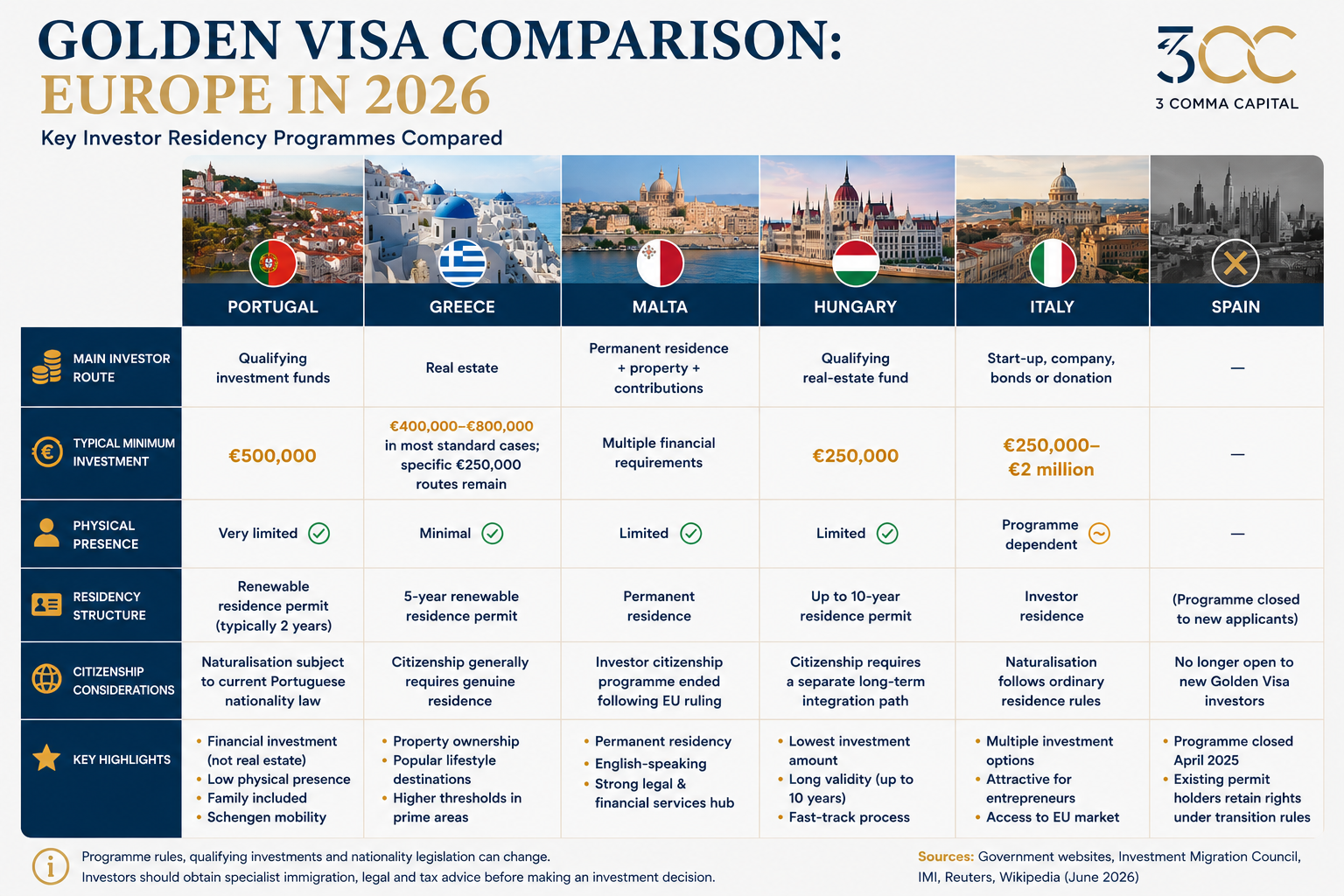
Key Investor European Residency Programmes Comparison:
Programme rules, qualifying investments and nationality legislation may change.Investors should obtain specialist immigration, legal and tax advice.
The European market increasingly requires investors to answer a basic question:
Do you want to buy property, make a financial investment or incur a non-recoverable cost in exchange for residency?
Portugal: The Financial Investment Route
Portugal's Golden Visa, formally known as the Residence Permit for Investment Activity, has evolved significantly since its introduction.One of the principal qualifying routes is now an investment of at least €500,000 in eligible Portuguese collective investment undertakings, subject to the applicable legal requirements.
For investors, this creates a fundamental distinction from property-based programmes. A qualifying fund investment is an investment asset. The investor subscribes for units in a regulated vehicle managed according to a defined strategy. Depending on the fund, the underlying portfolio may include bonds, equities, private companies or other qualifying investments.
Naturally, investment capital remains at risk and returns are never guaranteed. However, from an economic perspective, this is very different from paying a government contribution or being required to purchase a specific property simply to obtain residency.
U.S. investors may also wish to explore how a Self-Directed IRA can be used for a Portugal Golden Visa fund investment.
Portugal's Key Advantage: No Immediate Relocation
Portugal's physical presence requirement remains one of the programme's most distinctive features.Golden Visa investors are generally required to spend only limited periods in Portugal to maintain their residency status. This matters for an executive in London, an entrepreneur in New York, a family based in Dubai or an investor operating internationally.
Many residence programmes appear attractive initially, but require applicants to move their centre of life to the country if they want to preserve a meaningful long-term pathway.
Portugal's Golden Visa was designed differently. It allows investors to establish a Portuguese residence position while maintaining their principal professional and personal lives elsewhere, provided all programme requirements are met.
For globally mobile investors, this flexibility can be more valuable than the lowest headline investment threshold.
For additional information on eligibility, family inclusion and the application process, consult our Portugal Golden Visa FAQ.
Greece: A Strong Option for Property Investors
If an investor's main objective is to acquire European real estate, Greece remains one of Portugal's strongest competitors. The Greek Golden Visa continues to offer renewable residence through qualifying investment, with real estate remaining at the centre of the programme. However, the programme has become considerably more expensive in high-demand areas.The minimum property investment now reaches €800,000 in several prime locations, including parts of Attica, Thessaloniki and certain islands. A €400,000 threshold applies more broadly, while specific €250,000 routes may remain available for certain property conversions or restorations.
Where Greece Wins
Greece may be the stronger option for an investor who already wants to own a property in Athens, Thessaloniki or on a Greek island. In that case, residency becomes an additional benefit attached to an investment the buyer already intends to make.Where Portugal Wins
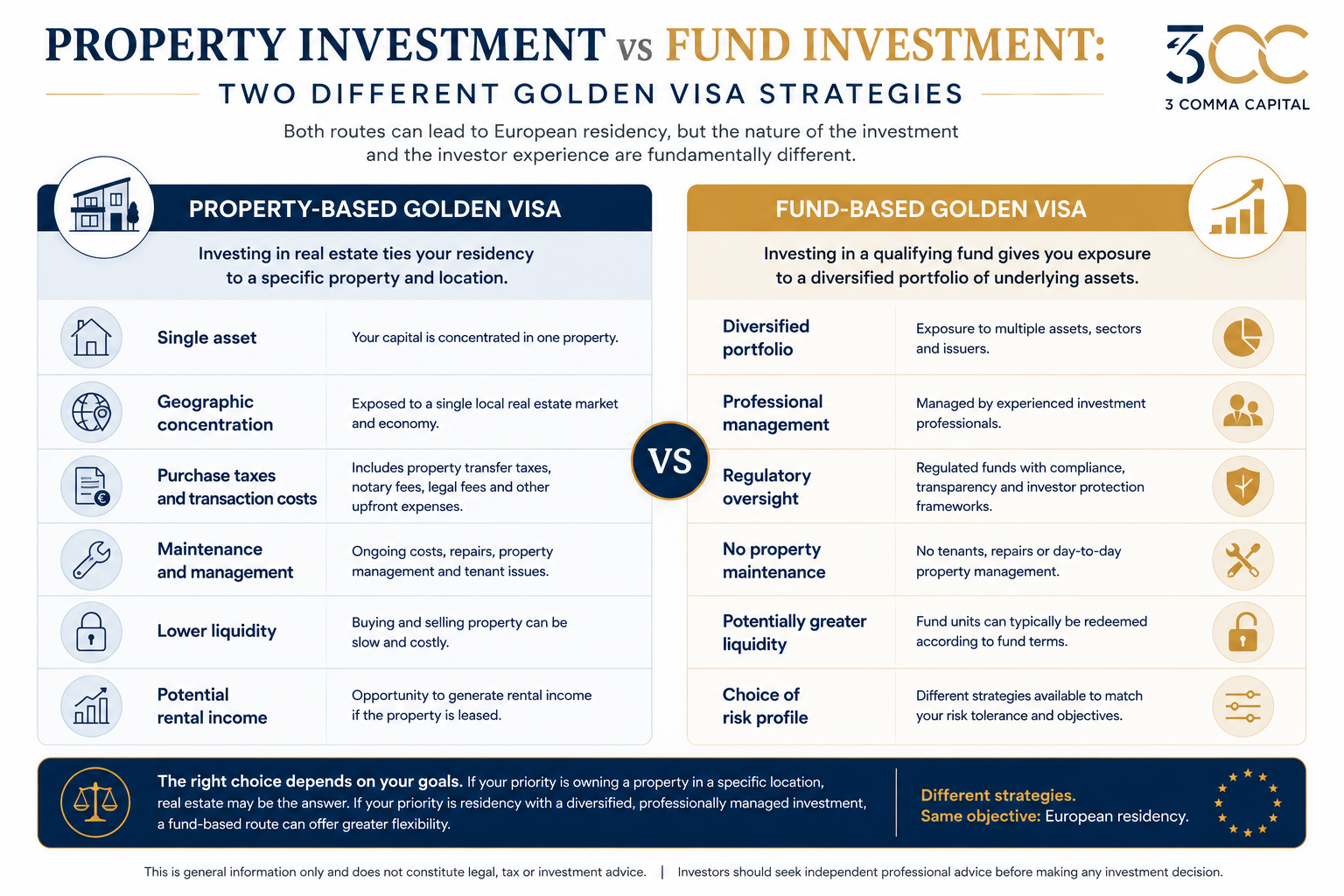
The comparison changes for investors whose main objective is residency and portfolio allocation rather than property ownership. A €500,000 Portuguese fund investment can provide diversified exposure across multiple underlying assets.An €800,000 property is concentrated in:
- one asset;
- one location;
- one local property market;
- with transaction costs;
- maintenance obligations;
- and potentially limited liquidity.
This does not mean Greek real estate is unattractive. It simply means the investment proposition is fundamentally different.
Portugal offers residency through portfolio investment. Greece remains primarily a residency-through-property programme.
Learn more about the differences between open-ended and closed-ended Golden Visa funds.
Malta: Permanent Residency, but With Higher Non-Recoverable Costs
Malta remains relevant through its permanent residence programme. Its main attraction is clear. Qualifying applicants can obtain permanent residency rather than progressing through the same renewal process used by some other programmes. However, investors should examine the total economic cost carefully.The programme typically combines administrative charges, government contributions and property requirements.
The distinction between an investment and a cost is important. If an investor places €500,000 into a qualifying investment fund, the capital remains represented by fund units, although its value can rise or fall.
A government contribution or administrative charge is not an investment. It is a cost.
Malta may therefore appeal to families that prioritise permanent residency from the outset. From a capital-efficiency perspective, however, Portugal's financial-investment route may be more attractive.
The citizenship question has also changed materially. Malta's former investor citizenship framework can no longer be considered a conventional pathway following the EU court ruling.
Hungary: The New Competitor
Hungary deserves more attention than it receives in many Golden Visa comparisons. The Guest Investor Programme offers a route to long-term residency through a €250,000 investment in qualifying real estate fund units.On headline numbers alone, Hungary is highly competitive.
The minimum investment is half the Portuguese fund threshold.
Why Not Simply Choose Hungary?
The minimum investment is only one part of the decision.Investors should also assess:
- the range of qualifying funds;
- the concentration of the underlying portfolio;
- fund liquidity;
- currency exposure;
- regulatory oversight;
- long-term residency objectives;
- family considerations;
- and the wider legal and political environment.
Portugal has developed a broader Golden Visa investment-fund ecosystem, with several regulated managers and strategies competing for international capital. This allows investors to choose between fixed income, balanced strategies, private equity and venture capital.
Hungary is a genuine competitor, but a lower entry threshold does not automatically result in a better investment proposition.
Italy: Attractive for Entrepreneurs
Italy's Investor Visa provides several qualifying routes.These include investment in an innovative Italian start-up, investment in an Italian company, government bonds and philanthropic contributions.
Italy may be particularly attractive for entrepreneurs, business owners and investors who already intend to establish a meaningful economic presence in the country. However, as a passive residence-by-investment solution, Portugal can be more straightforward.
Investing €250,000 in a single start-up is very different from investing €500,000 in a diversified regulated fund.
The first approach introduces significant company-specific risk. The second can offer exposure to multiple issuers, sectors and asset classes, depending on the fund's investment policy.
The key question is not simply: Which Golden Visa has the lowest minimum investment?
A better question is: What am I required to own in exchange for residency, and would I want to own that investment even without the residency benefit?
Spain Is No Longer Available
For new investors, Spain is no longer part of the Golden Visa comparison. The programme officially ended in 2025. New investors can no longer obtain Spanish residency through the previous significant-investment framework.Spain continues to offer other immigration routes for professionals, entrepreneurs and digital nomads. However, those are not residence-by-investment programmes.
For investors specifically seeking a low-presence European residency strategy, Spain's exit has strengthened the relative position of the remaining programmes.
What About the UAE?
The UAE Golden Visa is often included in international comparisons, but it should be assessed separately. The UAE offers long-term residency through several routes, including property and business investment.For investors prioritising tax efficiency, access to the Middle East, an international business hub and long-term UAE residence, Dubai and Abu Dhabi can be highly attractive. However, the UAE Golden Visa does not provide EU residency or a conventional pathway to an EU passport.
It solves a different problem.
For some globally mobile families, the decision may not be Portugal or the UAE. It may be Portugal and the UAE, with one residence strategy focused on European optionality and the other centred on tax residence and international business.
The Citizenship Question
Investors should be careful with older Golden Visa comparisons. Many articles still describe Portugal as offering a simple five-year route to citizenship.A Golden Visa provides residency.
Citizenship is a separate legal process governed by Portuguese nationality law and subject to the rules in force when the applicant becomes eligible and applies.
Portugal should therefore not be marketed as: Invest €500,000 and automatically receive an EU passport. That was never a precise description of the legal process.
Portugal's key competitive advantage is not automatic citizenship. It is the ability to maintain legal residence with a very limited physical presence requirement.
Read our latest analysis of Portugal's nationality law and the implications for Golden Visa investors.
Why Portugal Still Stands Out
There is no universally best Golden Visa.- Greece may be preferable for someone who already wants to own a home in Athens or on a Greek island.
- Malta may appeal to a family prioritising permanent residency from the beginning.
- Hungary competes strongly on headline cost.
- Italy may suit an entrepreneur who wants to invest directly in an Italian company.
- The UAE may be the better option for investors focused on tax residence and Middle Eastern business opportunities.
But consider the profile of a typical internationally mobile Golden Visa investor.
- They may already own a home.
- They may already have real estate exposure in several countries.
- They do not necessarily want to relocate immediately.
- They want European optionality and a plan B for themselves and their family.
- They want their capital professionally managed.
- They prefer a regulated financial investment.
- They do not want residency planning to dictate where they must spend most of each year.
For that investor, Portugal remains one of the most compelling residence-by-investment programmes available in Europe.
The €500,000 threshold is not the lowest. However, the combination is difficult to replicate:
EU residency, low physical presence, family inclusion, Schengen mobility, a regulated investment-fund route and the ability to choose a strategy aligned with the investor's risk profile.
The strongest programme is not necessarily the cheapest. It is the one where the residency strategy and the investment strategy make sense independently and reinforce each other when combined.
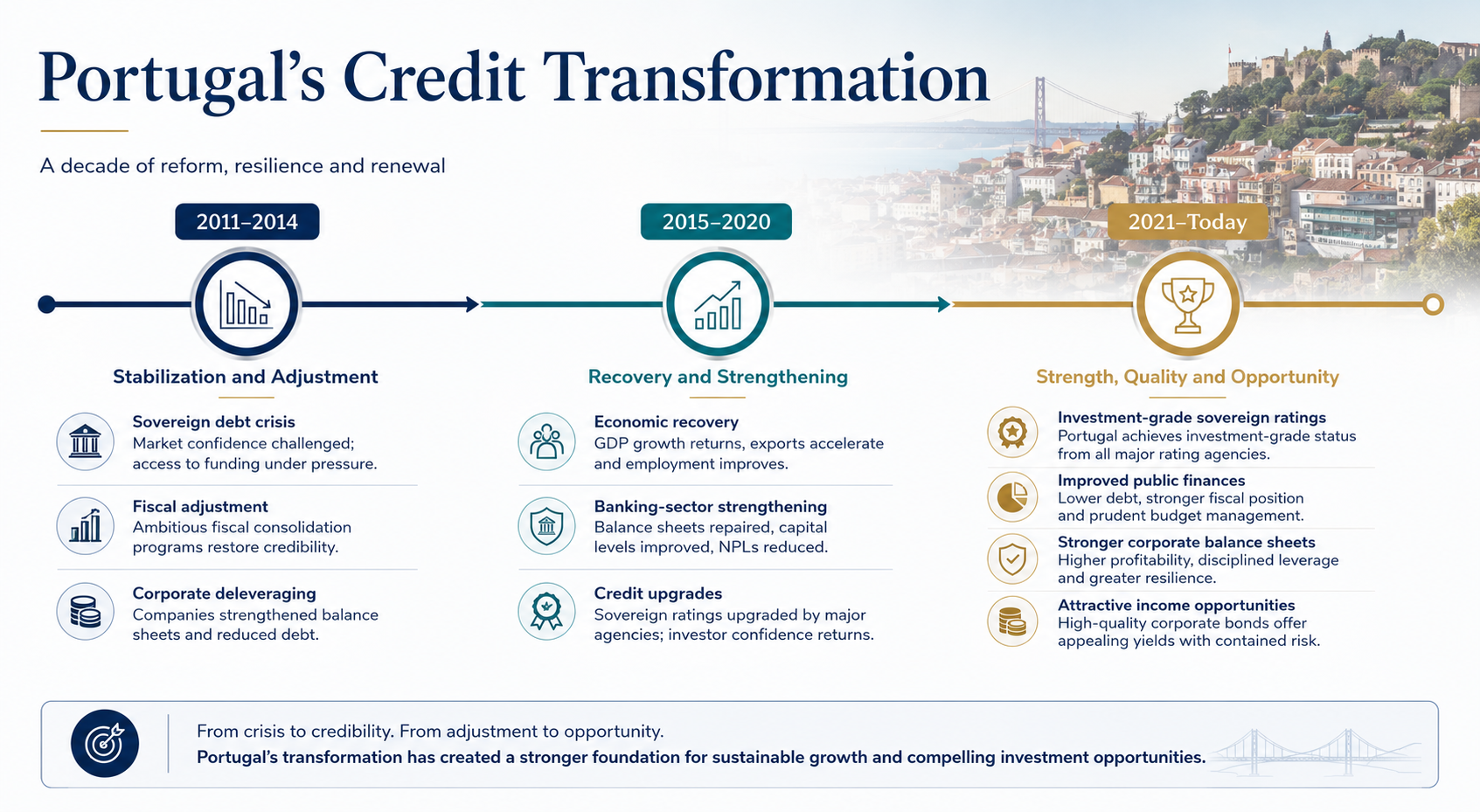
Explore the wider lifestyle, economic and investment advantages of Portugal.
The 3 Comma Capital Perspective
At 3 Comma Capital, we are an asset manager, not an immigration or tax advisory firm. Our role is focused on the investment side of the Portuguese Golden Visa ecosystem.We manage investment strategies designed for different investor profiles, including the Portugal Golden Income Fund, a diversified open-ended strategy combining a core fixed-income allocation with selected equity and digital-asset exposure, and the Atlantic Bond Fund, a fixed-income-focused strategy designed for more conservative investors.
The recent strategic combination with C2 Capital Partners marks an important milestone in our evolution, bringing together two highly complementary investment platforms with a combined track record spanning more than 17 years. Unlike firms established solely to serve the Golden Visa market, we are a diversified asset and wealth management platform managing close to €1 billion in assets, making us one of Portugal's largest alternative asset managers. Together, we offer a comprehensive range of investment solutions, including open-ended multi-asset and fixed income funds, private equity strategies, and bespoke portfolio allocations (including barbell strategies) tailored to different investor profiles.
Today, we serve hundreds of international clients across multiple jurisdictions, providing institutional-quality investment solutions under the European regulatory framework, internationally recognised for its robust investor protection standards. Our Golden Visa-eligible funds are simply one part of a broader platform built around disciplined portfolio construction, long-term wealth preservation, and global diversification.
For investors evaluating Portugal against other European residency programmes, we believe the investment itself deserves the same level of analysis as the immigration framework. After all, €500,000 is first and foremost investment capital.
The question should not simply be whether a fund qualifies for the Golden Visa.
Investors should also consider:
- the investment strategy;
- the underlying assets;
- liquidity;
- portfolio diversification;
- risk profile;
- management team;
- governance;
- custody;
- and alignment with their own financial objectives.
Residency may be the reason an investor begins the search.
The quality of the investment should determine where the capital is ultimately allocated.
Read our latest snapshot of the Portuguese economy.
► Bottom Line
Europe's Golden Visa market has changed, but Portugal remains one of the most balanced options for globally mobile investors seeking EU residency without full-time relocation.Greece is compelling for property buyers, Hungary competes on cost and Malta on permanent residency. Portugal's advantage lies in the combination of low physical presence and a regulated financial-investment route, allowing residency and portfolio strategy to work together.
 |
Investments Principal
|
With more than 20 years of experience in financial markets, Duarte specialized in the energy area in the last decade, where he had the opportunity to work with the main European Power and Gas institutions at CIMD Group. Previously, he worked as Market Strategist at IG Markets Iberia.
More about Duarte Caldas


