Golden Visa
Portugal, the Art of Living Well: Lifestyle, Leisure and Quality of Life

For many years, Portugal was introduced to the world through three familiar images: sunshine, beaches and history. All three remain true. But they no longer tell the whole story.
Today, Portugal stands out for offering a rare combination of quality of life, safety, nature, culture, gastronomy, sport and international accessibility. It is possible to play golf in the morning, have lunch beside the Atlantic, visit a museum or attend a concert in the afternoon, and end the day in a historic neighborhood, at a waterfront terrace or in a traditional fado house.
Few European destinations bring together such different experiences within such short distances.
Lisbon combines urban life, coastline, golf and heritage. The Algarve offers beaches, resorts, gastronomy and some of Europe’s most recognizable coastal scenery. The Douro transforms wine into a cultural and landscape experience. The Alentejo invites a slower pace among vineyards, historic towns and open horizons. Madeira and the Azores add dramatic nature, outdoor adventure and an even closer relationship with the ocean. This variety, together with a relaxed way of life and a strong connection between people, place and tradition, helps explain why Portugal has become more than somewhere to visit.
For a growing number of international families, it is a country in which to spend more time, establish a second residence or begin a new stage of life.
Daily life unfolds on terraces, in gardens, markets, beaches, golf courses, marinas, cycle paths, walking trails and historic squares. Even in the country’s largest cities, the transition from urban life to nature can be remarkably quick.
In Lisbon, a business meeting in the city centre can be followed by a walk along the Tagus, an afternoon in Carcavelos or dinner in Cascais. In Porto, the historic centre, the Douro River, the wine lodges of Vila Nova de Gaia and the Atlantic coast form part of the same broader experience. In smaller cities such as Évora, Braga, Coimbra, Aveiro or Viseu, quality of life is shaped by proximity, heritage and a more measured pace.
Portugal does not simply offer nice weather. It has developed a culture that knows how to use it.
Meals last longer. Late afternoons have a rhythm of their own. The ocean forms part of the national identity. Public space remains a place for social interaction rather than merely somewhere to pass through. This ability to integrate leisure into everyday life is one of Portugal’s most important, and sometimes least measurable, advantages.
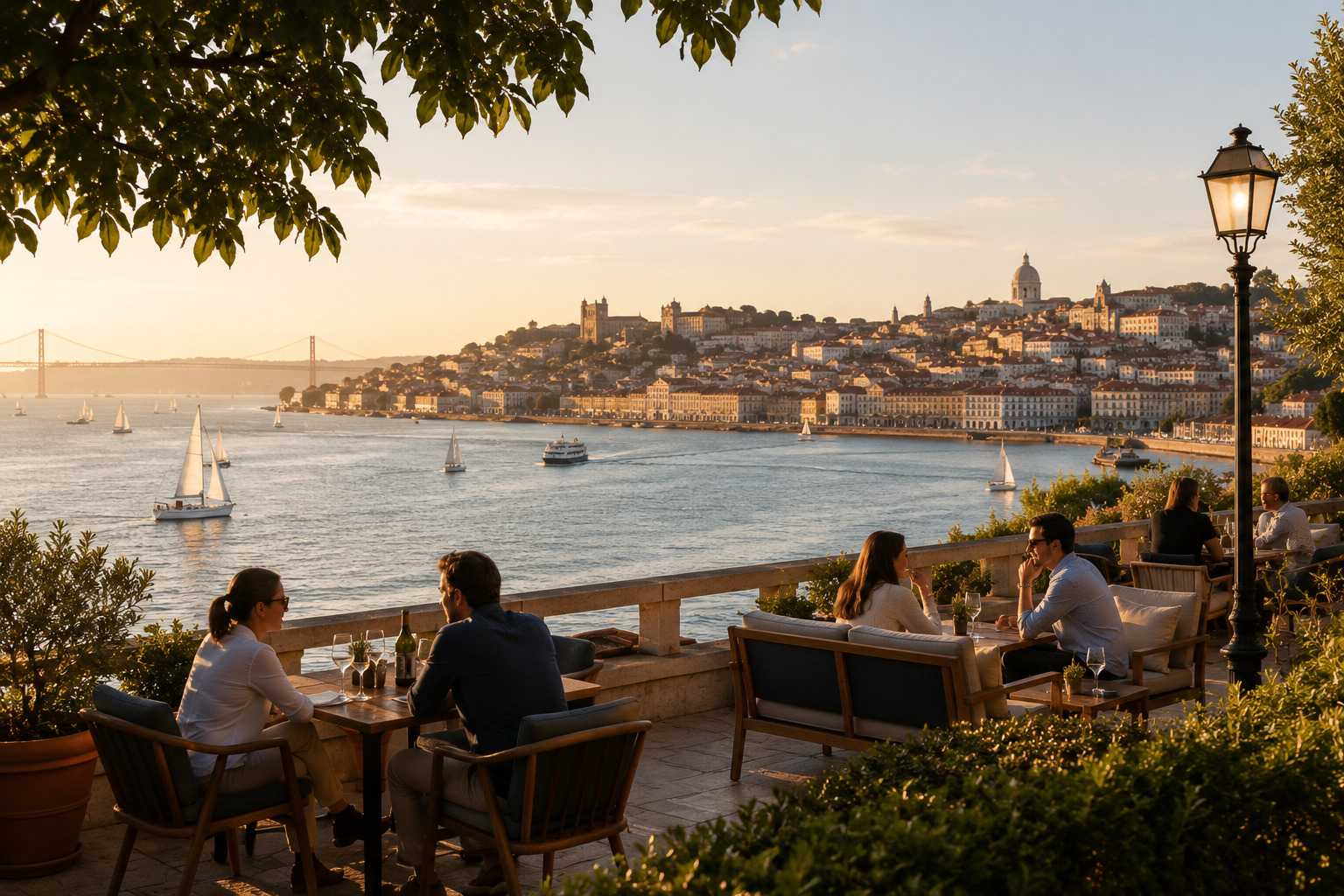
Photo: View of Tagus river, Lisboa
The region’s main advantage is combination. Visitors can play in the morning on a course surrounded by pine trees, spend the afternoon beside the Atlantic and return to central Lisbon for dinner, a concert or an evening in one of the city’s historic neighborhoods.
Aroeira, around 20 kilometers’ from central Lisbon, is among the best-known golf areas near the capital. Its courses are set within pine woodland and close to the long beaches of the Costa da Caparica. PGA Aroeira 1 opened in 1972, hosted the Portuguese Open in 1996 and 1997 and is scheduled to return to professional competition in September 2026.
Yet Aroeira is only part of the region’s offering. Golf courses can also be found around Cascais, Sintra, Estoril, Setúbal, Palmela, Troia and the Tagus Valley. Some are close to the ocean, while others are surrounded by vineyards, pine forests, cork oak landscapes or protected natural areas. Turismo de Portugal highlights the Lisbon region’s mild climate, variety of courses and proximity to beaches, World Heritage sites and wine-producing areas as important complements to a golfing holiday. (VisitPortugal)
What distinguishes Lisbon is not necessarily the largest concentration of golf courses. It is the possibility of making golf one part of a much broader lifestyle experience.
This is particularly relevant for couples or families in which not everyone plays. While one person spends the morning on the course, others can explore Lisbon, visit Sintra, go to the beach, shop, visit museums or simply enjoy the coast.
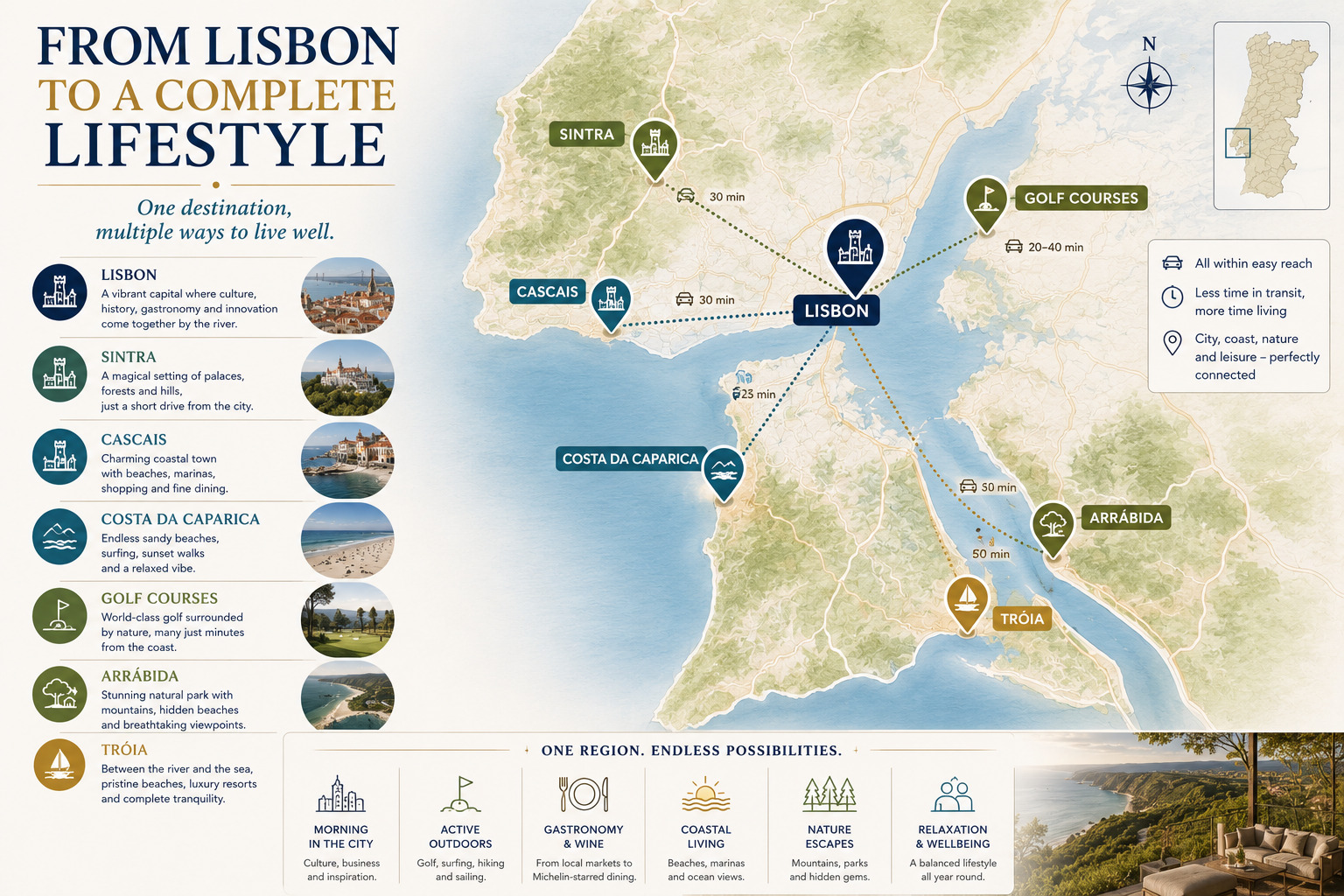
This combination of leisure, connectivity and stability is also one of the reasons Portugal is increasingly considered by international families.
Read more in: Portugal: Europe’s Safe Gateway for Life and Investment.
What unites much of the coastline is the constant presence of the Atlantic. The ocean shapes the light, climate, food, sport, culture and even the rhythm of everyday life.
A recent analysis based on traveler reviews in Tripadvisor placed two Portuguese beaches among the four European beaches most strongly associated with memorable sunsets. Praia da Falésia in the Algarve ranked third, while Praia da Ursa, near Cabo da Roca, ranked fourth. The analysis measured the proportion of reviews that specifically mentioned sunsets, so it should be read as a reflection of visitor impressions rather than a definitive measure of beach quality. While Iceland claimed the top position overall with Reynisfjara Beach, Portugal secured two places in the European top four.
Praia da Falésia is distinguished by its long stretch of sand and ochre-red cliffs overlooking the Atlantic. Praia da Ursa offers a much wilder experience, shaped by steep slopes, dramatic rock formations and a sense of isolation that is unusual so close to Lisbon.
Other Portuguese beaches, including Praia da Marinha, Praia do Camilo and Benagil, also appeared in the study. Portugal’s broader appeal is reinforced by other 2026 beach rankings, including recognition for Praia de Monte Clérigo on the Costa Vicentina.
The importance of these rankings is not simply that Portugal performs well. It is that the country offers several distinct types of coastal experience: resort beaches, surfing destinations, protected natural coastlines, family-friendly bays and remote Atlantic scenery.
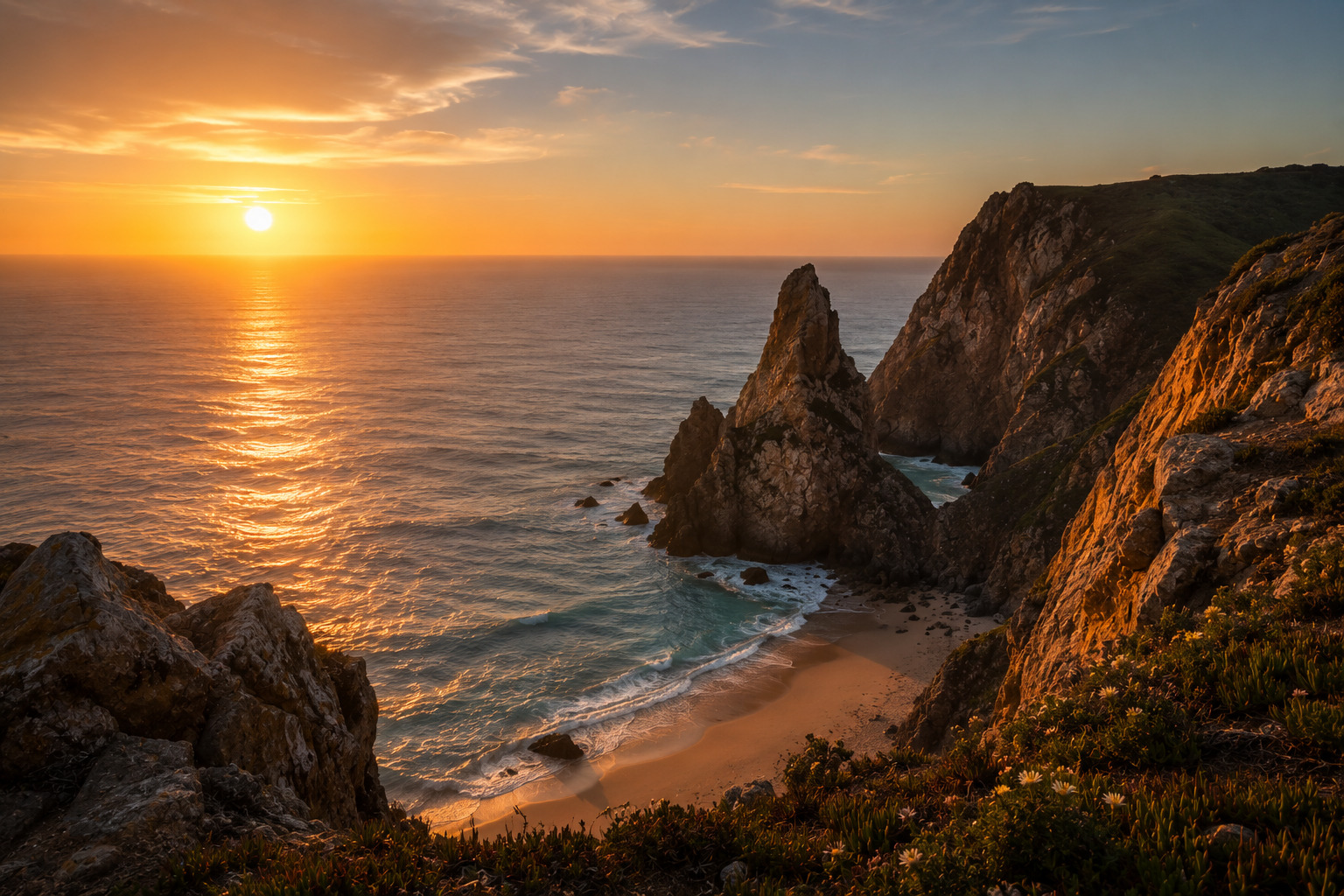
Photo: Sunset at praia da Ursa, Sintra
Ericeira has become a globally recognized surfing destination. Peniche hosts international competitions. Nazaré is associated with giant waves. Cascais combines marinas, sailing and urban life. Sagres attracts visitors seeking open landscapes, wind and nature. In the Azores, whale and dolphin watching has become one of the archipelago’s defining experiences.
Even for those who do not practice water sports, the sea remains present through coastal paths, waterfront restaurants, boat trips and towns whose identity is closely connected to fishing.
In Portugal, the ocean is not merely part of the scenery. It is an active part of the lifestyle.
In the north, the Douro offers a monumental landscape of terraces, estates and steep hillsides shaped by the river. Port wine made the region internationally famous, but the Douro also produces some of Portugal’s most respected still wines.
The Vinho Verde region offers a different experience, defined by freshness, rainfall and green landscapes. The Dão combines altitude, granite soils and elegance. Bairrada is closely associated with sparkling wine and the Baga grape. Lisbon and the Setúbal Peninsula combine Atlantic influence, proximity to the capital and a long winemaking tradition.
In the Alentejo, vineyards form part of a wider landscape of cork oak forests, olive groves, open plains and historic towns. The pace is slower, the food more closely connected to the land and many estates have evolved into complete wine-tourism destinations.
The islands add another dimension. Madeira has a globally recognized fortified-wine tradition, while the vineyards of Pico reflect the extraordinary adaptation of viticulture to volcanic rock and an Atlantic climate.
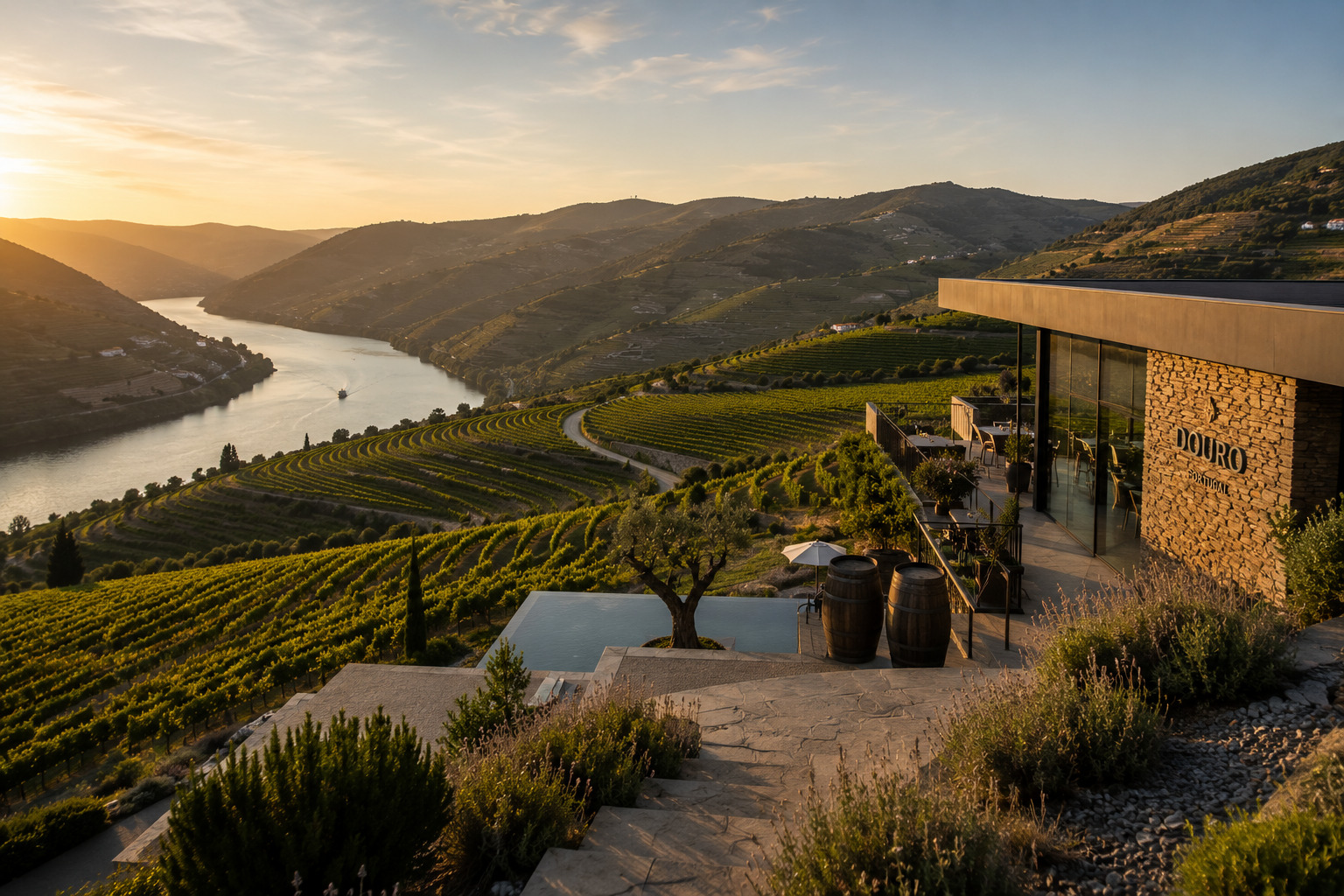
Photo: Douro wine region, Portugal
Turismo de Portugal presents wine tourism as a way to experience much more than wine itself. Vineyards, estates and wineries provide access to landscapes, heritage, regional cuisine and the communities that have shaped them. The Douro and Alentejo contain the greatest concentration of wine-tourism projects, but visitor experiences now exist across the country, including in the Algarve and the islands. (VisitPortugal)
In Lisbon, traditional cooking exists alongside international influences and contemporary restaurants. In Porto and northern Portugal, flavors tend to be richer and more substantial. The Alentejo transforms bread, olive oil, herbs and local produce into dishes with a strong territorial identity. In the Algarve, fish, seafood, citrus fruit and almonds reflect the region’s Atlantic and Mediterranean influences.
The islands have their own culinary traditions. In the Azores, beef, dairy products, fish and volcanic cooking play an important role. Madeira combines espada fish, Madeira’s espetada, wine and tropical fruit in a distinct regional cuisine.
Portugal has also developed an increasingly sophisticated contemporary restaurant scene. Portuguese chefs are revisiting regional recipes, ingredients and techniques without losing their connection to tradition.
For residents, however, gastronomic quality of life does not depend only on celebrated restaurants. It is found in markets, bakeries, neighborhood cafés, family-run restaurants, fresh fish counters and the continued importance of sharing a meal.
The Lisbon region is particularly effective at combining urban culture with leisure. Historic neighborhoods, Belém, the Tagus waterfront, Sintra, Cascais, beaches, golf and protected landscapes all sit within the same wider destination. Lisbon is the centre of a multifaceted region in which heritage, coastline, surfing, music and leisure remain closely connected. (VisitPortugal)
Portuguese culture is not limited to its past. Lisbon and Porto attract designers, artists, filmmakers, entrepreneurs and creative professionals. Comporta, the Alentejo and selected coastal areas have also attracted international buyers seeking privacy, landscape and a less accelerated relationship with daily life.
We explore this trend in greater detail in Why Hollywood and High-Net-Worth Americans Are Quietly Choosing Portugal.
In the north, Peneda-Gerês national park offers mountains, valleys, villages and hiking trails. The Douro combines river and vineyards. Serra da Estrela provides Portugal’s highest mainland landscapes. The Alentejo coast preserves long stretches of low-density nature. The Ria Formosa offers islands, channels and lagoon ecosystems.
Madeira is particularly valued for its levadas, Laurissilva forest and dramatic topography. The Azores offer volcanic lakes, thermal waters, whale watching, amazing lagoons, mountains and a more immersive natural environment.
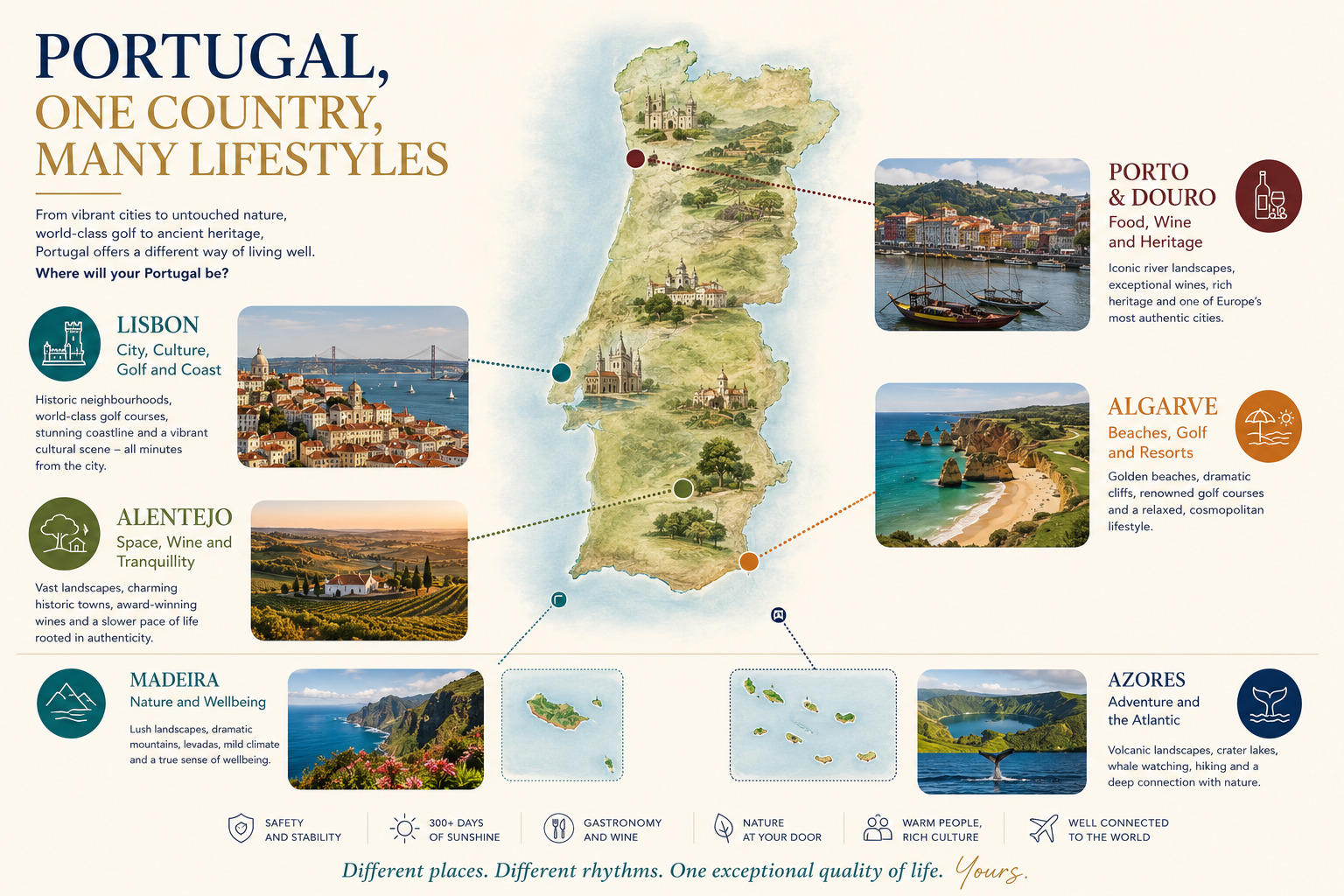
This variety supports very different ways of living. Some people prefer the energy of Lisbon. Others choose a coastal home, a property in the Alentejo or a quieter base closer to mountains and nature.
Portugal does not offer one single definition of quality of life. It offers several.
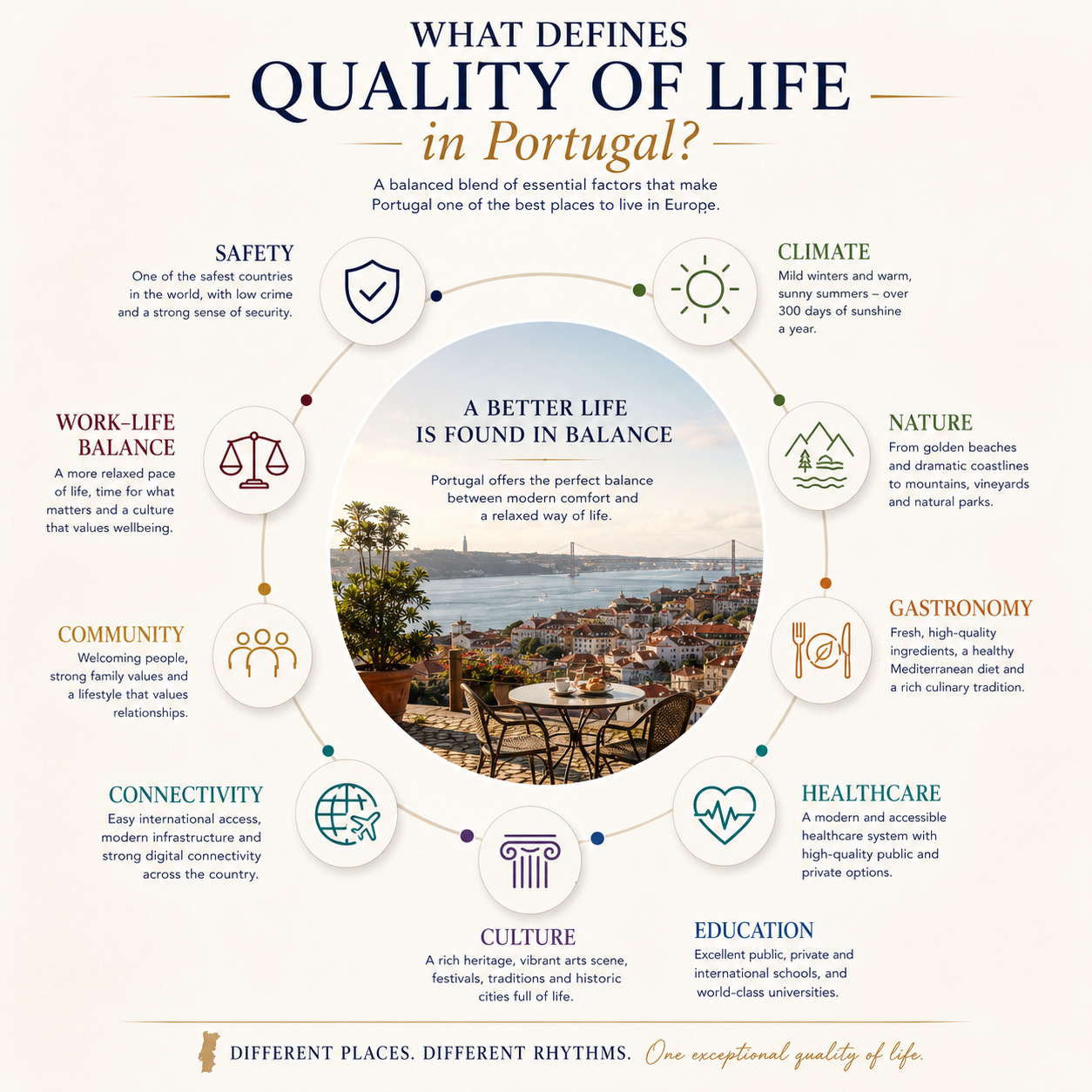
The growth of remote work and international careers has made this characteristic increasingly relevant. Many professionals can maintain global business relationships while building a more balanced local routine.
Portugal has a national public healthcare system, alongside an expanding private sector, particularly in Lisbon, Porto, the Algarve and areas with larger international communities. Families can choose among public, private and international schools, although availability and quality vary by location.
No destination is perfect. Housing affordability, tourism pressure in certain areas, traffic and capacity constraints in public services are real challenges. A credible article on Portugal’s lifestyle should acknowledge them.
Even so, the broader combination of safety, climate, food, nature and social life continues to make Portugal highly competitive for those seeking a more balanced European lifestyle.
For a broader discussion of safety, stability and long-term optionality, read Portugal: Europe’s Safe Gateway for Life and Investment.
In a world shaped by geopolitical tensions, political polarization, regional conflicts and growing uncertainty, safety has evolved from being a desirable characteristic into a strategic consideration.
For many families, the question is no longer simply "Where would we enjoy living?" It is increasingly "Where would we feel comfortable building our future?"
Portugal consistently ranks among the safest countries in the world and continues to benefit from strong democratic institutions, relatively low levels of violent crime and a stable social environment. Combined with its membership of the European Union and the Schengen Area, this offers residents and international investors a level of predictability that has become increasingly valuable.
Growing global uncertainty has reinforced the attractiveness of locations such as Lisbon and Cascais among international buyers, who increasingly value stability, security and quality of life alongside traditional investment considerations. Importantly, this trend is not driven by tax considerations alone.
Families are also evaluating:
Portugal offers a combination that is becoming increasingly difficult to find: a globally connected European country where economic opportunity, personal safety and lifestyle reinforce one another. For many international families, this balance has become one of Portugal's greatest competitive advantages.
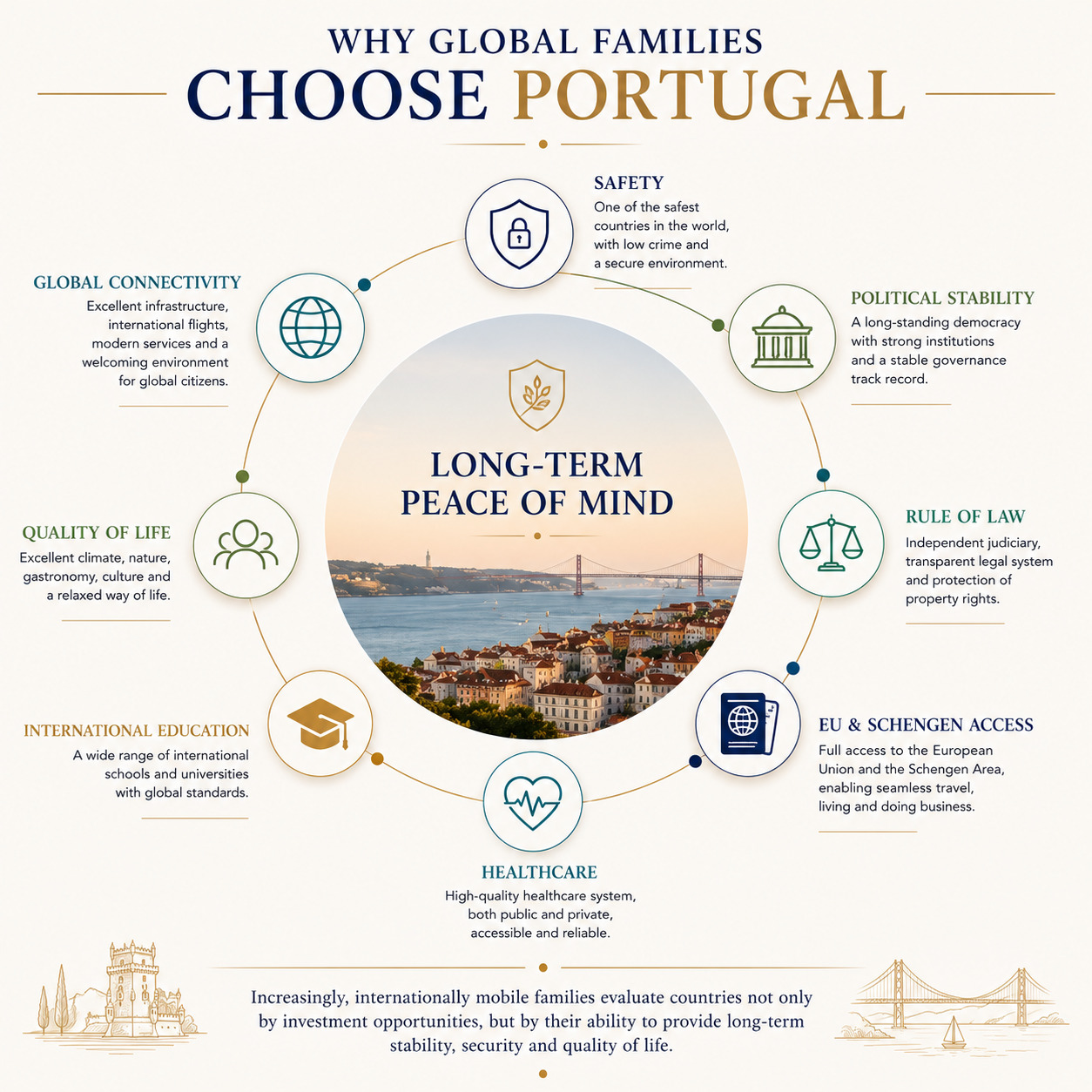
We explore this broader trend in Why Global Families Are Diversifying More Than Their Portfolios, where we examine how internationally mobile families are increasingly considering residency, jurisdiction and long-term resilience alongside traditional investment decisions.
Portugal benefits from a relatively human scale. Its main cities are international but remain accessible. Its regions have strong identities but are well connected. Quality of life is not based solely on luxury or consumption, but on regular access to simple and consistent experiences.
Lunch beside the sea. A walk through a historic centre. A morning on the golf course. Sunset on the beach. A weekend in the Douro. A harvest experience in the Alentejo. A concert in Lisbon. A levada walk in Madeira.
What distinguishes Portugal is that these experiences can form part of normal life rather than being reserved for a short holiday. For many international residents, the relationship begins with leisure.
It then becomes something deeper.
Portugal’s Golden Visa programme allows qualifying non-EU investors to obtain residence through eligible investments while maintaining relatively limited physical-presence requirements. This can be relevant for families seeking to establish a long-term connection to Portugal without immediately relocating their entire personal and professional lives.
Lifestyle and leisure should not be confused with the financial, legal and immigration criteria of an investment decision. But they should not be ignored either.
A residency strategy only makes sense if the chosen country is somewhere the investor and family can realistically imagine spending time and potentially living.
For a broader overview of the country’s residency and lifestyle advantages, see Why Portugal Is the Best Choice for a Golden Visa.
Investors looking for the programme’s practical requirements should also consult our complete guide to the Portugal Golden Visa.
Its strategy, underlying assets, liquidity, risk, fees, custody arrangements and investment horizon should be assessed with the same discipline applied to any other financial decision. Quality of life may explain why a family becomes interested in Portugal. Investment quality should determine how its capital is allocated.
Note: 3 Comma Capital is a regulated asset manager and does not provide legal, tax or immigration advice. Investors should obtain independent professional advice based on their individual circumstances.
Golf near Lisbon is not only about golf, because it can be combined with culture, gastronomy and the Atlantic. The beaches are not merely summer destinations, because they form part of daily life and national identity. Wine is not simply a drink, because it tells the story of regions, landscapes and communities. Food is not only restaurant culture, because it remains closely tied to family and place.
Portugal makes it possible to live fully without necessarily living quickly. It is small enough to remain accessible and diverse enough to continue surprising.
For visitors, it offers experiences. For residents, it offers routines with quality.
For international families, it may offer something more valuable still: the possibility of building a European life that combines safety, culture, nature, leisure and human connection.
Portugal is not simply somewhere people go. Increasingly, it is somewhere they choose to stay.
The 10 Most Common Golden Visa Mistakes and How to Avoid Them
Portugal Approves New Nationality Law: What It Means for Golden Visa Investors
Portugal Golden Visa After the Nationality Reform: Why Sophisticated Investors Still Choose Portugal
Today, Portugal stands out for offering a rare combination of quality of life, safety, nature, culture, gastronomy, sport and international accessibility. It is possible to play golf in the morning, have lunch beside the Atlantic, visit a museum or attend a concert in the afternoon, and end the day in a historic neighborhood, at a waterfront terrace or in a traditional fado house.
Few European destinations bring together such different experiences within such short distances.
Lisbon combines urban life, coastline, golf and heritage. The Algarve offers beaches, resorts, gastronomy and some of Europe’s most recognizable coastal scenery. The Douro transforms wine into a cultural and landscape experience. The Alentejo invites a slower pace among vineyards, historic towns and open horizons. Madeira and the Azores add dramatic nature, outdoor adventure and an even closer relationship with the ocean. This variety, together with a relaxed way of life and a strong connection between people, place and tradition, helps explain why Portugal has become more than somewhere to visit.
For a growing number of international families, it is a country in which to spend more time, establish a second residence or begin a new stage of life.
Key Takeaways
- Portugal makes it possible to combine city life, beaches, nature, culture and sport within the same day, often without long journeys.
- The Lisbon region is emerging as an increasingly attractive golf destination, combining quality courses with coastline, culture and urban life.
- Portugal’s beaches are valued not only for their quality, but also for their scenery and memorable sunsets.
- Portuguese wine offers a gateway into the country’s landscapes, history, gastronomy and regional identities.
- Portugal’s quality of life comes from the combination of several factors, including climate, safety, food, healthcare, education, mobility and pace of life.
- Each region offers a different lifestyle, from vibrant cities and coastal living to rural tranquillity and immersive natural environments.
- For many internationally mobile families, Portugal represents a leisure destination, a European base and a long-term lifestyle option.
A Country Where Life Happens Outdoors
Portugal’s relationship with outdoor life begins with the climate, but it goes much further.Daily life unfolds on terraces, in gardens, markets, beaches, golf courses, marinas, cycle paths, walking trails and historic squares. Even in the country’s largest cities, the transition from urban life to nature can be remarkably quick.
In Lisbon, a business meeting in the city centre can be followed by a walk along the Tagus, an afternoon in Carcavelos or dinner in Cascais. In Porto, the historic centre, the Douro River, the wine lodges of Vila Nova de Gaia and the Atlantic coast form part of the same broader experience. In smaller cities such as Évora, Braga, Coimbra, Aveiro or Viseu, quality of life is shaped by proximity, heritage and a more measured pace.
Portugal does not simply offer nice weather. It has developed a culture that knows how to use it.
Meals last longer. Late afternoons have a rhythm of their own. The ocean forms part of the national identity. Public space remains a place for social interaction rather than merely somewhere to pass through. This ability to integrate leisure into everyday life is one of Portugal’s most important, and sometimes least measurable, advantages.
Photo: View of Tagus river, Lisboa
Lisbon: Golf, Culture, Beaches and City Life in One Journey
For decades, the Algarve has been Portugal’s principal international golf destination. It remains essential to the country’s golf offering, but Lisbon is becoming an increasingly compelling alternative for travelers’ who do not want their trip to revolve entirely around the course.The region’s main advantage is combination. Visitors can play in the morning on a course surrounded by pine trees, spend the afternoon beside the Atlantic and return to central Lisbon for dinner, a concert or an evening in one of the city’s historic neighborhoods.
Aroeira, around 20 kilometers’ from central Lisbon, is among the best-known golf areas near the capital. Its courses are set within pine woodland and close to the long beaches of the Costa da Caparica. PGA Aroeira 1 opened in 1972, hosted the Portuguese Open in 1996 and 1997 and is scheduled to return to professional competition in September 2026.
Yet Aroeira is only part of the region’s offering. Golf courses can also be found around Cascais, Sintra, Estoril, Setúbal, Palmela, Troia and the Tagus Valley. Some are close to the ocean, while others are surrounded by vineyards, pine forests, cork oak landscapes or protected natural areas. Turismo de Portugal highlights the Lisbon region’s mild climate, variety of courses and proximity to beaches, World Heritage sites and wine-producing areas as important complements to a golfing holiday. (VisitPortugal)
What distinguishes Lisbon is not necessarily the largest concentration of golf courses. It is the possibility of making golf one part of a much broader lifestyle experience.
This is particularly relevant for couples or families in which not everyone plays. While one person spends the morning on the course, others can explore Lisbon, visit Sintra, go to the beach, shop, visit museums or simply enjoy the coast.
This combination of leisure, connectivity and stability is also one of the reasons Portugal is increasingly considered by international families.
Read more in: Portugal: Europe’s Safe Gateway for Life and Investment.
Beaches That Offer More Than Summer
Portugal’s coastline stretches across very different landscapes. There are long Atlantic beaches along the Costa da Caparica, dramatic cliffs and coves in the Algarve, wild stretches of coast in the Alentejo, sheltered bays around Lisbon and volcanic seascapes in Madeira and the Azores.What unites much of the coastline is the constant presence of the Atlantic. The ocean shapes the light, climate, food, sport, culture and even the rhythm of everyday life.
A recent analysis based on traveler reviews in Tripadvisor placed two Portuguese beaches among the four European beaches most strongly associated with memorable sunsets. Praia da Falésia in the Algarve ranked third, while Praia da Ursa, near Cabo da Roca, ranked fourth. The analysis measured the proportion of reviews that specifically mentioned sunsets, so it should be read as a reflection of visitor impressions rather than a definitive measure of beach quality. While Iceland claimed the top position overall with Reynisfjara Beach, Portugal secured two places in the European top four.
Praia da Falésia is distinguished by its long stretch of sand and ochre-red cliffs overlooking the Atlantic. Praia da Ursa offers a much wilder experience, shaped by steep slopes, dramatic rock formations and a sense of isolation that is unusual so close to Lisbon.
Other Portuguese beaches, including Praia da Marinha, Praia do Camilo and Benagil, also appeared in the study. Portugal’s broader appeal is reinforced by other 2026 beach rankings, including recognition for Praia de Monte Clérigo on the Costa Vicentina.
The importance of these rankings is not simply that Portugal performs well. It is that the country offers several distinct types of coastal experience: resort beaches, surfing destinations, protected natural coastlines, family-friendly bays and remote Atlantic scenery.
Photo: Sunset at praia da Ursa, Sintra
The Ocean as a Place for Leisure
Portugal’s beaches are not simply places to rest. The Atlantic has helped turn the country into an international destination for surfing, sailing, kitesurfing, diving, sport fishing, whale watching and coastal excursions.Ericeira has become a globally recognized surfing destination. Peniche hosts international competitions. Nazaré is associated with giant waves. Cascais combines marinas, sailing and urban life. Sagres attracts visitors seeking open landscapes, wind and nature. In the Azores, whale and dolphin watching has become one of the archipelago’s defining experiences.
Even for those who do not practice water sports, the sea remains present through coastal paths, waterfront restaurants, boat trips and towns whose identity is closely connected to fishing.
In Portugal, the ocean is not merely part of the scenery. It is an active part of the lifestyle.
Portuguese Wine: A Journey Through the Country
Few things explain Portugal as well as wine. Each wine region reflects its own combination of climate, soil, landscape, cuisine and history. To understand Portuguese wine is therefore also to understand Portugal itself.In the north, the Douro offers a monumental landscape of terraces, estates and steep hillsides shaped by the river. Port wine made the region internationally famous, but the Douro also produces some of Portugal’s most respected still wines.
The Vinho Verde region offers a different experience, defined by freshness, rainfall and green landscapes. The Dão combines altitude, granite soils and elegance. Bairrada is closely associated with sparkling wine and the Baga grape. Lisbon and the Setúbal Peninsula combine Atlantic influence, proximity to the capital and a long winemaking tradition.
In the Alentejo, vineyards form part of a wider landscape of cork oak forests, olive groves, open plains and historic towns. The pace is slower, the food more closely connected to the land and many estates have evolved into complete wine-tourism destinations.
The islands add another dimension. Madeira has a globally recognized fortified-wine tradition, while the vineyards of Pico reflect the extraordinary adaptation of viticulture to volcanic rock and an Atlantic climate.
Photo: Douro wine region, Portugal
Turismo de Portugal presents wine tourism as a way to experience much more than wine itself. Vineyards, estates and wineries provide access to landscapes, heritage, regional cuisine and the communities that have shaped them. The Douro and Alentejo contain the greatest concentration of wine-tourism projects, but visitor experiences now exist across the country, including in the Algarve and the islands. (VisitPortugal)
Gastronomy: Simplicity and Identity
Portuguese food rarely seeks attention through visual complexity. Its strength lies in the quality of its ingredients: fresh fish, seafood, olive oil, bread, cheese, vegetables, meat, rice, herbs and wine form the foundation of a cuisine deeply linked to place and season.In Lisbon, traditional cooking exists alongside international influences and contemporary restaurants. In Porto and northern Portugal, flavors tend to be richer and more substantial. The Alentejo transforms bread, olive oil, herbs and local produce into dishes with a strong territorial identity. In the Algarve, fish, seafood, citrus fruit and almonds reflect the region’s Atlantic and Mediterranean influences.
The islands have their own culinary traditions. In the Azores, beef, dairy products, fish and volcanic cooking play an important role. Madeira combines espada fish, Madeira’s espetada, wine and tropical fruit in a distinct regional cuisine.
Portugal has also developed an increasingly sophisticated contemporary restaurant scene. Portuguese chefs are revisiting regional recipes, ingredients and techniques without losing their connection to tradition.
For residents, however, gastronomic quality of life does not depend only on celebrated restaurants. It is found in markets, bakeries, neighborhood cafés, family-run restaurants, fresh fish counters and the continued importance of sharing a meal.
Culture, Heritage and Creativity
Portugal offers remarkable cultural density for a country of its size. Lisbon brings together museums, foundations, galleries, concerts, festivals, historic architecture and an increasingly international creative community. Porto combines heritage, design, gastronomy and a strong urban identity. Coimbra remains closely connected to its university and academic traditions. Évora, Guimarães, Braga, Tomar, Alcobaça and Batalha provide access to different periods of Portuguese history.The Lisbon region is particularly effective at combining urban culture with leisure. Historic neighborhoods, Belém, the Tagus waterfront, Sintra, Cascais, beaches, golf and protected landscapes all sit within the same wider destination. Lisbon is the centre of a multifaceted region in which heritage, coastline, surfing, music and leisure remain closely connected. (VisitPortugal)
Portuguese culture is not limited to its past. Lisbon and Porto attract designers, artists, filmmakers, entrepreneurs and creative professionals. Comporta, the Alentejo and selected coastal areas have also attracted international buyers seeking privacy, landscape and a less accelerated relationship with daily life.
We explore this trend in greater detail in Why Hollywood and High-Net-Worth Americans Are Quietly Choosing Portugal.
Nature Without Long Distances
One of Portugal’s greatest advantages is the ease with which the landscape changes. From Lisbon, travelers can reach the coast, hills, vineyards, golf courses, historic towns and natural reserves without crossing vast distances.In the north, Peneda-Gerês national park offers mountains, valleys, villages and hiking trails. The Douro combines river and vineyards. Serra da Estrela provides Portugal’s highest mainland landscapes. The Alentejo coast preserves long stretches of low-density nature. The Ria Formosa offers islands, channels and lagoon ecosystems.
Madeira is particularly valued for its levadas, Laurissilva forest and dramatic topography. The Azores offer volcanic lakes, thermal waters, whale watching, amazing lagoons, mountains and a more immersive natural environment.
This variety supports very different ways of living. Some people prefer the energy of Lisbon. Others choose a coastal home, a property in the Alentejo or a quieter base closer to mountains and nature.
Portugal does not offer one single definition of quality of life. It offers several.
Wellbeing, Healthcare and Balance
Quality of life also depends on how time is used. In many parts of Portugal, the distance between work and leisure can be relatively small. Residential areas, city centers, beaches, parks and services often exist within a manageable radius, making everyday life feel less fragmented.The growth of remote work and international careers has made this characteristic increasingly relevant. Many professionals can maintain global business relationships while building a more balanced local routine.
Portugal has a national public healthcare system, alongside an expanding private sector, particularly in Lisbon, Porto, the Algarve and areas with larger international communities. Families can choose among public, private and international schools, although availability and quality vary by location.
No destination is perfect. Housing affordability, tourism pressure in certain areas, traffic and capacity constraints in public services are real challenges. A credible article on Portugal’s lifestyle should acknowledge them.
Even so, the broader combination of safety, climate, food, nature and social life continues to make Portugal highly competitive for those seeking a more balanced European lifestyle.
For a broader discussion of safety, stability and long-term optionality, read Portugal: Europe’s Safe Gateway for Life and Investment.
Safety Has Become a Lifestyle Advantage
In the past, discussions about lifestyle often focused on sunshine, beaches or gastronomy. Today, another factor increasingly influences where international mobile families choose to spend their time and establish long-term roots: security.In a world shaped by geopolitical tensions, political polarization, regional conflicts and growing uncertainty, safety has evolved from being a desirable characteristic into a strategic consideration.
For many families, the question is no longer simply "Where would we enjoy living?" It is increasingly "Where would we feel comfortable building our future?"
Portugal consistently ranks among the safest countries in the world and continues to benefit from strong democratic institutions, relatively low levels of violent crime and a stable social environment. Combined with its membership of the European Union and the Schengen Area, this offers residents and international investors a level of predictability that has become increasingly valuable.
Growing global uncertainty has reinforced the attractiveness of locations such as Lisbon and Cascais among international buyers, who increasingly value stability, security and quality of life alongside traditional investment considerations. Importantly, this trend is not driven by tax considerations alone.
Families are also evaluating:
- political stability;
- the rule of law;
- healthcare systems;
- international education;
- access to Europe;
- business connectivity;
- and the ability to enjoy a high quality of life without sacrificing personal security.
Portugal offers a combination that is becoming increasingly difficult to find: a globally connected European country where economic opportunity, personal safety and lifestyle reinforce one another. For many international families, this balance has become one of Portugal's greatest competitive advantages.
We explore this broader trend in Why Global Families Are Diversifying More Than Their Portfolios, where we examine how internationally mobile families are increasingly considering residency, jurisdiction and long-term resilience alongside traditional investment decisions.
A Country to Visit, or a Country to Live In?
The real test of a destination is not whether it provides a good holiday. It is whether the quality remains once the holiday ends and ordinary life begins.Portugal benefits from a relatively human scale. Its main cities are international but remain accessible. Its regions have strong identities but are well connected. Quality of life is not based solely on luxury or consumption, but on regular access to simple and consistent experiences.
Lunch beside the sea. A walk through a historic centre. A morning on the golf course. Sunset on the beach. A weekend in the Douro. A harvest experience in the Alentejo. A concert in Lisbon. A levada walk in Madeira.
What distinguishes Portugal is that these experiences can form part of normal life rather than being reserved for a short holiday. For many international residents, the relationship begins with leisure.
It then becomes something deeper.
Portugal as a Second European Base
Quality of life is also one reason Portugal has become increasingly relevant to internationally mobile families. For some, the country becomes a primary residence. For others, it serves as a second European base, a recurring holiday destination, an educational option for children or a contingency plan for the future.Portugal’s Golden Visa programme allows qualifying non-EU investors to obtain residence through eligible investments while maintaining relatively limited physical-presence requirements. This can be relevant for families seeking to establish a long-term connection to Portugal without immediately relocating their entire personal and professional lives.
Lifestyle and leisure should not be confused with the financial, legal and immigration criteria of an investment decision. But they should not be ignored either.
A residency strategy only makes sense if the chosen country is somewhere the investor and family can realistically imagine spending time and potentially living.
For a broader overview of the country’s residency and lifestyle advantages, see Why Portugal Is the Best Choice for a Golden Visa.
Investors looking for the programme’s practical requirements should also consult our complete guide to the Portugal Golden Visa.
The 3 Comma Capital Perspective
At 3 Comma Capital, we believe that an investment in Portugal should be considered within the broader context in which that investment is made. Portugal offers a relatively unusual combination of European access, institutional stability and quality of life. However, an investment that qualifies for residency purposes should still be evaluated first and foremost as an investment.Its strategy, underlying assets, liquidity, risk, fees, custody arrangements and investment horizon should be assessed with the same discipline applied to any other financial decision. Quality of life may explain why a family becomes interested in Portugal. Investment quality should determine how its capital is allocated.
Note: 3 Comma Capital is a regulated asset manager and does not provide legal, tax or immigration advice. Investors should obtain independent professional advice based on their individual circumstances.
Conclusion: Portugal and the Art of Living Well
Portugal cannot be reduced to one beach, one city or one residency programme. Its appeal comes from the relationship between different dimensions.Golf near Lisbon is not only about golf, because it can be combined with culture, gastronomy and the Atlantic. The beaches are not merely summer destinations, because they form part of daily life and national identity. Wine is not simply a drink, because it tells the story of regions, landscapes and communities. Food is not only restaurant culture, because it remains closely tied to family and place.
Portugal makes it possible to live fully without necessarily living quickly. It is small enough to remain accessible and diverse enough to continue surprising.
For visitors, it offers experiences. For residents, it offers routines with quality.
For international families, it may offer something more valuable still: the possibility of building a European life that combines safety, culture, nature, leisure and human connection.
Portugal is not simply somewhere people go. Increasingly, it is somewhere they choose to stay.
Additional Resources for Golden Visa Investors
The following resources explore specific aspects of Golden Visa investing in greater detail.Portugal Golden Visa Fundamentals
Portugal Golden Visa Investment Funds GuideThe 10 Most Common Golden Visa Mistakes and How to Avoid Them
Portugal Approves New Nationality Law: What It Means for Golden Visa Investors
Portugal Golden Visa After the Nationality Reform: Why Sophisticated Investors Still Choose Portugal
 |
Business Development Director
|
Alexandre is a seasoned professional with over 20 years of experience in business development, investor relations, relationship management, and sales. He has held senior positions at Kreab, Liberdade Capital, and OFI Asset Management, and was the founder of ACE Consulting, a real estate investment advisory firm.
More about Alexandre Cunha Elias


