

Democrats have regained control of Congress, but Washington's new balance of power may bring as much confrontation as compromise. With financial markets reassessing the implications for fiscal policy, artificial intelligence and the US economy, internationally minded investors are increasingly considering how to diversify not only their portfolios, but also their future residence options.
Key Takeaways
- A major political realignment: Democrats have secured control of both chambers of Congress, setting the stage for divided government during the final two years of Donald Trump's presidency.
- Gridlock creates both constraints and risks: Congressional majorities give Democrats greater oversight and legislative influence, but presidential veto powers and Senate procedures will make significant policy changes difficult.
- Financial markets are reassessing the outcome: An initial positive reaction was followed by a sharp equity sell-off, highlighting concerns about AI infrastructure investment, economic growth and policy uncertainty.
- American demand for international residency is accelerating: Investment Migration firms report a 50%+ increase in US applications for additional residence and citizenship options over the latest 18-month period.
- Portugal offers an established European alternative: Improving public finances, stronger sovereign credit ratings and institutional integration within the EU support its appeal as a long-term residence and investment destination.
- A Plan B does not require leaving America: Portugal's Golden Visa offers eligible investors a potential European residence option without immediate relocation.
- Investment strategy remains essential: The Atlantic Bond Fund and Atlantic Growth Fund offer distinct approaches for investors prioritising capital preservation or long-term growth.
A Political Earthquake in Washington
The 2026 US midterm elections have fundamentally changed the political balance in Washington.
In a sweeping electoral reversal, Democrats have secured majorities in both the House of Representatives and the Senate, ending Republican control of Congress and creating the prospect of a deeply divided federal government. With 54 Senate seats secured and 253 seats in the House of Representatives, the scale of the reversal represents a significant setback for President Donald Trump, reflecting voter dissatisfaction with the cost of living, the economic consequences of the conflict with Iran and broader concerns about political accountability.
Yet the most important question for investors is not simply who won the election. It is whether Washington's new political configuration will make the United States more predictable or introduce a different form of uncertainty.
When the new Congress convenes in January 2027, Democrats will gain substantial legislative and oversight powers. President Trump, however, will retain the presidency, the power to veto legislation and considerable authority over foreign affairs and trade policy.
This combination creates the conditions for political gridlock: an environment in which major legislative initiatives become harder to implement, compromises are more difficult to negotiate and uncertainty over future policy can persist for extended periods.
The implications are particularly significant because the election arrives at a sensitive moment for the US economy. Elevated borrowing costs, persistent fiscal deficits, energy-related inflation pressures and growing questions about the financing of artificial intelligence infrastructure have already complicated the investment outlook.
For financial markets, businesses and internationally mobile families, the consequences extend well beyond the immediate election result.
Divided Government: A Constraint on Power and More Uncertainty
Political gridlock is not inherently negative for financial markets. Historically, investors have sometimes welcomed divided government because it can constrain abrupt legislative changes, limit fiscal expansion and provide a degree of institutional balance.
The Institutional Limits of Democratic Control
Although Democrats will control both chambers of Congress, their ability to reshape federal policy remains constrained.
Under the Senate's filibuster rules, most legislation requires 60 votes to overcome procedural opposition. Democrats' projected majority falls short of that threshold.
More importantly, President Trump retains the power to veto legislation. Overriding a presidential veto requires a two-thirds majority in both chambers, a threshold Democrats will also be unable to meet without substantial Republican support. These institutional constraints create an important asymmetry.
Republicans will find it difficult to advance major legislative initiatives without Democratic cooperation. Democrats, meanwhile, will struggle to reverse the administration's existing policies or impose an alternative programme. History shows that when the domestic agenda is blocked, presidents tend to turn to foreign affairs to deliver results. After the Bush administration's midterm losses in 2006, for example, it pivoted to active diplomatic engagement with North Korea; in 2015, the Obama administration reached the Iran nuclear deal while Republicans controlled Congress.
For the Trump administration, that could mean continued emphasis on tariffs, international negotiations and the conflict involving Iran.
Trade Policy and Geopolitics Remain Presidential Priorities
Congressional control does not eliminate the president's influence over international economic policy.
The administration retains significant authority over trade measures, tariffs and foreign policy, subject to legal and institutional constraints. Following the election, oil prices retreated as investors reassessed the likelihood of further escalation and the possibility of diplomatic progress. Lower energy prices could alleviate inflationary pressures, improve household purchasing power and reduce the need for additional monetary tightening. Nevertheless, the geopolitical outlook remains uncertain. A renewed escalation could quickly reverse those developments, affecting energy prices, inflation expectations, interest rates and financial markets.
The result is an unusual policy environment: greater legislative constraints at home, but continued scope for consequential executive decisions abroad.
Beyond Portfolio Diversification: The Rise of the Plan B
For decades, wealthy families have diversified their financial assets across equities, bonds, currencies, sectors and geographical markets. Increasingly, they are applying a similar principle to their personal lives.
The question is no longer simply where to invest. It is also where a family has the legal right to live, establish a home and pursue its future if circumstances change.
Political volatility, changes in taxation, social tensions and geopolitical uncertainty can all affect the attractiveness of remaining dependent on one country. This does not imply that the United States is becoming an unsuitable place to live or invest. Nor does it suggest that Europe is immune to political or economic instability. Rather, it reflects a broader recognition that flexibility has value precisely because the future is uncertain.
American Demand for Additional Residency Rights Is Rising
Recent research from a reputable investment migration firm reports this shift. According to its October 26' findings, applications from US nationals for additional residence and citizenship options increased by 52% over the latest 18-month period, compared with the preceding 18 months. Americans remain the firm's largest source nationality. Perhaps more revealingly, only 9% of American applicants currently reside outside the United States.
This suggests that most applicants are not pursuing immediate relocation. Instead, many are seeking to establish additional rights and opportunities while continuing to live and work in America.
The phenomenon is not limited to the United States. Growing interest has also been observed among citizens of France, Italy, Germany, Canada and Australia.
International financial media has similarly documented the increasing interest among Americans in overseas residence options, often motivated by a combination of political uncertainty, family planning, healthcare considerations and long-term lifestyle objectives.
The underlying motivation is increasingly similar across these markets: preserving future choices.
Residency as a Form of Jurisdictional Diversification
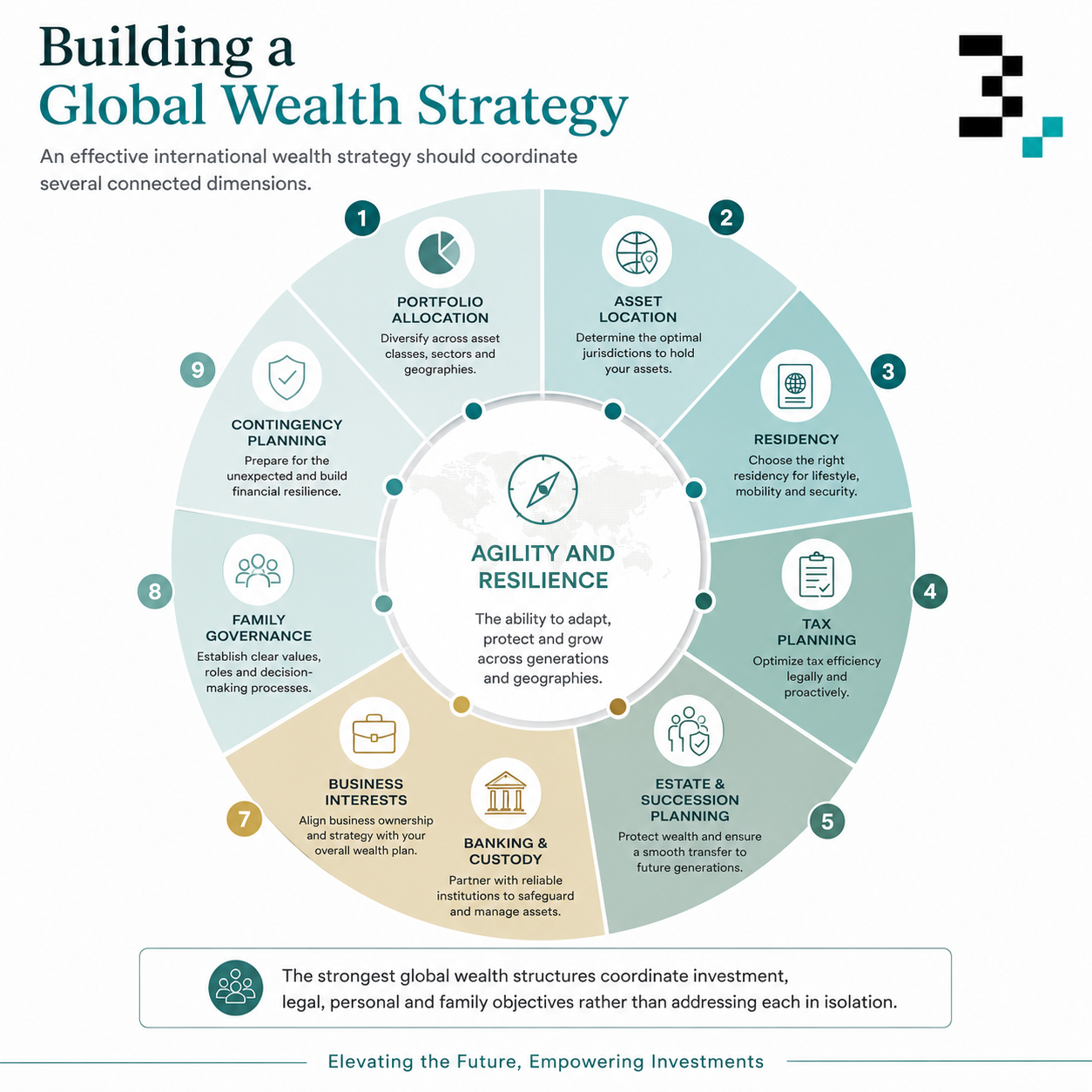
Financial diversification reduces dependence on the performance of individual assets or markets. Jurisdictional diversification addresses a different question: how dependent is a family's future on the legal, political and economic environment of one country?
An additional residence permit can provide access to an alternative place to live, greater geographical mobility and options for family members. It does not eliminate political risk, guarantee tax advantages or automatically provide citizenship. Nevertheless, it can expand the range of choices available to a family.
For many American families, establishing a European Plan B is not a decision to relocate, but a decision to preserve optionality. They may continue living, working and investing in the United States while securing an additional residence option for themselves and their families. Much like insurance, the value of such an arrangement lies partly in having it available before circumstances make it necessary.
A Plan B is not necessarily a plan to leave. It is a plan to retain the ability to choose.
Portugal: Political Stability and Sound Economic Fundamentals
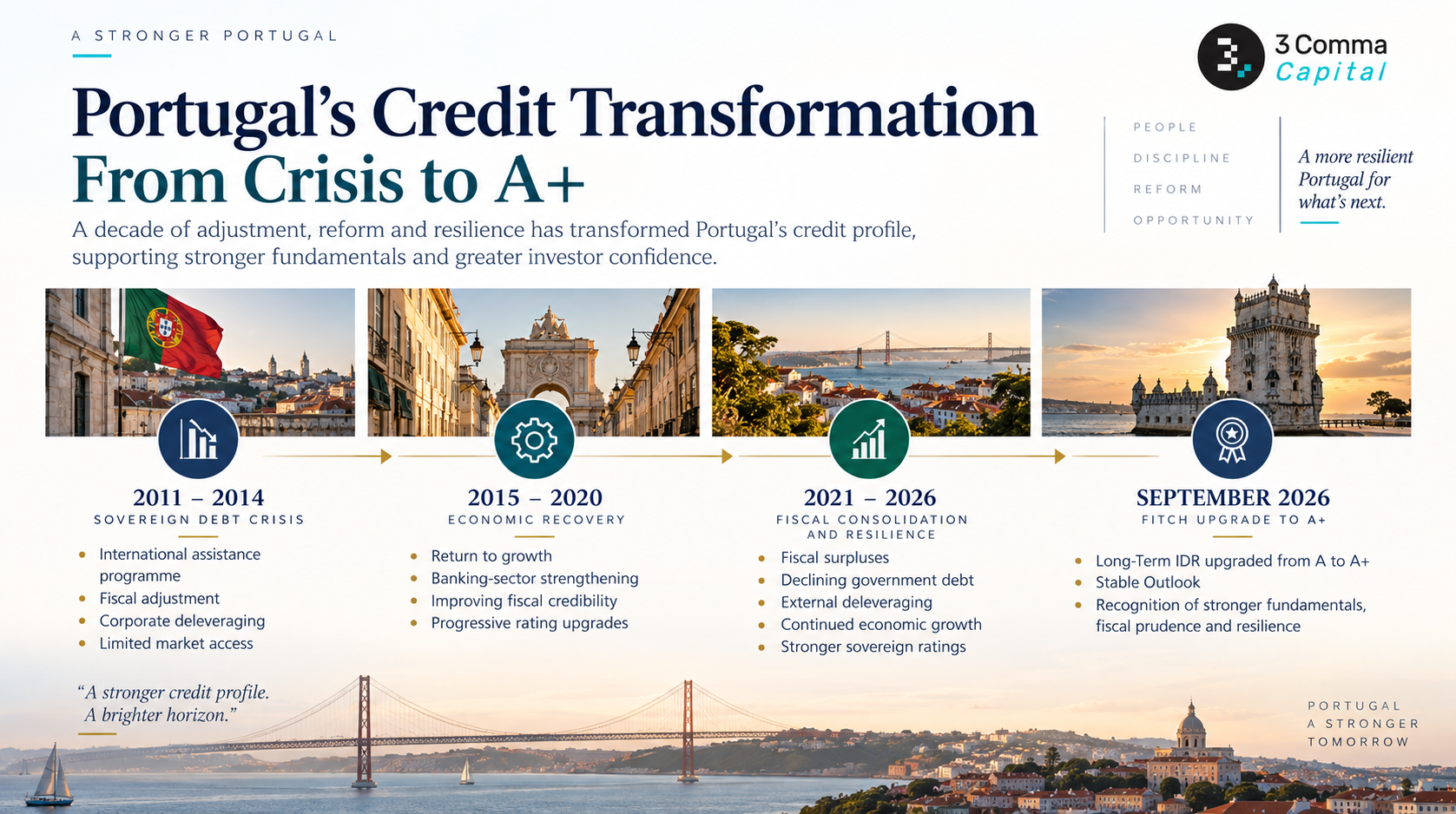
Portugal offers an institutional environment anchored in the European Union and the euro area, supported by established democratic institutions and a broad political commitment to European integration and fiscal responsibility. Although the country has experienced periods of political fragmentation and government changes, its core economic and European policy commitments have remained broadly consistent across administrations. This institutional continuity, combined with EU membership and access to the single market, provides a framework for international investors seeking to diversify their geographical exposure.
Portugal's economic fundamentals have also strengthened considerably over the past decade. According to the European Commission, the Portuguese economy has outperformed the EU average for four consecutive years, while public debt declined from approximately 134% of GDP in 2020 to below 90% in 2025. The country recorded its third consecutive budget surplus in 2025, and its improving fiscal position has supported sovereign credit rating upgrades, including an A+ rating from S&P and Fitch. Although challenges remain, particularly around productivity, housing affordability and external economic risks, Portugal's combination of fiscal consolidation, economic resilience and institutional integration strengthens its appeal as a European destination for long-term residence and investment.
Why Portugal's Golden Visa Deserves Attention
For American investors considering European residency, Portugal offers an established route through its Golden Visa programme, formally known as the Residence Permit for Investment Activity (Autorização de Residência para Investimento, or ARI).
The programme allows eligible non-EU nationals to apply for Portuguese residency through qualifying investments, including eligible non-real-estate investment funds. For investors who wish to retain their principal residence and professional commitments in the United States, several characteristics are particularly relevant.
European Residency Without Immediate Relocation
Portugal's Golden Visa provides a pathway to Portuguese residence while allowing qualifying investors to maintain their primary lives elsewhere, subject to the programme's minimum physical-presence and renewal requirements. This flexibility is especially relevant for entrepreneurs, executives, retirees and families who want European options without committing to immediate emigration.
Schengen Mobility and Family Planning
Portuguese residence permits can facilitate short-term travel throughout the Schengen Area, subject to applicable rules. The programme also provides for eligible family reunification, making it relevant to longer-term family planning. Portuguese residence does not, by itself, grant an unrestricted right to live or work in every European Union member state.
An Established Investment-Based Route
For the qualifying investment fund route, the standard minimum investment is €500,000, subject to the legal eligibility conditions applicable to the fund and investor. Investors should also distinguish between eligibility for Portuguese residency and any future application for permanent residence or citizenship. These are separate legal processes, with their own requirements and potential legislative changes.
The Golden Visa is therefore best understood as a long-term residence and investment strategy, rather than an automatic route to an EU passport.

Choosing an Investment Strategy That Fits the Investor
A Golden Visa investment should never be evaluated solely on its immigration benefits. The underlying investment must also be appropriate for the investor's objectives, risk tolerance, liquidity requirements and investment horizon. Through the 3 Comma Capital and C2 Capital Partners investment platform, investors can access different Golden Visa-eligible strategies designed for distinct financial objectives.
Two approaches are particularly relevant for American investors considering a European Plan B:
Atlantic Bond Fund: A Conservative Approach
For investors whose primary objective is capital preservation and relatively low volatility, the Atlantic Bond Fund (ABF) offers a fixed-income-focused investment strategy.
Its reference allocation centres on approximately 60% Portuguese investment-grade corporate bonds, complemented by around 40% in diversified European and global credit exposure across more than 2,000 issuers, alongside a limited allocation to gold.
The strategy seeks to generate income while maintaining disciplined credit selection, diversification and risk management.
With a risk indicator of 2 out of 7, the fund is positioned for investors who favour a conservative approach to their Golden Visa investment.
As an open-ended fund with daily liquidity, it also offers a different liquidity structure from traditional closed-end investment vehicles, although redemptions remain subject to the fund's governing documents and prevailing market conditions.
Capital preservation is an investment objective, not a guarantee against losses.
For investors who view the Golden Visa primarily as a long-term residence-planning decision, ABF offers a strategy centred on fixed-income stability rather than aggressive capital appreciation.
Explore the Atlantic Bond Fund
Atlantic Growth Fund: A Long-Term Growth Approach
For investors seeking greater capital appreciation alongside their European residency objectives, the Atlantic Growth Fund (AGF) provides a more growth-oriented multi-asset strategy.
Its reference allocation combines approximately 70% exposure to Portuguese and global equities with 30% in Portuguese investment-grade corporate bonds.
This structure is designed to capture long-term equity market opportunities while retaining a fixed-income component.
The fund has a risk indicator of 3 out of 7, although investors should recognise that equity exposure introduces market volatility and the possibility of capital losses.
Like ABF, AGF is structured as an open-ended fund with daily liquidity, subject to applicable fund terms.
For investors whose Golden Visa allocation also forms part of a broader long-term wealth accumulation strategy, AGF offers a greater emphasis on growth potential.
Explore the Atlantic Growth Fund
One Platform, Different Investment Objectives
Both funds operate within the broader 3 Comma Capital and C2 Capital Partners investment platform, combining investment management expertise with regulated fund structures and ongoing investor reporting. The appropriate choice depends on the investor.
A conservative investor prioritising stability may prefer a fixed-income-focused allocation. An investor with a longer investment horizon and greater tolerance for market fluctuations may favour a growth-oriented strategy.
In either case, the decision should begin with the financial investment itself, not merely the residency benefit attached to it.
For American Investors, Planning Ahead Matters
For US citizens, international investment and residency planning also introduces specific considerations. These include US tax reporting obligations, the potential treatment of non-US investment funds under the Passive Foreign Investment Company (PFIC) rules, foreign-exchange execution and the use of appropriate investment account structures. Certain eligible investors may explore funding arrangements involving Self-Directed Individual Retirement Accounts (SDIRAs), subject to custodian acceptance, applicable US rules and individual tax and legal advice.
These matters should be evaluated before subscribing to a fund.
The broader principle is straightforward: an effective Plan B requires coordination between investment management, immigration planning and tax considerations.
No single investment fund can resolve all three dimensions independently.

Bottom Line: Optionality Has Value
The Democrats' victory in the 2026 midterm elections represents a major change in the balance of political power in Washington. Whether the next two years bring constructive compromise or prolonged confrontation remains uncertain. Regardless of whether Democrats or Republicans seek to advance major legislation, they will face greater resistance. For investors, the message is that international diversification can encompass both financial assets and the legal rights that shape a family's future.
You cannot diversify away political uncertainty. But you can diversify your exposure to it.
Explore Your European Residency Options
3 Comma Capital helps international investors understand its Golden Visa-eligible investment strategies and coordinate the investment subscription process alongside their appointed legal and tax advisers.
Whether your priority is capital preservation or long-term growth, our team can help you evaluate the investment characteristics of the Atlantic Bond Fund and Atlantic Growth Fund.
Explore our Golden Visa investment strategies
Disclaimer: This article is provided for general information only and does not constitute investment, tax, immigration or legal advice, or an offer to invest. All investments involve risk, including potential loss of capital. Golden Visa eligibility, immigration requirements and tax treatment depend on applicable law and individual circumstances. Fund allocations and risk indicators should be checked against current official fund documentation. 3 Comma Capital is an investment fund manager, not an immigration or tax adviser.


