Market Watch
Portugal Upgraded to A+: Why Fitch’s Decision Matters for Investors

Portugal has reached another important milestone in its transformation from one of the countries at the centre of Europe’s sovereign debt crisis into one of the euro area’s increasingly resilient credit stories.
Fitch Ratings has upgraded Portugal’s Long-Term Issuer Default Rating from A to A+, with a Stable Outlook, citing stronger public finances, a sustained decline in government debt, fiscal balances considerably stronger than comparable sovereigns and a continued commitment to fiscal prudence.
The upgrade matters well beyond the Portuguese government bond market.
For investors, sovereign credit quality establishes an important reference point for the broader domestic financial system. A stronger sovereign can contribute to lower financing costs, greater investor confidence and a more supportive environment for Portuguese banks and corporate issuers.
For 3 Comma Capital, where Portuguese sovereign and corporate fixed income represents an important component of several investment strategies, the latest upgrade reinforces a thesis we have been discussing for some time:
Portugal's credit story has fundamentally changed.
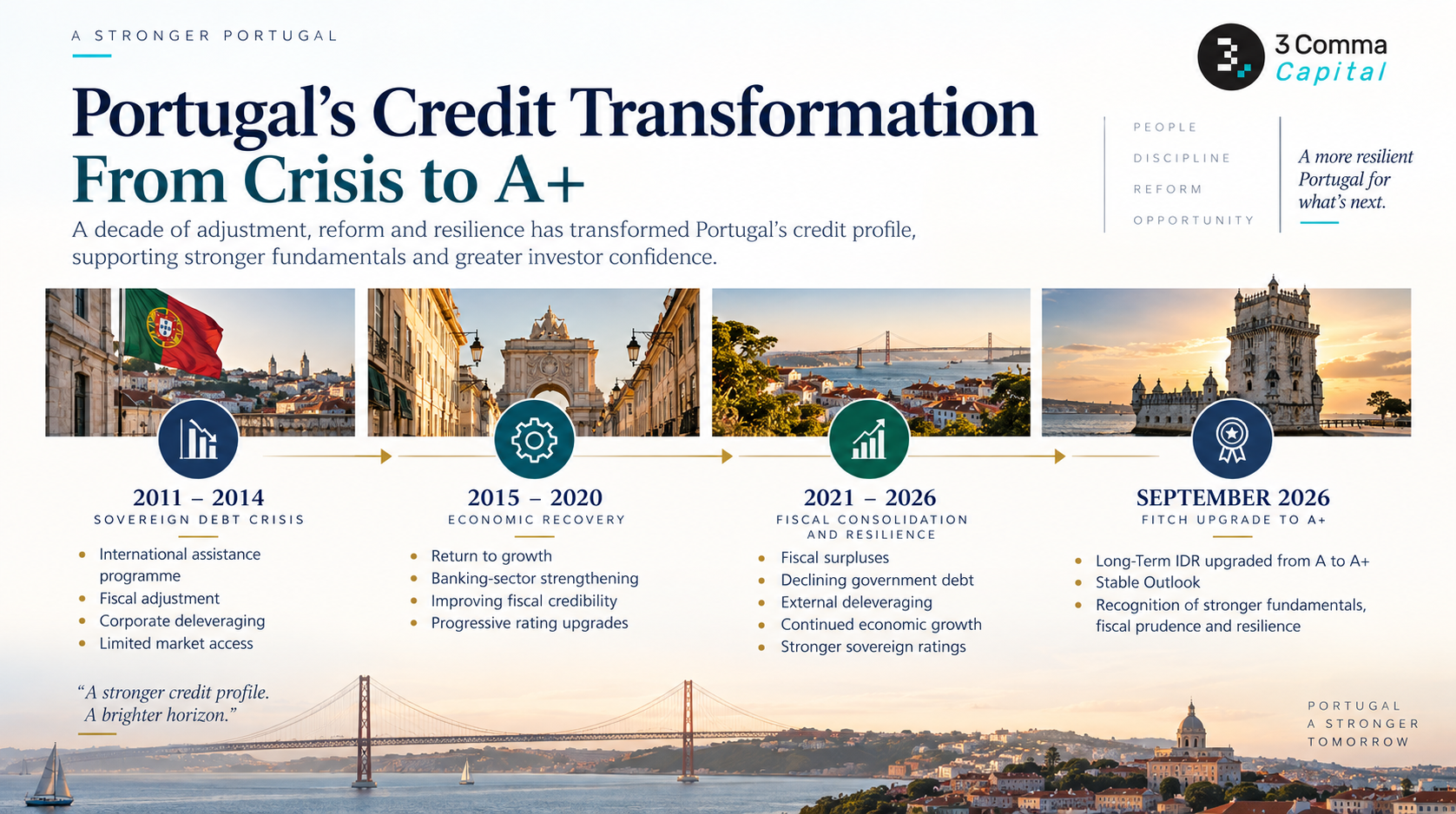
Portugal entered the European sovereign debt crisis with high indebtedness, weak economic growth, large external imbalances and limited access to financial markets. In 2011, the country requested a €78 billion financial assistance programme from the European Union and the International Monetary Fund.
What followed was a prolonged process of fiscal adjustment, private-sector deleveraging, banking-sector restructuring and economic reform. As we explored in our analysis of Portugal's credit transformation and the opportunity in Portuguese corporate bonds, the result is a credit market fundamentally different from the one international investors encountered during the sovereign debt crisis.
The Portugal of 2026 presents a very different credit profile. Fitch now highlights a record of repeated fiscal outperformance, persistent current-account surpluses, improving external indebtedness and political commitment to fiscal prudence. (This progression has been visible across rating agencies, building on a broader sequence of sovereign upgrades that we have followed in the Knowledge Hub)
Perhaps most importantly, these improvements have persisted across different governments. That institutional continuity matters to credit investors because sustainable sovereign credit improvement cannot depend on a single economic cycle or political administration.
Fitch explicitly recognises this, noting Portugal's record of relatively stable fiscal policy through changes of government.
Fitch expects general government debt to decline from 89.7% of GDP in 2025 to 87.0% in 2026, before falling further to 82.9% by 2028.
That trajectory is significant.
Portugal's debt burden remains considerably higher than the projected 59.5% median for A-rated sovereigns, meaning the country's fiscal transformation is not complete. However, the direction of travel has become an increasingly important part of the credit story. The structure of Portuguese debt also helps mitigate refinancing risk. Government liabilities are overwhelmingly denominated in euros and the large proportion of fixed-rate debt means that higher euro-area interest rates feed into the government's interest bill only gradually.
At the same time, the spread between Portuguese government bonds and German Bunds remains below 40 basis points. This is particularly striking when considered against Portugal's position during the sovereign debt crisis.
Financial markets no longer price Portuguese sovereign risk as an outlier within the euro area.
That represents a profound structural change.
Following a fiscal surplus of 0.7% of GDP in 2025, Fitch expects another surplus of approximately 0.1% in 2026.
That may appear modest in isolation but the comparison with other A-rated sovereigns tells a different story. Fitch expects the median A-rated country to run a deficit of approximately 3.0% of GDP.
Portugal is therefore entering the A+ category with fiscal balances considerably stronger than many of its rating peers. Fitch expects small deficits to return in 2027 and 2028, averaging approximately 0.4% of GDP, as tax reductions, higher interest expenditure and demographic pressures weigh on the budget. Yet even those deficits would remain significantly stronger than the peer-group median.
This matters because fiscal space is ultimately a form of resilience.
Countries entering an economic shock with healthier public finances generally have greater capacity to respond without materially destabilising their debt trajectory.
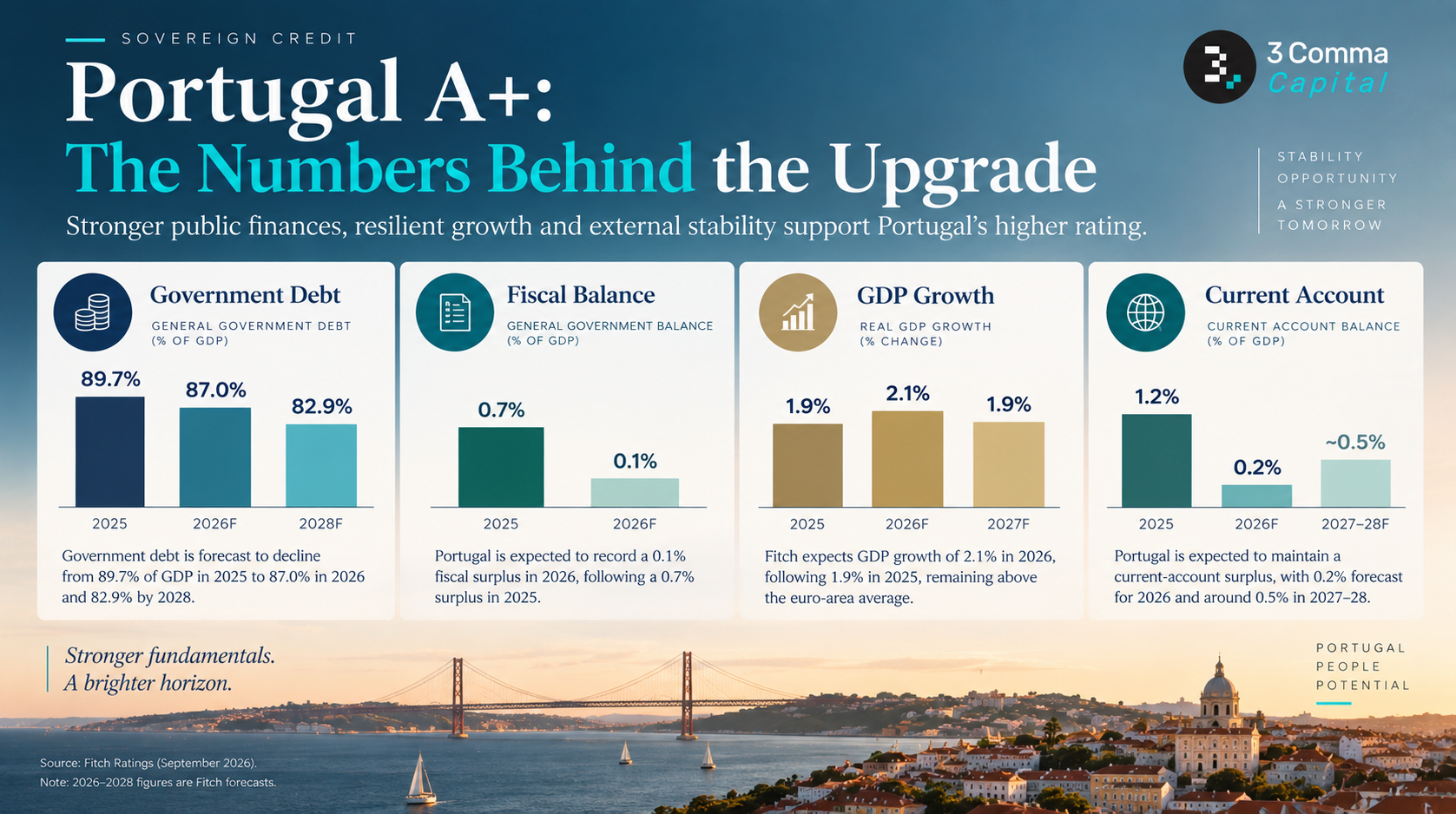
Fitch's A+ upgrade reflects a combination of declining government debt, strong fiscal balances, resilient economic growth and a continued external surplus. Forecast figures are based on Fitch Ratings estimates.
Fitch expects real GDP growth of 2.1% in 2026, following 1.9% in 2025, compared with a forecast 2.0% median among A-rated sovereigns. More importantly, Portugal has maintained a pattern of growth above the euro-area average since 2022.
Investment should be an important contributor in 2026 as absorption of Recovery and Resilience Plan funds accelerates, while private consumption remains supported by employment, real wage growth and household savings.
Fitch expects growth to moderate slightly to 1.9% in both 2027 and 2028 as PRR investment fades, partly offset by Portugal 2030 and other EU-funded investment.
The longer-term challenge remains productivity. Portugal still needs stronger productivity growth, investment and structural reforms if it is to achieve more meaningful convergence in GDP per capita with Europe's wealthier economies.
This is important because Fitch identifies precisely such convergence and stronger medium-term growth prospects as factors that could eventually support another rating upgrade.
Long-term government borrowing costs across several of the world's largest economies have risen to levels not seen for many years. In September 2026, Japan's 10-year government bond yield reached 3% for the first time since 1996, while German and French 10-year yields moved to their highest levels since 2011 and 2008 respectively. UK long-term government borrowing costs have reached levels last seen in the late 1990s, while long-dated US Treasury yields have also moved above 5%.
Several forces are contributing to this repricing.
Persistent inflation concerns, higher energy prices, large fiscal deficits, increased government bond issuance and reduced central-bank support have all pushed investors to demand greater compensation for holding long-duration debt. Fiscal sustainability has also become a more important differentiator between sovereign borrowers.
For governments, higher yields represent a challenge because they gradually increase debt-servicing costs.
For fixed-income investors, however, the same environment creates something that was largely absent during the ultra-low-rate era: meaningful starting income. (We explored this changing market regime in greater detail in Why Fixed Income Is Back: Income, Selectivity and the New Bond Market Regime)
This distinction is important.
A bond investor today can potentially earn materially higher income from high-quality sovereign and corporate credit than was available for much of the previous decade. Higher starting yields can also provide a larger income cushion against future price volatility.
This distinction between absolute yield and credit spread is important: Global interest rates can remain elevated while Portugal's credit spread relative to stronger European sovereigns compresses as the country's fundamentals improve.
For investors, these two forces can therefore coexist:
That combination helps explain why Portuguese fixed income deserves particular attention in the current environment, but it also reinforces the importance of active management. If sovereign and corporate spreads continue to tighten, existing securities may benefit from repricing, while new issues could eventually offer less incremental yield. Duration, issuer selection, credit quality and entry price therefore become increasingly important.

Higher starting yields can improve prospective income and provide a larger cushion against price volatility, although they may also reflect higher inflation, duration and fiscal risks.
That position has steadily improved.
Fitch expects Portugal to maintain a current-account surplus in 2026 despite higher energy import costs and strong domestic demand. After a surplus of 1.2% of GDP in 2025, the agency forecasts 0.2% in 2026, followed by approximately 0.5% in 2027 and 2028. Meanwhile, Portugal's net international investment position improved to -48.4% of GDP in the second quarter of 2026, while net external debt fell to 33.9% of GDP, according to the Banco de Portugal definition cited by Fitch.
Portugal still carries significant legacy external debt, but persistent current-account surpluses mean the country is gradually repairing that balance sheet. That improves its capacity to absorb external shocks and reduces one of the vulnerabilities that historically weighed on the sovereign rating.
A stronger sovereign can support corporate credit through several channels.
Finally, an improving sovereign rating can broaden the universe of institutional investors willing or able to hold Portuguese exposure. The relationship is not mechanical. A Portuguese company does not automatically become safer because the sovereign is upgraded, and corporate credit must always be analysed issuer by issuer.
Nevertheless, the backdrop matters. And Portugal's backdrop continues to improve.
Additional reading: Portuguese corporate bonds can offer an attractive combination of credit quality and income
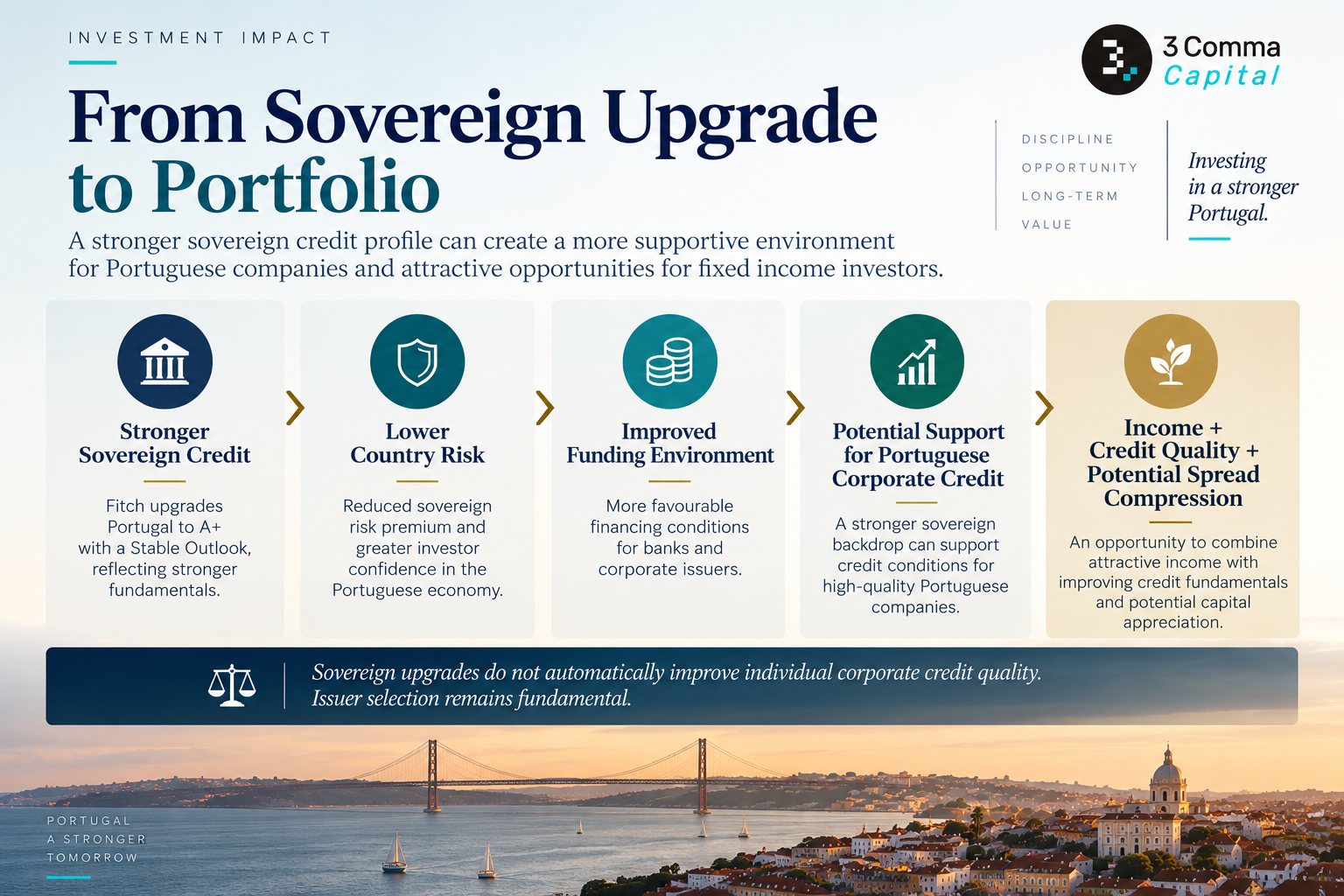
A stronger sovereign credit profile can create a more supportive environment for Portuguese corporate issuers, potentially combining attractive income with improving credit fundamentals and opportunities from spread compression. Issuer selection remains fundamental.
The upgrade does not change our investment philosophy. If anything, it reinforces it.
Our approach has been based on the view that Portuguese fixed income can offer an attractive combination of credit quality and income, particularly where smaller issue sizes and lower international coverage can create additional yield relative to comparable issuers in Europe's larger markets.
A stronger sovereign credit profile reinforces several aspects of that thesis.
This should not be assumed or guaranteed, but it is an important mechanism through which credit upgrades can benefit existing fixed-income portfolios.
As Portugal moves further into the A rating category, international recognition of the country's credit transformation may increase. For investors already familiar with Portuguese issuers, that creates an interesting dynamic: the market can retain some of the yield characteristics of a smaller credit market while increasingly benefiting from the fundamentals of a stronger sovereign.
That is precisely the type of asymmetry we seek to identify.
As investors perceive Portugal as safer, they may demand a smaller premium for holding Portuguese debt. Government yields can converge further toward those of stronger euro-area sovereigns, while corporate credit spreads may also tighten. Existing bonds can benefit from that repricing, but new bonds may eventually be issued at lower yields.
In other words, Portugal's credit transformation can gradually reduce some of the very yield premium that originally made the market attractive. For active portfolio managers, this reinforces the importance of security selection.
The opportunity is no longer simply "buy Portuguese bonds." It is identifying those issuers and securities where the yield still adequately compensates investors for duration, liquidity and credit risk.
Fitch identifies two worth special attention:
The agency does not currently consider this a material near-term macro-financial risk, pointing to structural supply constraints, tighter macroprudential lending standards and a sound banking sector. Nevertheless, affordability has become an increasingly important economic and social challenge.
Externally, Portugal remains exposed to weaker global demand, geopolitical tensions and energy-price shocks, and low productivity remains one of the principal constraints on long-term economic convergence.
Recognising these risks does not undermine Portugal's credit story. It makes the improvement more credible.
The agency identifies three broad possibilities:
This means the next chapter of Portugal's credit transformation will be more difficult than the last. Moving from crisis-era ratings toward A+ required balance-sheet repair and fiscal credibility.
Moving further will increasingly require productivity, investment and sustainable economic convergence.
That is a healthy transition.
The country still carries legacy vulnerabilities:
But the direction is difficult to ignore:
For investors, this matters because Portugal's investment proposition is evolving. The country is no longer interesting simply because Portuguese assets may offer a premium associated with a peripheral European economy.
Increasingly, the opportunity lies in something more compelling: accessing selected assets that can still offer attractive income within a sovereign credit environment whose underlying fundamentals have materially strengthened.
For 3 Comma Capital's fixed-income strategies, that combination remains particularly relevant. Portugal's credit transformation has already travelled a remarkable distance.
The upgrade from A to A+ suggests that international markets and rating agencies are increasingly recognising just how far.
For investors interested in how 3 Comma Capital approaches fixed-income investing in this environment, explore the Atlantic Bond Fund and the Portugal Golden Income Fund.
Fitch Ratings has upgraded Portugal’s Long-Term Issuer Default Rating from A to A+, with a Stable Outlook, citing stronger public finances, a sustained decline in government debt, fiscal balances considerably stronger than comparable sovereigns and a continued commitment to fiscal prudence.
The upgrade matters well beyond the Portuguese government bond market.
For investors, sovereign credit quality establishes an important reference point for the broader domestic financial system. A stronger sovereign can contribute to lower financing costs, greater investor confidence and a more supportive environment for Portuguese banks and corporate issuers.
For 3 Comma Capital, where Portuguese sovereign and corporate fixed income represents an important component of several investment strategies, the latest upgrade reinforces a thesis we have been discussing for some time:
Portugal's credit story has fundamentally changed.
Key Takeaways
- Fitch upgraded Portugal's sovereign rating from A to A+, with a Stable Outlook.
- Government debt is forecast to decline from 89.7% of GDP in 2025 to 87.0% in 2026 and 82.9% by 2028.
- Portugal is expected to record a 0.1% fiscal surplus in 2026, compared with a forecast 3.0% deficit for the median A-rated sovereign.
- Fitch expects GDP growth of 2.1% in 2026, following 1.9% in 2025, continuing Portugal's recent record of outperforming the euro area.
- The country's external position has continued to improve, supported by current-account surpluses and external deleveraging.
- Portuguese government bond spreads to German Bunds remain below 40 basis points, reflecting significantly improved perceptions of sovereign risk.
- A stronger sovereign credit profile can have positive implications for Portuguese banks and corporate issuers and therefore for portfolios with meaningful exposure to Portuguese fixed income.
From Sovereign Debt Crisis to A+
The significance of the upgrade becomes clearer when viewed over a longer horizon.Portugal entered the European sovereign debt crisis with high indebtedness, weak economic growth, large external imbalances and limited access to financial markets. In 2011, the country requested a €78 billion financial assistance programme from the European Union and the International Monetary Fund.
What followed was a prolonged process of fiscal adjustment, private-sector deleveraging, banking-sector restructuring and economic reform. As we explored in our analysis of Portugal's credit transformation and the opportunity in Portuguese corporate bonds, the result is a credit market fundamentally different from the one international investors encountered during the sovereign debt crisis.
The Portugal of 2026 presents a very different credit profile. Fitch now highlights a record of repeated fiscal outperformance, persistent current-account surpluses, improving external indebtedness and political commitment to fiscal prudence. (This progression has been visible across rating agencies, building on a broader sequence of sovereign upgrades that we have followed in the Knowledge Hub)
Perhaps most importantly, these improvements have persisted across different governments. That institutional continuity matters to credit investors because sustainable sovereign credit improvement cannot depend on a single economic cycle or political administration.
Fitch explicitly recognises this, noting Portugal's record of relatively stable fiscal policy through changes of government.
Public Debt Continues to Fall
One of the central reasons behind Fitch's decision is the continued improvement in Portugal's public finances.Fitch expects general government debt to decline from 89.7% of GDP in 2025 to 87.0% in 2026, before falling further to 82.9% by 2028.
That trajectory is significant.
Portugal's debt burden remains considerably higher than the projected 59.5% median for A-rated sovereigns, meaning the country's fiscal transformation is not complete. However, the direction of travel has become an increasingly important part of the credit story. The structure of Portuguese debt also helps mitigate refinancing risk. Government liabilities are overwhelmingly denominated in euros and the large proportion of fixed-rate debt means that higher euro-area interest rates feed into the government's interest bill only gradually.
At the same time, the spread between Portuguese government bonds and German Bunds remains below 40 basis points. This is particularly striking when considered against Portugal's position during the sovereign debt crisis.
Financial markets no longer price Portuguese sovereign risk as an outlier within the euro area.
That represents a profound structural change.
Fiscal Discipline Is Becoming a Structural Advantage
The upgrade is not based solely on falling debt. Fitch also emphasises Portugal's record of fiscal discipline.Following a fiscal surplus of 0.7% of GDP in 2025, Fitch expects another surplus of approximately 0.1% in 2026.
That may appear modest in isolation but the comparison with other A-rated sovereigns tells a different story. Fitch expects the median A-rated country to run a deficit of approximately 3.0% of GDP.
Portugal is therefore entering the A+ category with fiscal balances considerably stronger than many of its rating peers. Fitch expects small deficits to return in 2027 and 2028, averaging approximately 0.4% of GDP, as tax reductions, higher interest expenditure and demographic pressures weigh on the budget. Yet even those deficits would remain significantly stronger than the peer-group median.
This matters because fiscal space is ultimately a form of resilience.
Countries entering an economic shock with healthier public finances generally have greater capacity to respond without materially destabilising their debt trajectory.
Fitch's A+ upgrade reflects a combination of declining government debt, strong fiscal balances, resilient economic growth and a continued external surplus. Forecast figures are based on Fitch Ratings estimates.
Economic Growth Remains Resilient
Portugal's credit improvement has not occurred solely through austerity or fiscal consolidation. The economy has continued to expand.Fitch expects real GDP growth of 2.1% in 2026, following 1.9% in 2025, compared with a forecast 2.0% median among A-rated sovereigns. More importantly, Portugal has maintained a pattern of growth above the euro-area average since 2022.
Investment should be an important contributor in 2026 as absorption of Recovery and Resilience Plan funds accelerates, while private consumption remains supported by employment, real wage growth and household savings.
Fitch expects growth to moderate slightly to 1.9% in both 2027 and 2028 as PRR investment fades, partly offset by Portugal 2030 and other EU-funded investment.
The longer-term challenge remains productivity. Portugal still needs stronger productivity growth, investment and structural reforms if it is to achieve more meaningful convergence in GDP per capita with Europe's wealthier economies.
This is important because Fitch identifies precisely such convergence and stronger medium-term growth prospects as factors that could eventually support another rating upgrade.
Fixed Income Is Becoming Relevant Again
Portugal's upgrade also comes at an unusually important moment for global fixed-income markets. After more than a decade in which exceptionally low interest rates compressed yields across developed markets, the investment landscape has changed considerably.Long-term government borrowing costs across several of the world's largest economies have risen to levels not seen for many years. In September 2026, Japan's 10-year government bond yield reached 3% for the first time since 1996, while German and French 10-year yields moved to their highest levels since 2011 and 2008 respectively. UK long-term government borrowing costs have reached levels last seen in the late 1990s, while long-dated US Treasury yields have also moved above 5%.
Several forces are contributing to this repricing.
Persistent inflation concerns, higher energy prices, large fiscal deficits, increased government bond issuance and reduced central-bank support have all pushed investors to demand greater compensation for holding long-duration debt. Fiscal sustainability has also become a more important differentiator between sovereign borrowers.
For governments, higher yields represent a challenge because they gradually increase debt-servicing costs.
For fixed-income investors, however, the same environment creates something that was largely absent during the ultra-low-rate era: meaningful starting income. (We explored this changing market regime in greater detail in Why Fixed Income Is Back: Income, Selectivity and the New Bond Market Regime)
This distinction is important.
A bond investor today can potentially earn materially higher income from high-quality sovereign and corporate credit than was available for much of the previous decade. Higher starting yields can also provide a larger income cushion against future price volatility.
Portugal's Position Is Particularly Interesting
Against this global backdrop, Portugal presents an interesting combination: Portuguese yields have participated in the broader global repricing of fixed income, but the country's relative sovereign risk premium has remained remarkably contained. In September 2026, the Portuguese 10-year sovereign spread over Germany was approximately 37 basis points.This distinction between absolute yield and credit spread is important: Global interest rates can remain elevated while Portugal's credit spread relative to stronger European sovereigns compresses as the country's fundamentals improve.
For investors, these two forces can therefore coexist:
Higher global yields
⇒ potentially more attractive starting incomeImproving Portuguese credit quality
⇒ potentially lower relative risk premiumThat combination helps explain why Portuguese fixed income deserves particular attention in the current environment, but it also reinforces the importance of active management. If sovereign and corporate spreads continue to tighten, existing securities may benefit from repricing, while new issues could eventually offer less incremental yield. Duration, issuer selection, credit quality and entry price therefore become increasingly important.
Higher starting yields can improve prospective income and provide a larger cushion against price volatility, although they may also reflect higher inflation, duration and fiscal risks.
Portugal's External Balance Sheet Is Also Improving
One of the less visible parts of Portugal's transformation has occurred externally. During the sovereign debt crisis, Portugal's high external indebtedness represented an important vulnerability.That position has steadily improved.
Fitch expects Portugal to maintain a current-account surplus in 2026 despite higher energy import costs and strong domestic demand. After a surplus of 1.2% of GDP in 2025, the agency forecasts 0.2% in 2026, followed by approximately 0.5% in 2027 and 2028. Meanwhile, Portugal's net international investment position improved to -48.4% of GDP in the second quarter of 2026, while net external debt fell to 33.9% of GDP, according to the Banco de Portugal definition cited by Fitch.
Portugal still carries significant legacy external debt, but persistent current-account surpluses mean the country is gradually repairing that balance sheet. That improves its capacity to absorb external shocks and reduces one of the vulnerabilities that historically weighed on the sovereign rating.
Why a Sovereign Upgrade Matters for Portuguese Corporate Bonds
This is where the Fitch decision becomes particularly relevant for investors. A sovereign rating is not simply an assessment of the government's ability to repay its debt. It also influences the financial ecosystem in which domestic companies operate.A stronger sovereign can support corporate credit through several channels.
- First, it can reduce the perceived country-risk premium demanded by international investors.
- Second, it can improve funding conditions for banks, which can subsequently influence financing conditions throughout the economy.
- Third, Portuguese companies issuing bonds internationally are assessed partly within the broader institutional, economic and financial environment of their home country.
Finally, an improving sovereign rating can broaden the universe of institutional investors willing or able to hold Portuguese exposure. The relationship is not mechanical. A Portuguese company does not automatically become safer because the sovereign is upgraded, and corporate credit must always be analysed issuer by issuer.
Nevertheless, the backdrop matters. And Portugal's backdrop continues to improve.
Additional reading: Portuguese corporate bonds can offer an attractive combination of credit quality and income
A stronger sovereign credit profile can create a more supportive environment for Portuguese corporate issuers, potentially combining attractive income with improving credit fundamentals and opportunities from spread compression. Issuer selection remains fundamental.
What This Means for 3 Comma Capital's Portfolios
The Fitch upgrade is particularly relevant to 3 Comma Capital because Portuguese fixed income represents an important component of our investment universe. Both the Portugal Golden Income Fund and the Atlantic Bond Fund maintain substantial exposure to Portuguese corporate bonds, with the objective of combining recurring income with capital preservation and portfolio stability.The upgrade does not change our investment philosophy. If anything, it reinforces it.
Our approach has been based on the view that Portuguese fixed income can offer an attractive combination of credit quality and income, particularly where smaller issue sizes and lower international coverage can create additional yield relative to comparable issuers in Europe's larger markets.
A stronger sovereign credit profile reinforces several aspects of that thesis.
1. A stronger macroeconomic foundation
Portuguese companies operate within an economy characterised by improving public finances, resilient employment, continued economic growth and declining sovereign indebtedness. That does not eliminate corporate risk, but it creates a healthier environment in which businesses can operate.2. Potential support for corporate funding conditions
As sovereign risk declines, the risk premium attached to the jurisdiction can also compress. For high-quality Portuguese issuers, particularly banks, utilities and infrastructure-related companies, this can support access to capital markets and refinancing conditions.3. Potential valuation benefits for existing bonds
Falling required credit spreads can increase the market value of existing fixed-rate bonds. If Portuguese sovereign and corporate spreads continue to compress as the country's credit profile improves, existing bondholders can potentially benefit from capital appreciation in addition to coupon income.This should not be assumed or guaranteed, but it is an important mechanism through which credit upgrades can benefit existing fixed-income portfolios.
4. Greater international recognition
Portugal remains a relatively small fixed-income market. That has historically contributed to lower analyst coverage and, in some cases, a liquidity premium.As Portugal moves further into the A rating category, international recognition of the country's credit transformation may increase. For investors already familiar with Portuguese issuers, that creates an interesting dynamic: the market can retain some of the yield characteristics of a smaller credit market while increasingly benefiting from the fundamentals of a stronger sovereign.
That is precisely the type of asymmetry we seek to identify.
The Other Side of the Story: Success Can Compress Future Returns
There is also an important nuance for fixed-income investors. Credit improvement is positive for existing bondholders, but it can eventually make new investments less attractive.As investors perceive Portugal as safer, they may demand a smaller premium for holding Portuguese debt. Government yields can converge further toward those of stronger euro-area sovereigns, while corporate credit spreads may also tighten. Existing bonds can benefit from that repricing, but new bonds may eventually be issued at lower yields.
In other words, Portugal's credit transformation can gradually reduce some of the very yield premium that originally made the market attractive. For active portfolio managers, this reinforces the importance of security selection.
The opportunity is no longer simply "buy Portuguese bonds." It is identifying those issuers and securities where the yield still adequately compensates investors for duration, liquidity and credit risk.
Risks Have Not Disappeared
An A+ rating does not mean Portugal is without vulnerabilities.Fitch identifies two worth special attention:
- Public debt remains high relative to rating peers. Population ageing will increase expenditure pressures. Lower net migration could weigh on social-security contributions. Defence commitments will create additional medium-term fiscal demands.
- Portugal's housing market also deserves attention. Residential property prices in the first quarter of 2026 were approximately 99% above their Q4 2019 level, compared with just 31% across the euro area.
The agency does not currently consider this a material near-term macro-financial risk, pointing to structural supply constraints, tighter macroprudential lending standards and a sound banking sector. Nevertheless, affordability has become an increasingly important economic and social challenge.
Externally, Portugal remains exposed to weaker global demand, geopolitical tensions and energy-price shocks, and low productivity remains one of the principal constraints on long-term economic convergence.
Recognising these risks does not undermine Portugal's credit story. It makes the improvement more credible.
What Could Take Portugal Even Higher?
Perhaps one of the most interesting elements of Fitch's assessment is what would be required for another upgrade.The agency identifies three broad possibilities:
- Further debt reduction: Government debt would need to move materially closer to the peer-group median while fiscal prudence is maintained.
- Greater structural convergence: Portugal would need to close more of the gap in GDP per capita and governance indicators relative to higher-rated economies.
- Improved medium-term growth prospects: Structural reforms and productive deployment of European funds could raise potential growth.
This means the next chapter of Portugal's credit transformation will be more difficult than the last. Moving from crisis-era ratings toward A+ required balance-sheet repair and fiscal credibility.
Moving further will increasingly require productivity, investment and sustainable economic convergence.
That is a healthy transition.
From Recovery to Credibility
Portugal's upgrade to A+ is another milestone in a transformation that has taken more than a decade.The country still carries legacy vulnerabilities:
- Public debt remains elevated.
- Productivity needs to improve.
- Demographic pressures are real.
But the direction is difficult to ignore:
- Debt is falling.
- Fiscal balances compare favourably with rating peers.
- External indebtedness is declining.
- The economy continues to grow.
- Institutions remain strong.
- And international credit markets increasingly recognise the difference.
For investors, this matters because Portugal's investment proposition is evolving. The country is no longer interesting simply because Portuguese assets may offer a premium associated with a peripheral European economy.
Increasingly, the opportunity lies in something more compelling: accessing selected assets that can still offer attractive income within a sovereign credit environment whose underlying fundamentals have materially strengthened.
For 3 Comma Capital's fixed-income strategies, that combination remains particularly relevant. Portugal's credit transformation has already travelled a remarkable distance.
The upgrade from A to A+ suggests that international markets and rating agencies are increasingly recognising just how far.
For investors interested in how 3 Comma Capital approaches fixed-income investing in this environment, explore the Atlantic Bond Fund and the Portugal Golden Income Fund.
 |
Investments Principal
|
With more than 20 years of experience in financial markets, Duarte specialized in the energy area in the last decade, where he had the opportunity to work with the main European Power and Gas institutions at CIMD Group. Previously, he worked as Market Strategist at IG Markets Iberia.
More about Duarte Caldas


