Golden Visa
Why Global Families Are Diversifying More Than Their Portfolios

For decades, wealth management focused primarily on one question:
How should capital be allocated?
Investors built portfolios across equities, bonds, real estate, private markets and alternative assets, seeking to balance growth, income and risk. Today, another question is becoming equally important:
Where should wealth be held, managed and ultimately accessed?
As families, businesses and investments become more international, diversification is expanding beyond asset classes. Increasingly, globally mobile investors are also diversifying their residencies, banking relationships, custody arrangements, legal structures and exposure to individual jurisdictions.
This shift reflects a world in which wealth is more mobile, but the geopolitical, regulatory and fiscal environment is less predictable. This development can be described as a transition towards multijurisdictional family life, with relatives, homes, business interests and financial assets increasingly spread across borders. Research argues that successful cross-border wealth planning now requires greater agility, resilience and coordination.
For investors, the implication is significant.
Modern diversification is no longer only about what you own. It is also about where you live, where your assets are legally held and whether you can continue accessing them under changing circumstances.
► Why Portugal has become an increasingly attractive destination for international investors
What has changed is the scale and accessibility of that movement.
Digital banking, international investment platforms, improved connectivity and a broader range of residency programmes have made it easier for families to establish genuine links with multiple jurisdictions. At the same time, economic and geopolitical fragmentation has created new reasons to do so.
Trade tensions, armed conflict, abrupt regulatory changes, capital controls and shifting tax policies have increased the value of geographic optionality. Families are increasingly seeking the ability to move not only capital, but also people, businesses and decision-making structures.
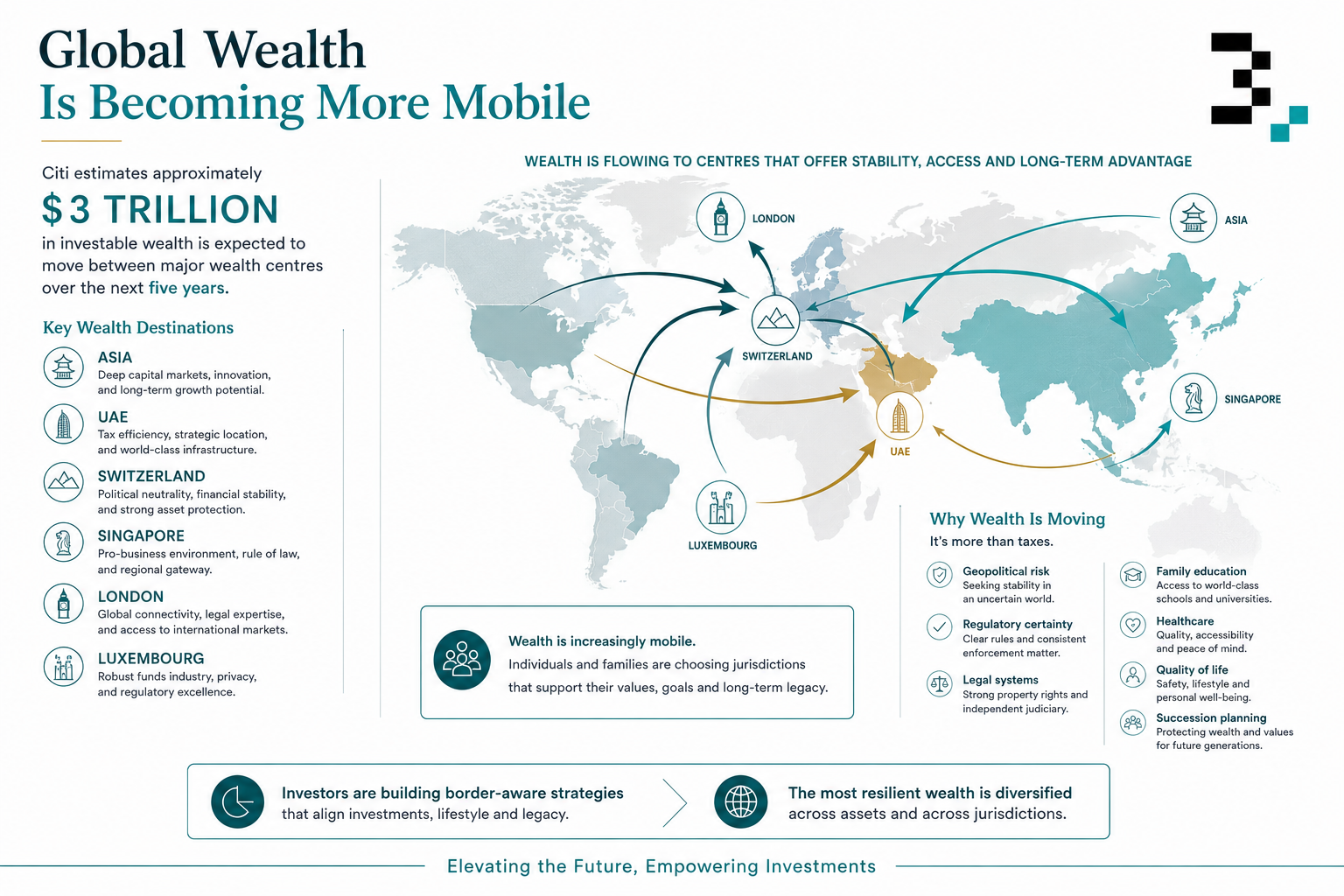
Drawing on BCG estimates, research suggests that several trillion dollars could move towards leading international financial centers between 2025 and 2029. Hong Kong and Singapore are expected to receive a substantial portion of these flows, while Switzerland, the UAE and the United States remain important destinations for internationally held wealth.
More recent BCG research estimates that cross-border wealth reached $15.6 trillion in 2025, with the ten largest booking centers receiving more than 90% of new flows. Hong Kong narrowly overtook Switzerland as the largest cross-border booking centre, highlighting the growing importance of Asian wealth hubs. [BCG 2026 Global Wealth Report]
We can identify three closely related motivations:
Security, political stability and strong property rights can be decisive for those living in jurisdictions exposed to crime, civil unrest, expropriation or arbitrary government action. Education and healthcare are equally important.
Families may seek proximity to leading universities, international schools, specialist medical facilities and environments where multiple generations can live comfortably.
Lifestyle then completes the picture.
Climate, cultural activity, access to nature, international connectivity and a different pace of life can all influence the decision to establish an additional residence. This helps explain why countries such as Portugal, Italy, Switzerland and the UAE can attract wealthy families for very different reasons. One offers relaxed European living and EU access. Another provides international business connectivity. Others compete through institutional strength, privacy, education or healthcare.
The strongest destination is therefore not always the jurisdiction with the lowest tax rate. It is often the one that provides the best overall balance for the family.
For entrepreneurs, establishing a presence in the United States, Singapore, London or Dubai may provide access to deeper markets and international networks.
For investors, local presence can open opportunities that may be difficult to access remotely, particularly in private markets, real estate and regulated investment structures.
Families are also increasingly establishing or expanding family offices across multiple financial centers. A strategically located office can provide local expertise, financing access, investment sourcing and support for relatives living in different countries.
A globally diversified portfolio may still be vulnerable if most assets are ultimately registered, custodied or governed within one jurisdiction. Sudden policy changes, capital restrictions, political instability or weakening legal protections can affect the accessibility and ownership of otherwise diversified investments.
This is why asset location is receiving greater attention.
But global families are increasingly considering a second dimension: Asset location.
Asset location refers to the jurisdictions in which assets are legally registered, held in custody, administered or governed.
The distinction matters.
A portfolio may contain hundreds of securities from around the world while still relying on:
A jurisdiction may change its tax treatment, tighten reporting rules, impose restrictions on transfers or weaken legal protections. In extreme cases, political crises or capital controls can affect whether owners are able to move or access their assets. Strategic asset location is therefore not necessarily about secrecy or avoiding transparency.
Most major financial centers participate in international information-sharing arrangements such as the Common Reporting Standard. The objective is instead to operate through transparent, compliant structures in jurisdictions offering strong property rights, legal certainty and institutional stability.
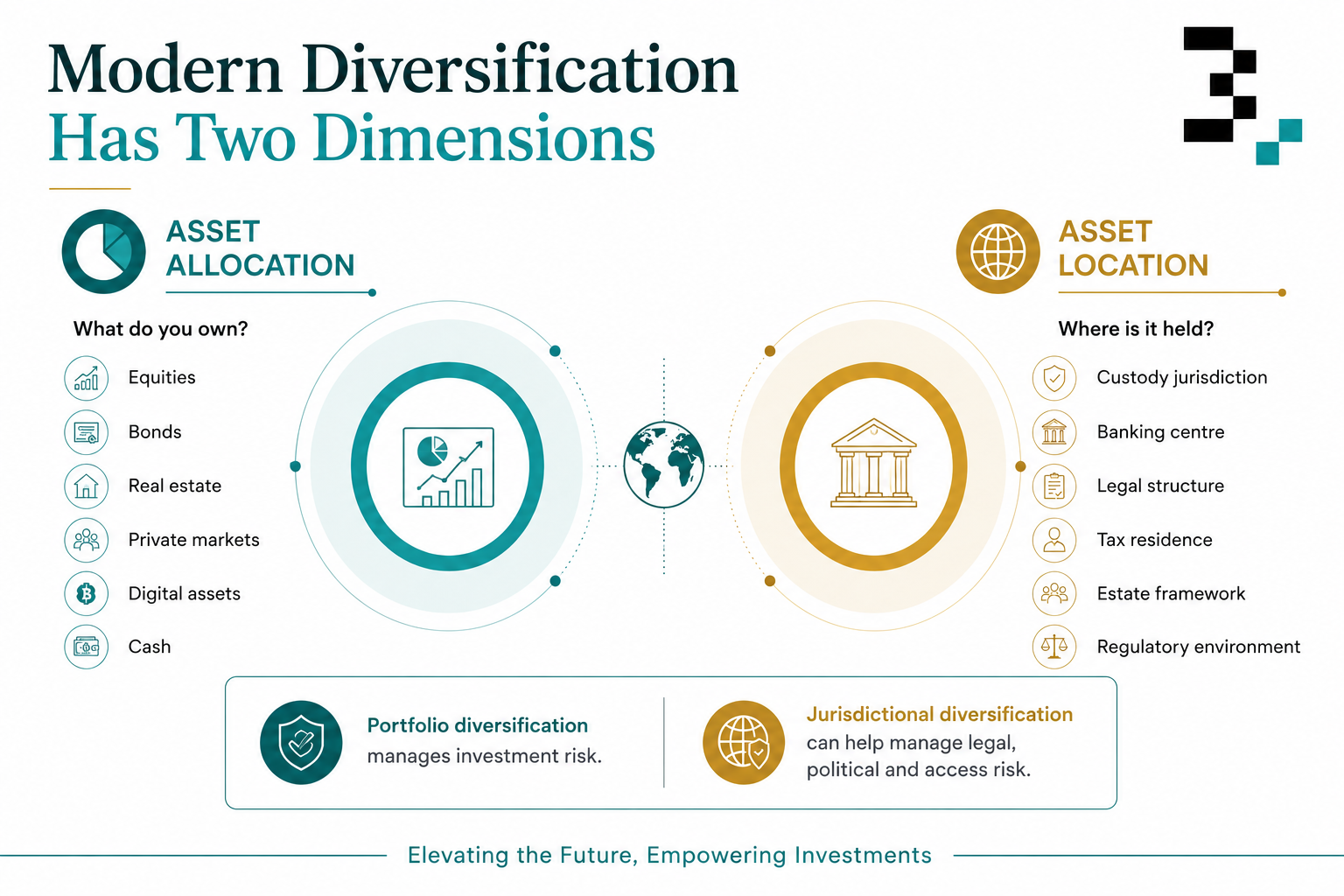
Portfolio diversification manages investment risk. Jurisdictional diversification can help manage legal, political and access risk.
Additional residency rights can give a family the ability to relocate if circumstances change. They can also provide access to education, healthcare, business opportunities and a more stable legal environment.
The decision does not necessarily imply abandoning one's home country.
Many globally mobile families retain their original residences and business interests while adding carefully selected connections elsewhere. This approach is closer to diversification than emigration.
The additional jurisdiction functions as:
Investment migration programmes have become one mechanism for creating this optionality. Henley & Partners reported record demand during 2025 and noted that nine of the ten countries expected to receive the largest net inflows of millionaires operated structured investment migration programmes.
However, migration estimates of this type should be treated as directional rather than precise. The methodology behind some widely cited millionaire-migration figures has been questioned, reinforcing the importance of using them as evidence of a broad trend rather than definitive population statistics. (Financial Times)
► Investors considering European residency can explore our detailed comparison of the main programmes in [Portugal vs Greece, Malta, Hungary and Italy: Which Golden Visa Is Best in 2026?]
Its strength lies in combining several characteristics that globally mobile families increasingly value:
► Explore why Portugal continues to attract international investors: Why Hollywood and High Net Worth Americans Are Quietly Choosing Portugal
Portugal was projected to receive a net inflow of approximately 1,400 migrating millionaires in 2025, representing around $8.1 billion of investable wealth, according to Henley and New World Wealth's estimates. The same research identified Portugal as one of Southern Europe's increasingly important wealth destinations.
These estimates are not official migration statistics, but they reinforce a visible trend: Portugal is increasingly considered by international entrepreneurs, retirees, investors and families seeking a European base.
► Read our complete guide to the Portugal Golden Visa.
This can be particularly relevant for families that:
The residency decision and the investment decision should nevertheless be evaluated separately. An investment should not be selected only because it qualifies for an immigration programme. Investors should assess its strategy, underlying assets, risks, liquidity, governance, custody and expected investment horizon.
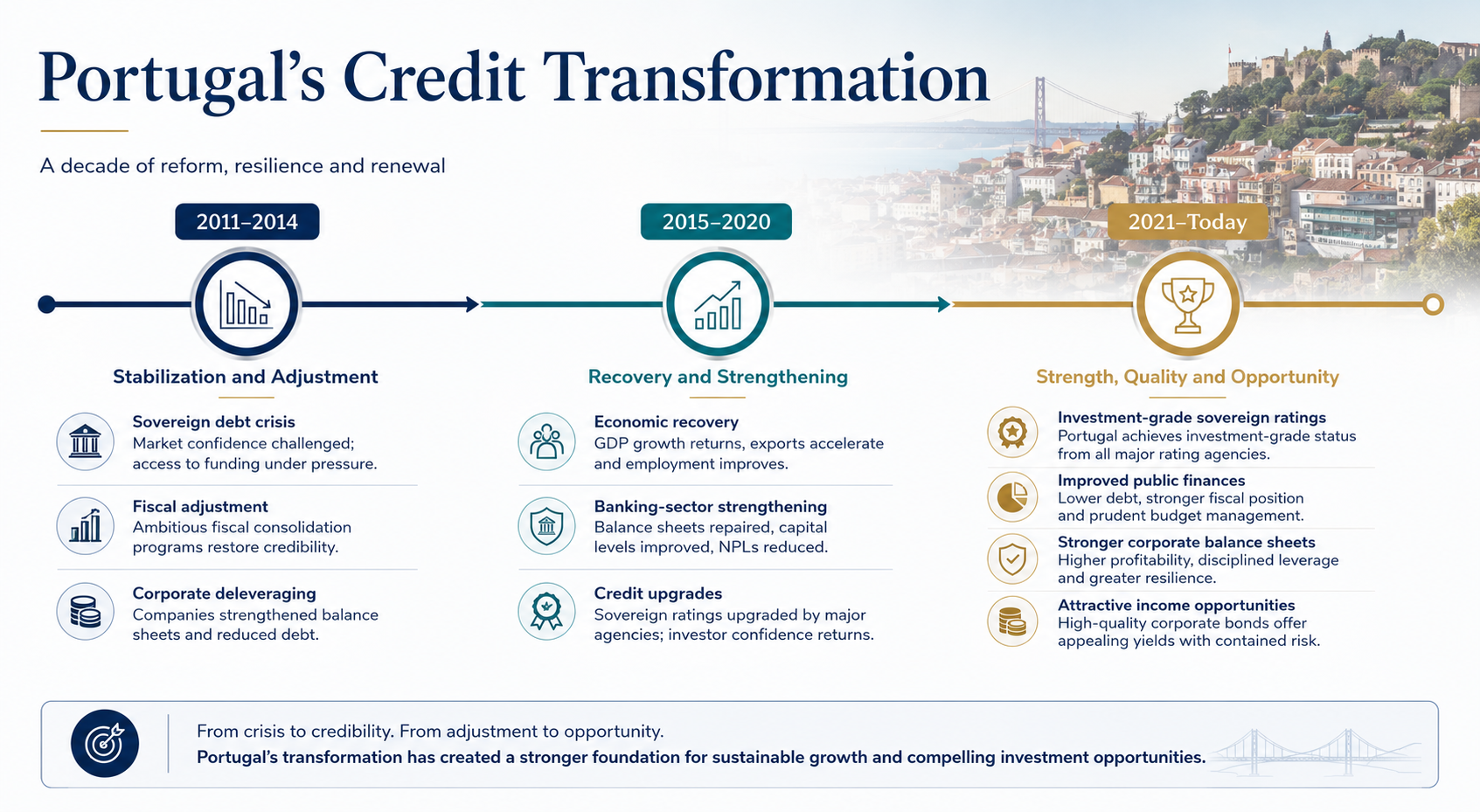
► Learn more about the country's economic fundamentals in our [Snapshot of the Portuguese Economy: Mid-Year 2026 Update].
Similarly, obtaining a second residence does not by itself resolve international tax or estate-planning questions.
Before moving, families may need to consider:
These questions are particularly important for American citizens, who generally remain subject to U.S. taxation and reporting regardless of where they reside.
Portugal's previous NHR regime closed to most new applicants, while the narrower IFICI framework, frequently called NHR 2.0, is targeted at specific qualifying professional and economic activities.
It may be attractive for certain applicants, but it should not be treated as a universal tax incentive for everyone moving to Portugal.
► Learn more about Portugal's IFICI tax regime.
3 Comma Capital is an asset manager and does not provide immigration, legal or tax advice. Individuals should obtain independent professional advice based on their personal circumstances.
Dubai may serve business and Middle Eastern interests.
Singapore or Hong Kong can provide access to Asian opportunities.
The United States remains important for capital markets, technology and private investment.
These offices do not necessarily duplicate one another. Each may perform a specialized role within the family's global structure. Several jurisdictions actively encourage this activity.
Singapore offers tax incentive frameworks for qualifying single-family offices, while Hong Kong and Dubai have developed regimes intended to attract family investment structures and local employment. Research also highlights Luxembourg, Switzerland, Jersey, London and the United States as established wealth centers with different legal, financial and strategic advantages.
Portugal is unlikely to replace those centers as a primary global custody or family-office jurisdiction. Its more natural role may be as a European residence, lifestyle and investment base within a broader international architecture. That distinction strengthens rather than weakens the Portuguese proposition.
Global planning is rarely about finding one jurisdiction that performs every function. It is about choosing complementary locations for complementary objectives.
This depends partly on the strength of the institution holding the assets, but also on the jurisdiction's:
This does not mean that assets should simply be scattered among as many countries as possible. Excessive complexity creates its own risks, including higher costs, inconsistent governance, reporting failures and fragmented investment oversight.
The goal should be intentional diversification, supported by coordinated legal, tax, banking and investment advice.
From an investment perspective, three principles stand out.
First, residency capital should still be treated as investment capital. The assets should be selected according to risk tolerance, time horizon, liquidity needs and financial objectives.
Second, diversification should be genuine. Owning several investments that ultimately depend on the same issuer, industry, geography or economic factor may provide less protection than it appears.
Third, the structure should remain understandable. Complexity can sometimes be necessary, but every account, entity and investment should have a clear purpose within the family's wider plan.
For investors considering Portugal's fund-based Golden Visa route, 3 Comma Capital manages strategies designed for different profiles.
► U.S. investors considering the use of retirement assets can also read our guide to [using a Self-Directed IRA for a Portugal Golden Visa investment].
It means that jurisdictional concentration should be recognized as a risk alongside market, credit, currency and liquidity risk.
For globally mobile families, resilience may come from combining:
In modern wealth management, optionality is becoming an asset in its own right.
Portugal can play a valuable role in that architecture by offering European residency, lifestyle appeal and access to regulated investment funds. The strongest strategy, however, is not built around one jurisdiction. It is built through coordinated, transparent and purposeful diversification.
How should capital be allocated?
Investors built portfolios across equities, bonds, real estate, private markets and alternative assets, seeking to balance growth, income and risk. Today, another question is becoming equally important:
Where should wealth be held, managed and ultimately accessed?
As families, businesses and investments become more international, diversification is expanding beyond asset classes. Increasingly, globally mobile investors are also diversifying their residencies, banking relationships, custody arrangements, legal structures and exposure to individual jurisdictions.
This shift reflects a world in which wealth is more mobile, but the geopolitical, regulatory and fiscal environment is less predictable. This development can be described as a transition towards multijurisdictional family life, with relatives, homes, business interests and financial assets increasingly spread across borders. Research argues that successful cross-border wealth planning now requires greater agility, resilience and coordination.
For investors, the implication is significant.
Modern diversification is no longer only about what you own. It is also about where you live, where your assets are legally held and whether you can continue accessing them under changing circumstances.
► Why Portugal has become an increasingly attractive destination for international investors
Key Takeaways
- Global wealth is becoming increasingly mobile, as families expand their personal, business and investment interests across multiple jurisdictions.
- Asset allocation alone may no longer provide sufficient resilience in a world of geopolitical fragmentation, regulatory change and sovereign risk.
- Asset location is becoming an important part of wealth planning, covering where investments are registered, custodied and administered.
- Second residencies are increasingly viewed as strategic options, providing flexibility for families rather than simply lifestyle benefits.
- Safety, education, healthcare, business access and legal certainty often matter as much as taxation.
- Portugal is emerging as an important European destination for globally mobile wealth, combining lifestyle, EU access and an investment-based residency route.
- Cross-border planning introduces significant complexity, particularly in taxation, succession, governance and reporting.
- The objective is not to find one perfect jurisdiction, but to build a coordinated international structure across complementary locations.
Global Wealth Is Becoming More Mobile
The movement of wealthy individuals and their capital is not new. For generations, merchants, entrepreneurs, industrial families and investors have established interests outside their countries of origin in search of opportunity, security and diversification.What has changed is the scale and accessibility of that movement.
Digital banking, international investment platforms, improved connectivity and a broader range of residency programmes have made it easier for families to establish genuine links with multiple jurisdictions. At the same time, economic and geopolitical fragmentation has created new reasons to do so.
Trade tensions, armed conflict, abrupt regulatory changes, capital controls and shifting tax policies have increased the value of geographic optionality. Families are increasingly seeking the ability to move not only capital, but also people, businesses and decision-making structures.
Drawing on BCG estimates, research suggests that several trillion dollars could move towards leading international financial centers between 2025 and 2029. Hong Kong and Singapore are expected to receive a substantial portion of these flows, while Switzerland, the UAE and the United States remain important destinations for internationally held wealth.
More recent BCG research estimates that cross-border wealth reached $15.6 trillion in 2025, with the ten largest booking centers receiving more than 90% of new flows. Hong Kong narrowly overtook Switzerland as the largest cross-border booking centre, highlighting the growing importance of Asian wealth hubs. [BCG 2026 Global Wealth Report]
The Three Forces Driving Global Wealth Mobility
Although taxation frequently dominates public discussion, it is rarely the only factor behind international relocation.We can identify three closely related motivations:
- improving family life;
- expanding businesses and investment opportunities;
- increasing the resilience of family wealth.
Enhancing Family Life
For many families, the first priority is not investment return. It is quality of life.Security, political stability and strong property rights can be decisive for those living in jurisdictions exposed to crime, civil unrest, expropriation or arbitrary government action. Education and healthcare are equally important.
Families may seek proximity to leading universities, international schools, specialist medical facilities and environments where multiple generations can live comfortably.
Lifestyle then completes the picture.
Climate, cultural activity, access to nature, international connectivity and a different pace of life can all influence the decision to establish an additional residence. This helps explain why countries such as Portugal, Italy, Switzerland and the UAE can attract wealthy families for very different reasons. One offers relaxed European living and EU access. Another provides international business connectivity. Others compete through institutional strength, privacy, education or healthcare.
The strongest destination is therefore not always the jurisdiction with the lowest tax rate. It is often the one that provides the best overall balance for the family.
Seeking Business and Portfolio Growth
International expansion can also unlock access to customers, capital, investment opportunities and specialist talent.For entrepreneurs, establishing a presence in the United States, Singapore, London or Dubai may provide access to deeper markets and international networks.
For investors, local presence can open opportunities that may be difficult to access remotely, particularly in private markets, real estate and regulated investment structures.
Families are also increasingly establishing or expanding family offices across multiple financial centers. A strategically located office can provide local expertise, financing access, investment sourcing and support for relatives living in different countries.
Making Wealth More Resilient
The third motivation is more defensive.A globally diversified portfolio may still be vulnerable if most assets are ultimately registered, custodied or governed within one jurisdiction. Sudden policy changes, capital restrictions, political instability or weakening legal protections can affect the accessibility and ownership of otherwise diversified investments.
This is why asset location is receiving greater attention.
Asset Allocation Is Only Half of the Question
Traditional wealth management focuses on asset allocation. This determines how much capital is invested in equities, fixed income, real estate, private equity, cash or other assets.But global families are increasingly considering a second dimension: Asset location.
Asset location refers to the jurisdictions in which assets are legally registered, held in custody, administered or governed.
The distinction matters.
A portfolio may contain hundreds of securities from around the world while still relying on:
- one custodian;
- one banking system;
- one legal jurisdiction;
- one currency;
- or one set of government policies.
A jurisdiction may change its tax treatment, tighten reporting rules, impose restrictions on transfers or weaken legal protections. In extreme cases, political crises or capital controls can affect whether owners are able to move or access their assets. Strategic asset location is therefore not necessarily about secrecy or avoiding transparency.
Most major financial centers participate in international information-sharing arrangements such as the Common Reporting Standard. The objective is instead to operate through transparent, compliant structures in jurisdictions offering strong property rights, legal certainty and institutional stability.
Modern Diversification Has Two Dimensions
Portfolio diversification manages investment risk. Jurisdictional diversification can help manage legal, political and access risk.
Second Residency as a Strategic Asset
A second residency is often marketed around travel, lifestyle or tax planning. Those benefits may be relevant, but the broader strategic value is optionality.Additional residency rights can give a family the ability to relocate if circumstances change. They can also provide access to education, healthcare, business opportunities and a more stable legal environment.
The decision does not necessarily imply abandoning one's home country.
Many globally mobile families retain their original residences and business interests while adding carefully selected connections elsewhere. This approach is closer to diversification than emigration.
The additional jurisdiction functions as:
- a potential future home;
- an educational base for children;
- a location for business expansion;
- a contingency plan;
- or part of a broader succession strategy.
Investment migration programmes have become one mechanism for creating this optionality. Henley & Partners reported record demand during 2025 and noted that nine of the ten countries expected to receive the largest net inflows of millionaires operated structured investment migration programmes.
However, migration estimates of this type should be treated as directional rather than precise. The methodology behind some widely cited millionaire-migration figures has been questioned, reinforcing the importance of using them as evidence of a broad trend rather than definitive population statistics. (Financial Times)
► Investors considering European residency can explore our detailed comparison of the main programmes in [Portugal vs Greece, Malta, Hungary and Italy: Which Golden Visa Is Best in 2026?]
Why Portugal Fits the Global Wealth Mobility Trend
Portugal occupies an interesting position within this changing landscape. It is not a global booking centre on the scale of Switzerland, Singapore or Hong Kong. Nor does it compete with Dubai primarily on taxation or corporate connectivity.Its strength lies in combining several characteristics that globally mobile families increasingly value:
- political and institutional stability;
- EU and Schengen membership;
- a favorable climate and high quality of life;
- international education and healthcare;
- strong connectivity with Europe, Africa and the Americas;
- a comparatively secure environment;
- and a residency-by-investment programme with low physical-presence requirements.
► Explore why Portugal continues to attract international investors: Why Hollywood and High Net Worth Americans Are Quietly Choosing Portugal
Portugal was projected to receive a net inflow of approximately 1,400 migrating millionaires in 2025, representing around $8.1 billion of investable wealth, according to Henley and New World Wealth's estimates. The same research identified Portugal as one of Southern Europe's increasingly important wealth destinations.
These estimates are not official migration statistics, but they reinforce a visible trend: Portugal is increasingly considered by international entrepreneurs, retirees, investors and families seeking a European base.
The Golden Visa Fund Route
Portugal's Golden Visa has evolved away from real estate and towards investments intended to direct capital into the productive economy. One of the main routes involves investing at least €500,000 in qualifying Portuguese investment funds, subject to all applicable programme conditions.► Read our complete guide to the Portugal Golden Visa.
This can be particularly relevant for families that:
- want European residency without relocating immediately;
- prefer a regulated financial investment to direct property ownership;
- already have substantial real-estate exposure;
- want professional portfolio management;
- or seek an investment strategy aligned with their risk profile.
The residency decision and the investment decision should nevertheless be evaluated separately. An investment should not be selected only because it qualifies for an immigration programme. Investors should assess its strategy, underlying assets, risks, liquidity, governance, custody and expected investment horizon.
► Learn more about the country's economic fundamentals in our [Snapshot of the Portuguese Economy: Mid-Year 2026 Update].
Tax Residence and Investment Residence Are Not the Same
Residency planning is frequently discussed alongside taxation, but the two should not be confused. Holding a residence permit does not automatically mean becoming tax resident in that jurisdiction. Tax residence generally depends on factors such as physical presence, accommodation, family connections and the location of personal or economic interests.Similarly, obtaining a second residence does not by itself resolve international tax or estate-planning questions.
Before moving, families may need to consider:
- exit taxes in the original jurisdiction;
- taxation of worldwide income;
- controlled foreign company rules;
- inheritance and gift taxes;
- trust or foundation treatment;
- pension taxation;
- reporting obligations;
- and the interaction of different succession regimes.
These questions are particularly important for American citizens, who generally remain subject to U.S. taxation and reporting regardless of where they reside.
Portugal's previous NHR regime closed to most new applicants, while the narrower IFICI framework, frequently called NHR 2.0, is targeted at specific qualifying professional and economic activities.
It may be attractive for certain applicants, but it should not be treated as a universal tax incentive for everyone moving to Portugal.
► Learn more about Portugal's IFICI tax regime.
3 Comma Capital is an asset manager and does not provide immigration, legal or tax advice. Individuals should obtain independent professional advice based on their personal circumstances.
Family Offices Are Becoming More International
The rise of multijurisdictional family offices reflects the same underlying trend. Rather than managing everything from one headquarters, larger families may establish complementary operations in several regions. A European location can support EU investments and family members living in Europe.Dubai may serve business and Middle Eastern interests.
Singapore or Hong Kong can provide access to Asian opportunities.
The United States remains important for capital markets, technology and private investment.
These offices do not necessarily duplicate one another. Each may perform a specialized role within the family's global structure. Several jurisdictions actively encourage this activity.
Singapore offers tax incentive frameworks for qualifying single-family offices, while Hong Kong and Dubai have developed regimes intended to attract family investment structures and local employment. Research also highlights Luxembourg, Switzerland, Jersey, London and the United States as established wealth centers with different legal, financial and strategic advantages.
Portugal is unlikely to replace those centers as a primary global custody or family-office jurisdiction. Its more natural role may be as a European residence, lifestyle and investment base within a broader international architecture. That distinction strengthens rather than weakens the Portuguese proposition.
Global planning is rarely about finding one jurisdiction that performs every function. It is about choosing complementary locations for complementary objectives.
Where Assets Are Held Affects Whether They Remain Accessible
Investors naturally focus on return on capital. Cross-border wealth planning must also consider the return of capital. In other words, can the rightful owner continue to access, transfer and control the assets when circumstances change?This depends partly on the strength of the institution holding the assets, but also on the jurisdiction's:
- property rights;
- rule of law;
- political stability;
- regulatory predictability;
- currency convertibility;
- capital-movement rules;
- and treatment of foreign investors.
This does not mean that assets should simply be scattered among as many countries as possible. Excessive complexity creates its own risks, including higher costs, inconsistent governance, reporting failures and fragmented investment oversight.
The goal should be intentional diversification, supported by coordinated legal, tax, banking and investment advice.
Five Questions Every International Investor Should Ask
Before expanding a family's global footprint, investors should consider five fundamental questions.1. Where are my assets legally held?
Investors should understand the custody chain, governing jurisdiction and protections applying to each important account or structure.2. Am I overly dependent on one country?
A globally diversified portfolio can still be concentrated in one legal, banking or currency system.3. What would happen if I needed to relocate?
Families should consider whether they have practical access to another residence, suitable accommodation, banking and essential services.4. Is my succession plan genuinely international?
Wills, trusts, marital-property rules and forced-heirship provisions may interact differently across jurisdictions.5. Are all advisers working from the same plan?
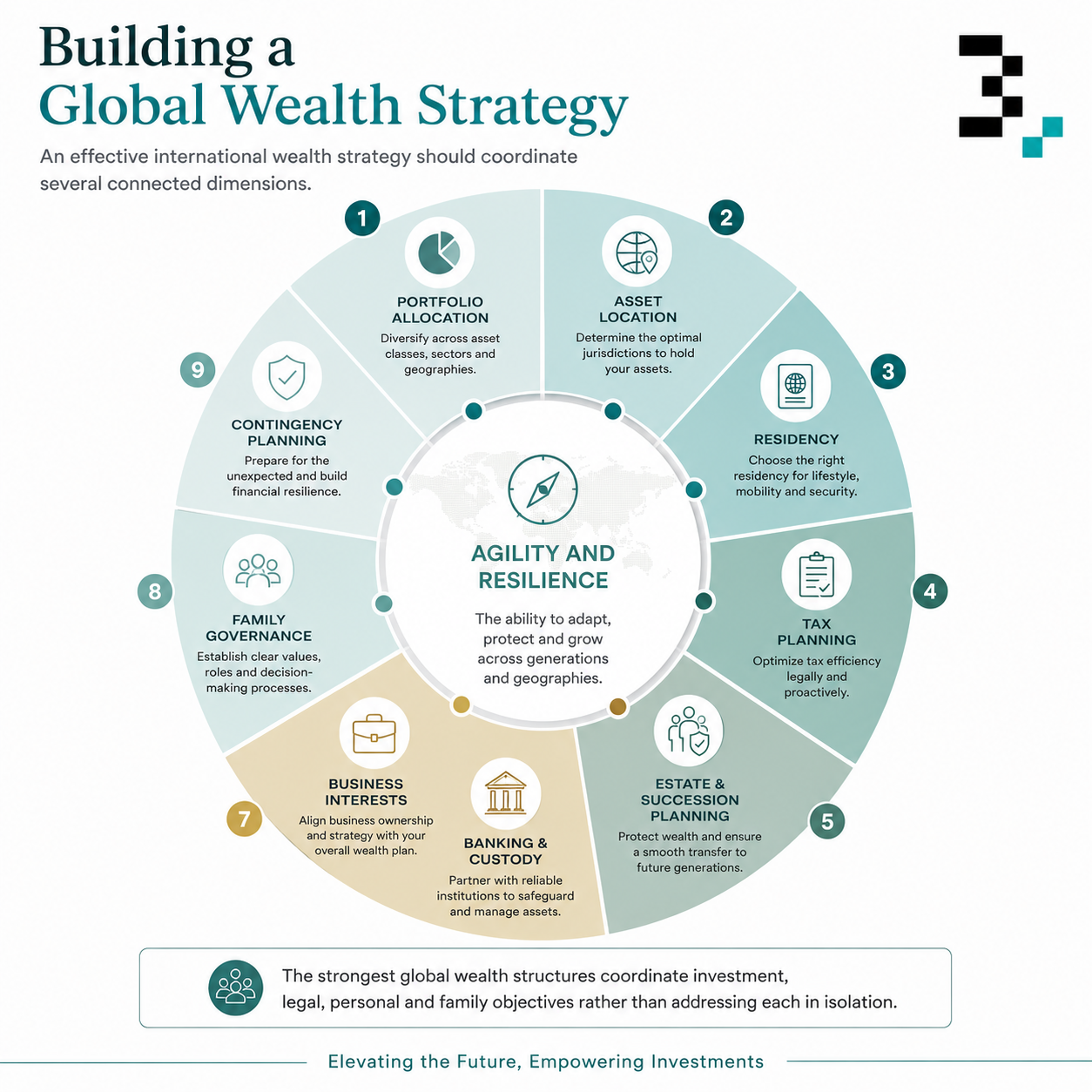
Investment managers, lawyers, tax advisers, immigration specialists and family-office executives should understand the wider structure rather than advising in isolation.Building a Global Wealth Strategy
An effective international wealth strategy should coordinate several connected dimensions.The 3 Comma Capital Perspective
At 3 Comma Capital, our role is focused on investment management. We do not advise families on immigration, taxation or legal structuring. However, we frequently work with international investors whose investment decisions form part of a broader relocation or residency strategy.From an investment perspective, three principles stand out.
First, residency capital should still be treated as investment capital. The assets should be selected according to risk tolerance, time horizon, liquidity needs and financial objectives.
Second, diversification should be genuine. Owning several investments that ultimately depend on the same issuer, industry, geography or economic factor may provide less protection than it appears.
Third, the structure should remain understandable. Complexity can sometimes be necessary, but every account, entity and investment should have a clear purpose within the family's wider plan.
For investors considering Portugal's fund-based Golden Visa route, 3 Comma Capital manages strategies designed for different profiles.
- The Portugal Golden Income Fund combines a core allocation to Portuguese fixed income with selected global equity and digital-asset exposure, seeking to balance capital preservation and long-term growth.
- The Atlantic Bond Fund offers a dedicated fixed-income strategy for investors seeking a more conservative approach.
► U.S. investors considering the use of retirement assets can also read our guide to [using a Self-Directed IRA for a Portugal Golden Visa investment].
Conclusion
Wealth management is moving beyond the traditional boundaries of portfolio construction. In a more fragmented world, families increasingly need to consider not only which assets they own, but where those assets are held, where family members can reside and how the wider structure would respond to political, economic or personal change. This does not mean every investor requires several residencies, multiple family offices and accounts across numerous financial centers.It means that jurisdictional concentration should be recognized as a risk alongside market, credit, currency and liquidity risk.
For globally mobile families, resilience may come from combining:
- a diversified investment portfolio;
- strong custody and legal protections;
- access to more than one jurisdiction;
- coordinated succession planning;
- and sufficient flexibility to respond when circumstances change.
In modern wealth management, optionality is becoming an asset in its own right.
Bottom Line
Global families are increasingly diversifying more than their portfolios. They are also diversifying where they live, where their assets are held and which legal and financial systems they depend on.Portugal can play a valuable role in that architecture by offering European residency, lifestyle appeal and access to regulated investment funds. The strongest strategy, however, is not built around one jurisdiction. It is built through coordinated, transparent and purposeful diversification.
 |
Investments Principal
|
With more than 20 years of experience in financial markets, Duarte specialized in the energy area in the last decade, where he had the opportunity to work with the main European Power and Gas institutions at CIMD Group. Previously, he worked as Market Strategist at IG Markets Iberia.
More about Duarte Caldas


