Market Watch
Snapshot of the Portuguese Economy: Q4 2026 Update

Stronger Growth, Persistent Inflation and Portugal's Next Economic Challenge
Portugal enters the final quarter of 2026 with a stronger economic outlook than anticipated at mid-year. Despite persistent geopolitical tensions, elevated energy prices and a challenging international environment, the Portuguese economy has demonstrated remarkable resilience, prompting Banco de Portugal to revise its growth projections significantly higher. As discussed in our mid-year assessment of the Portuguese economy, domestic demand and investment were already central to Portugal's growth outlook. Banco de Portugal's latest projections suggest that these drivers have proved stronger than initially anticipated.
According to the central bank's October 2026 Economic Bulletin, Portuguese GDP is now expected to expand by 2.3% in 2026, compared with the 1.8% forecast published in June. Growth is projected to moderate to 1.8% in both 2027 and 2028, as the economy adjusts to the gradual withdrawal of extraordinary European investment support.
The upward revision reflects stronger-than-expected economic activity in the second quarter, resilient household consumption, accelerating investment supported by European recovery funds and an improvement in export performance.
Yet the outlook presents an important contrast. While growth is proving stronger than anticipated, inflation remains elevated, the investment cycle is heavily influenced by the final implementation phase of the Recovery and Resilience Plan (PRR), and structural challenges surrounding productivity, demographics and external competitiveness remain unresolved.
Portugal's economic resilience is no longer the central question. The challenge now is whether the country can transform that resilience into sustainable, productivity-driven growth.
Key Takeaways
- GDP growth revised higher: Banco de Portugal now projects growth of 2.3% in 2026, an upward revision of 0.5 percentage points from June. Growth is expected to moderate to 1.8% in 2027 and 2028.
- Domestic demand remains the principal growth engine: Private consumption is projected to increase by 3.1% in 2026, supported by employment, wage growth and fiscal measures.
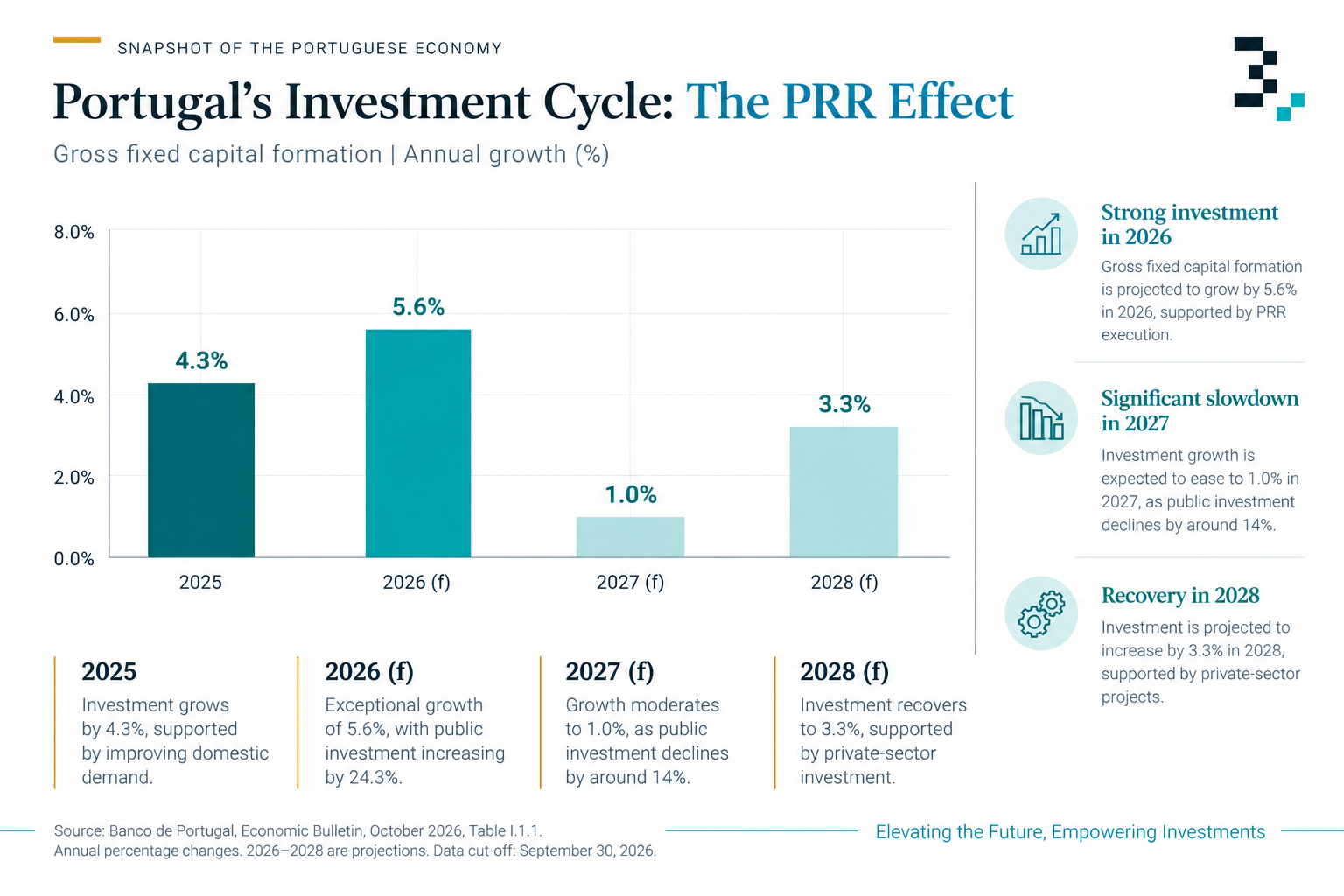
- Investment accelerates before a significant slowdown: Gross fixed capital formation is expected to grow by 5.6% in 2026, supported by PRR execution, before slowing to 1.0% in 2027.
- Exports are recovering: Exports of goods and services are projected to increase by 3.5% in 2026, following stagnation in 2025, with non-tourism services becoming an increasingly important source of external growth.
- Inflation remains elevated: Harmonized inflation is expected to average 3.1% in 2026, potentially reaching 3.6% in the fourth quarter, before moderating to 2.4% in 2027 and 2.0% in 2028.
- The labour market remains resilient: Unemployment is projected at 5.6% throughout 2026–2028, although employment growth is expected to moderate.
- External imbalances deserve attention: Imports are expected to grow by 6.0% in 2026, outpacing exports, while increasing import intensity limits the domestic value generated by some components of demand.
- Portugal's economic structure continues to evolve: Non-tourism services represented 23.5% of total exports in 2025, surpassing tourism.
- Risks remain external: Geopolitical tensions, energy prices, financial-market volatility and weaker international demand could affect both growth and inflation.
Portugal's Growth Outlook Improves Significantly
The most important development in Banco de Portugal's October Economic Bulletin is the upward revision to economic growth.
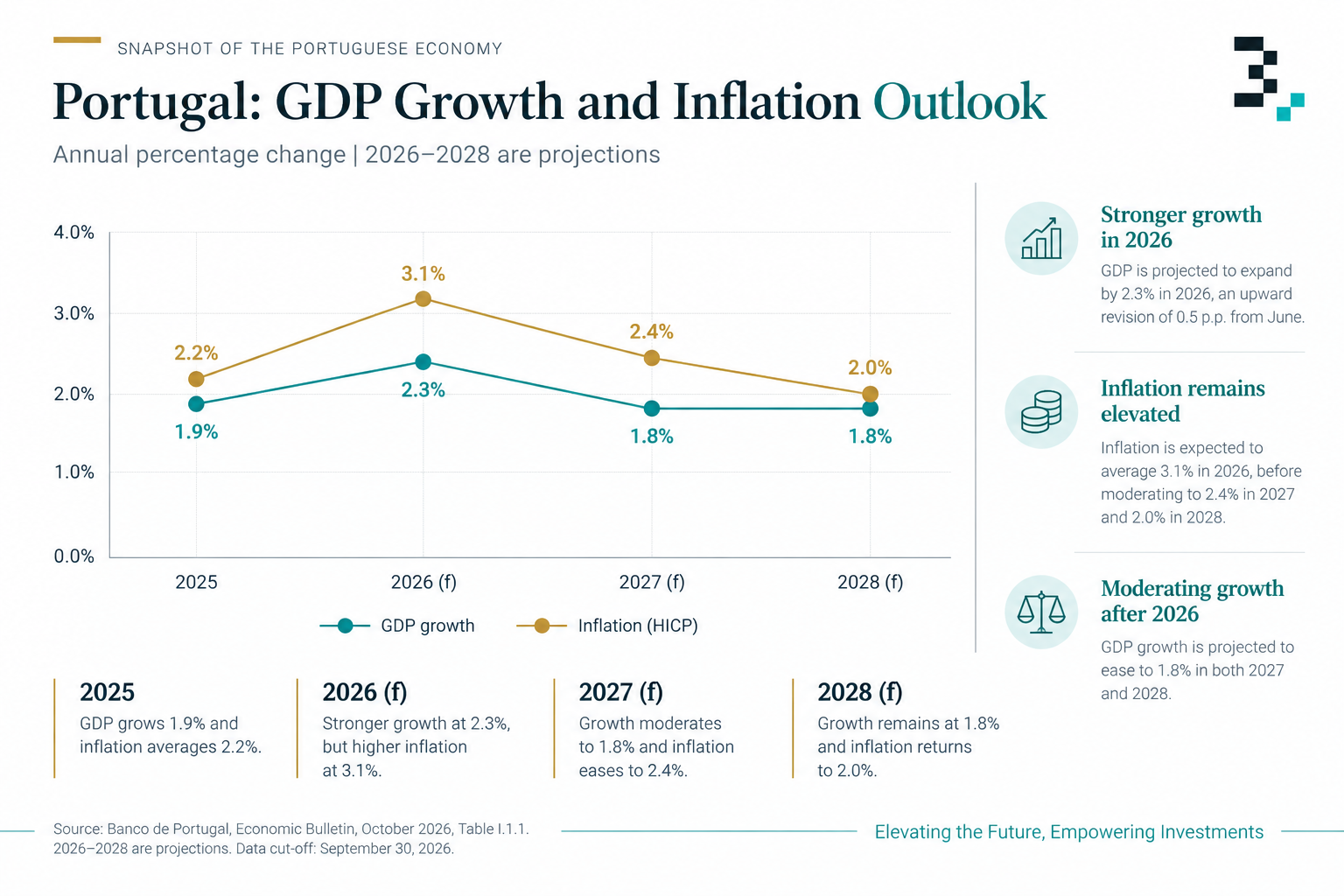
Following GDP growth of 1.9% in 2025, the central bank now expects the Portuguese economy to expand by 2.3% in 2026, before moderating to 1.8% in both 2027 and 2028. This represents an increase of 0.5 percentage points for 2026 and 0.2 percentage points for 2027 compared with the June projections.
Portugal's Economic Outlook: October 2026
| Indicator | 2025 | 2026 (f) | 2027 (f) | 2028 (f) |
|---|---|---|---|---|
| GDP growth | 1.9% | 2.3% | 1.8% | 1.8% |
| Private consumption | 3.7% | 3.1% | 2.1% | 1.7% |
| Gross fixed capital formation | 4.3% | 5.6% | 1.0% | 3.3% |
| Exports | 0.0% | 3.5% | 3.0% | 3.0% |
| Imports | 4.6% | 6.0% | 2.9% | 3.0% |
| Employment growth | 2.3% | 1.7% | 0.7% | 0.3% |
| Unemployment rate | 6.0% | 5.6% | 5.6% | 5.6% |
| Inflation (HICP) | 2.2% | 3.1% | 2.4% | 2.0% |
Source: Banco de Portugal, Economic Bulletin, October 2026, Table I.1.1. Annual percentage changes except unemployment. (f) Forecast. Projection data cut-off: September 30, 2026.
The revision largely reflects stronger-than-expected economic activity during the second quarter. Portuguese GDP expanded by 0.9% quarter-on-quarter in Q2 2026, substantially exceeding the 0.4% growth anticipated in June. The National Statistics Institute also revised first-quarter growth higher, from 0.0% to 0.2%.
The stronger second-quarter performance was supported primarily by household consumption and exports. However, Banco de Portugal expects activity to moderate in the third quarter, projecting quarterly GDP growth of approximately 0.2%, before accelerating again towards year-end. The anticipated fourth-quarter recovery reflects stronger household spending, supported by fiscal measures, and renewed export momentum.
The stronger 2026 outlook is encouraging, but the sustainability of growth beyond the current stimulus cycle will be the more important test.
Domestic Demand Continues to Support Growth
Household consumption remains a central pillar of Portugal's economic performance. Banco de Portugal expects private consumption to increase by 3.1% in 2026, a substantial upward revision from the 1.9% forecast published in June.
The improvement reflects stronger employment, wage growth and fiscal measures designed to support disposable income, including personal income tax reductions and extraordinary pension supplements. Consumption also benefited from a strong second quarter, increasing by 0.9% compared with the previous three months, supported by higher purchases of durable goods.
Nevertheless, household finances continue to face pressure from inflation. Real disposable income is projected to increase by 2.0% in 2026, compared with 3.1% in 2025. With consumption growing faster than real income, the household saving rate is expected to decline by 0.9 percentage points to 11.4%.
This remains a relatively elevated saving rate by historical standards, suggesting that Portuguese households retain a degree of financial resilience. Looking ahead, consumption growth is expected to moderate to 2.1% in 2027 and 1.7% in 2028, reflecting slower employment growth and the gradual normalization of household spending.
The central bank also notes that higher energy prices may be particularly challenging for lower-income households, even if average real income growth remains broadly similar across income groups. The longer-term challenge is to sustain purchasing power through productivity improvements and real wage growth rather than relying excessively on temporary fiscal support.
Investment Accelerates, but the PRR Transition Looms
Investment is expected to be one of the strongest contributors to Portuguese economic growth in 2026. Banco de Portugal projects gross fixed capital formation growth of 5.6%, compared with 4.5% in June.
This acceleration is largely attributable to the implementation of Portugal's Recovery and Resilience Plan, with a substantial concentration of public investment as projects approach completion. Public investment is projected to increase by an exceptional 24.3% in 2026.
However, the outlook changes considerably in 2027. Public investment is expected to decline by approximately 14%, contributing to a sharp moderation in total investment growth to 1.0%, before recovering to 3.3% in 2028.
Can the investment supported by European recovery funds generate sufficient improvements in productivity and productive capacity to sustain growth after the funding cycle ends?
The answer will depend not simply on the amount invested, but on the long-term economic value generated. Investments in digital infrastructure, energy transition, industrial modernization and business competitiveness could provide benefits extending beyond the immediate spending cycle.
Private-sector investment will also play an increasingly important role. Banco de Portugal expects business investment to grow by 3.1% in 2026, supported in part by investment in the Sines data centre and PRR-financed projects. Business investment growth is subsequently expected to average approximately 3.7% in 2027–2028, benefiting from digital and energy-transition projects.
Housing investment is expected to grow at a more moderate average rate of approximately 2% between 2026 and 2028, reflecting slower population growth, more moderate household income gains and persistent affordability challenges.
The coming transition will test Portugal's ability to replace extraordinary public investment stimulus with sustained private-sector capital formation. For investors, the distinction between temporary expenditure-driven growth and lasting productivity improvements will be particularly important.
Exports Recover as Portugal's Economic Structure Evolves
After a weak performance in 2025, Portuguese exports are expected to recover during 2026–2028. Banco de Portugal projects exports of goods and services to increase by 3.5% in 2026, followed by 3.0% in both 2027 and 2028.
The recovery is already visible in the first half of the year. Goods exports increased by 4.1% year-on-year during the first six months of 2026, while non-tourism services also gained momentum. Tourism exports, by contrast, stagnated compared with the corresponding period of 2025.
Beyond Tourism: The Rise of Knowledge-Intensive Services
One of the most interesting analyses in the October Economic Bulletin examines the growing importance of non-tourism services in Portugal's export structure.
Between 1996 and 2025, non-tourism services exports increased from 3.1% to 10.3% of GDP. Their share of total Portuguese exports rose from 11.8% to 23.5%, surpassing tourism. The trade balance for non-tourism services also improved substantially, moving from a small deficit to a surplus equivalent to 3.6% of GDP.
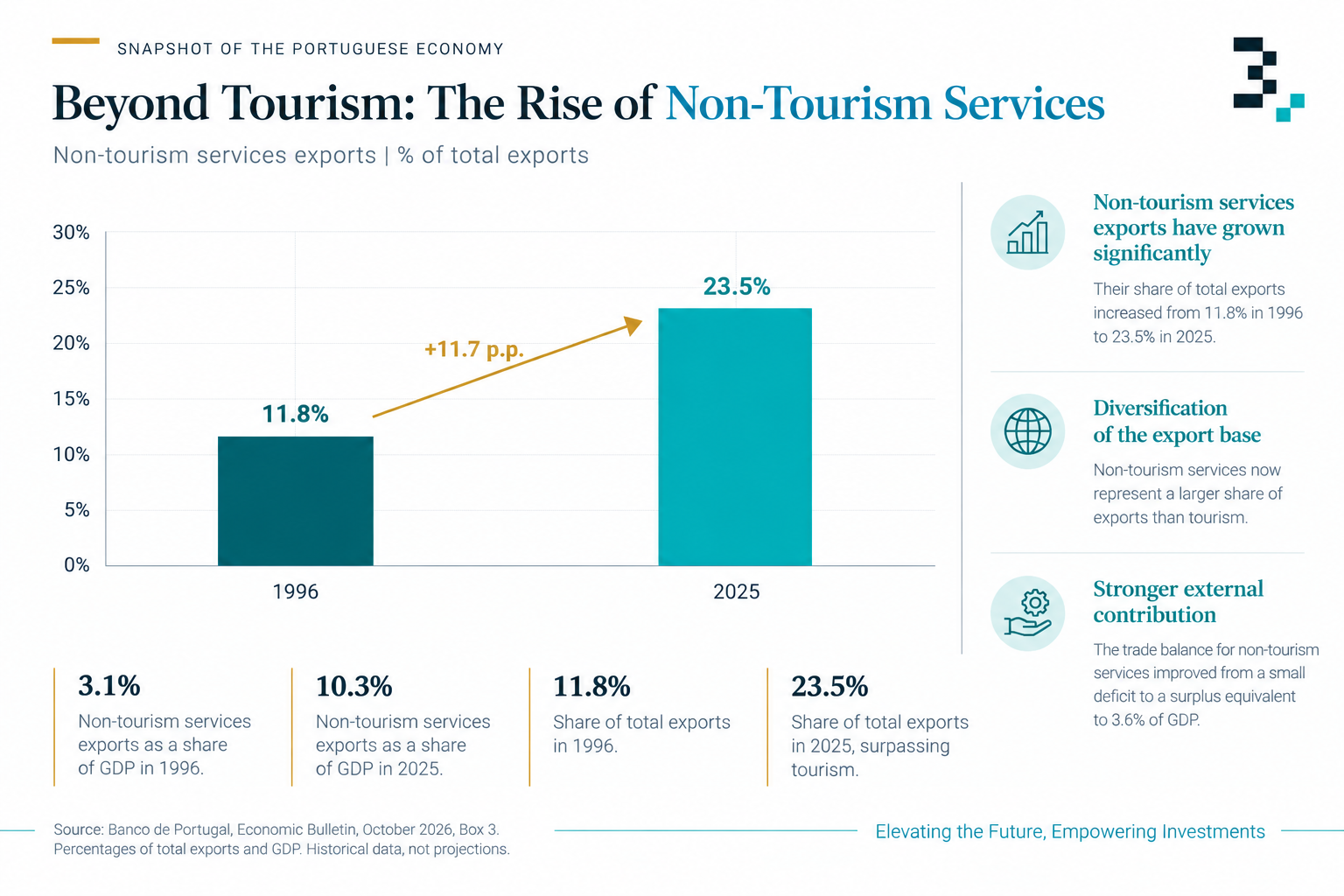
These developments reflect the expansion of telecommunications, information technology, business services and transportation, alongside the increasing integration of Portuguese companies into international value chains. Foreign direct investment has also contributed to this transformation, supporting internationally oriented businesses.
A greater contribution from knowledge-intensive services can support higher-value economic activity, encourage investment in skills and technology, and reduce dependence on traditional sectors. Maintaining this momentum will require continued investment in human capital, technological capabilities and international competitiveness.
The Other Side of Growth: Portugal's Import Dependence
The October Bulletin also highlights a less visible structural challenge: the growing import content of Portuguese economic activity. Banco de Portugal projects imports to increase by 6.0% in 2026, considerably faster than exports.
Part of this increase reflects stronger investment and purchases of durable consumer goods, both of which typically have relatively high import content. However, the central bank identifies a longer-term trend: the ratio of imports to final demand increased from 22.4% in 1999 to 32.4% in 2025, reaching approximately 33.3% in the first half of 2026.
This evolution is not unique to Portugal. Similar trends have occurred across the Euro Area as production processes and supply chains have become increasingly internationalized. Nevertheless, the implications for domestic growth are significant.
According to Banco de Portugal's estimates, approximately 40% of fixed investment expenditure in 2025 was associated with imported content, while the corresponding share for machinery and equipment reached approximately 78%.
Imported machinery, equipment and technology can improve Portugal's productive capacity over time, but their immediate contribution to domestic value added is more limited. This distinction is particularly relevant during a period of strong investment growth supported by European funds.
The objective should not be to reduce international economic integration, which remains essential for a small open economy. Rather, the challenge is to increase the domestic value generated by investment, strengthen local supply chains where economically viable and improve the competitiveness of Portuguese companies.
The quality of economic growth matters as much as its headline rate.
Inflation Remains the Principal Near-Term Concern
Despite the stronger growth outlook, inflation continues to present a significant challenge. Banco de Portugal expects harmonized inflation to average 3.1% in 2026, unchanged from June.
Inflation increased from 2.2% in the first quarter to 3.4% in the third quarter, and the central bank projects a peak of approximately 3.6% in Q4 2026. The increase has been driven primarily by higher energy prices associated with the conflict in the Middle East.
Nevertheless, the central bank notes an important distinction between the current energy shock and the inflationary episode following Russia's invasion of Ukraine in 2022. The recent shock has so far produced a more contained increase in energy and food prices, with a more limited transmission to underlying inflation.
Banco de Portugal projects inflation to decline to 2.4% in 2027 and 2.0% in 2028, assuming that energy pressures gradually ease and second-round effects on wages and business margins remain limited. A prolonged conflict, further disruptions to energy supply or stronger-than-expected wage pressures could delay normalization.
For investors, inflation affects real returns, corporate margins, financing conditions and the purchasing power of future cash flows. Portfolio construction should remain mindful of scenarios in which inflation proves more persistent than anticipated.
For investors, persistent inflation reinforces the importance of managing duration, credit exposure and real returns, themes explored in our analysis of the changing fixed-income investment environment.
Labour Market Resilience Meets Demographic Constraints
Portugal's labour market continues to demonstrate resilience. Banco de Portugal expects the unemployment rate to remain at approximately 5.6% throughout 2026–2028, compared with 6.0% in 2025.
Employment growth is projected to reach 1.7% in 2026, before moderating to 0.7% in 2027 and 0.3% in 2028. This slowdown reflects the gradual normalization of labour supply growth, including lower net migration flows compared with 2021–2024.
Immigration has played an important role in supporting Portugal's employment expansion. The October Bulletin also highlights substantial upward revisions to population estimates, concentrated primarily in net migration, with implications for the interpretation of employment statistics.
Nominal compensation per employee is projected to increase by 4.5% in 2026, 4.1% in 2027 and 3.7% in 2028. While wage growth supports household income, sustained increases in labour costs that exceed productivity gains could weaken international competitiveness.
As population ageing limits the contribution of labour supply to future growth, Portugal will increasingly need higher productivity, improved skills and more efficient capital allocation.
External Balances and Fiscal Discipline Remain Important
Portugal's external position is expected to weaken temporarily in 2026, reflecting stronger imports and higher energy costs. Banco de Portugal projects the current and capital account surplus to decline from 2.7% of GDP in 2025 to 2.5% in 2026, before falling to 0.9% in 2027 and recovering to 1.4% in 2028.
The balance of goods and services is expected to move from a surplus of 1.0% of GDP in 2025 to a deficit of 0.4% in 2026, reflecting stronger import growth and less favorable terms of trade.
This emphasis on fiscal credibility is particularly relevant following Portugal's recent sovereign credit rating upgrade, which highlighted the country's improving public finances and strengthened credit profile.
European funding continues to provide an important offset. Net transfers from the European Union are projected to reach approximately 2.6% of GDP in 2026, their highest level since the mid-1990s. However, these transfers are expected to decline significantly after completion of the PRR, averaging approximately 0.8% of GDP in 2027–2028.
Fiscal discipline also remains central to Portugal's resilience. Banco de Portugal emphasizes preserving budgetary balance and continuing to reduce public indebtedness, particularly amid volatility in international sovereign debt markets. Longer-term pressures associated with defence spending, public investment and population ageing will require careful management.
Risks to Outlook: Energy, Financial Markets and Competitiveness
Although Banco de Portugal has revised growth projections higher, the balance of risks remains tilted towards weaker growth and higher inflation. The principal source of uncertainty is the geopolitical situation in the Middle East. A prolonged or intensified conflict could lead to further increases in energy prices, supply-chain disruptions and weaker confidence.
The central bank also identifies the possibility of an abrupt correction in international financial markets, potentially triggered by a reassessment of expected returns on artificial intelligence investments or concerns over fiscal sustainability in major economies.
More favorable outcomes are also possible. A faster resolution of geopolitical tensions, lower energy prices, stronger European investment in defence and infrastructure, or greater-than-expected productivity gains from artificial intelligence could support economic activity.
Nevertheless, the medium-term priorities remain structural: increasing productive and technological capital, improving workforce qualifications, adapting to demographic change and removing obstacles to more efficient resource allocation.
What Does This Mean for Investors?
Banco de Portugal's October projections reinforce a constructive, although increasingly selective, assessment of the Portuguese economy. Growth is stronger than previously expected. The labour market remains resilient. Investment is accelerating. And Portugal's export structure continues to evolve towards activities with greater technological and knowledge intensity.
However, the composition of growth suggests that investors should distinguish between temporary stimulus and sustainable improvements in corporate fundamentals.
For fixed-income investors, economic resilience and disciplined public finances provide a supportive macroeconomic backdrop, but energy costs, financing conditions and differences in issuer credit quality remain important considerations.
For fixed-income investors, economic resilience and disciplined public finances provide a supportive macroeconomic backdrop. As explored in our analysis of the Portuguese corporate bond market, issuer quality, credit selection and liquidity considerations remain essential.
For equity investors, opportunities may be linked to companies benefiting from digital transformation, infrastructure modernization, export expansion and productivity improvements. Stronger GDP growth, however, does not automatically translate into higher corporate profitability.
For multi-asset investors, resilient growth combined with elevated inflation and geopolitical uncertainty reinforces the importance of diversification, liquidity management and disciplined risk allocation.
Three developments deserve particular attention over the coming quarters:
- The transition beyond the PRR: The sharp slowdown projected for public investment in 2027 will test whether private investment can sustain momentum.
- The evolution of Portugal's export base: The growing importance of non-tourism services suggests that international competitiveness is becoming less dependent on traditional sectors.
- The relationship between wages and productivity: With employment growth moderating, sustainable increases in output per worker will become increasingly important.
Portugal's outlook remains encouraging, but the next phase of the cycle is likely to reward disciplined investment analysis rather than broad exposure to domestic growth alone.
► Bottom Line
Portugal enters the final quarter of 2026 with a stronger economic outlook than anticipated just a few months ago. Banco de Portugal's upward revision of GDP growth to 2.3% in 2026 reflects stronger domestic demand, recovering exports and accelerating investment supported by European recovery funds.
At the same time, inflation remains elevated, external balances face pressure and the expected reduction in public investment after 2026 introduces an important challenge for the years ahead.
Beyond the immediate projections, the October Economic Bulletin highlights a deeper transformation: knowledge-intensive services are becoming more important to exports, investment in technology and digital infrastructure is expanding, and the economy has shown an ability to adapt to repeated external shocks.
Yet the next stage of Portugal's development will depend on converting these strengths into lasting productivity gains, stronger international competitiveness and sustainable private-sector growth.
Portugal has demonstrated its ability to withstand economic uncertainty. The next challenge is to translate that resilience into lasting economic value.
For investors, understanding that transition will be essential to identifying the opportunities (and managing the risks) of the next economic cycle.
Sources
- Banco de Portugal - Economic Bulletin, October 2026. Primary source, including Table I.1.1 and Boxes 3 and 4. Data cut-off: September 30, 2026.
- Banco de Portugal - October 2026 Economic Bulletin: Overview.
- Banco de Portugal - Press Release on the October 2026 Economic Bulletin.
- 3 Comma Capital - Snapshot of the Portuguese Economy: Mid-Year 2026 Update.
Disclaimer: This article is provided for informational purposes only and does not constitute investment advice, a recommendation or an offer to buy or sell any financial instrument. Economic forecasts are subject to uncertainty and may be revised. Investors should consider their individual circumstances and seek appropriate professional advice before making investment decisions.
 |
Investments Principal
|


