

Why a Golden Visa portfolio is more diversified than its Portuguese allocation suggests, and why the Portuguese part is worth owning.
Golden Visa funds invest at least 60% of their investments in Portuguese companies. Investors sometimes read that as a concentrated bet on one small economy. It is a natural first reading, and it misses two things.
The first is that a company’s home and its market are rarely the same thing, in Portugal or anywhere else. Portugal’s best-known companies sell cork in the United States, groceries in Poland and electricity in Brazil, just as Europe’s and America’s largest companies earn much of their revenue far from home. The second is that the part of the allocation that genuinely is domestic gives investors a share in one of the stronger economies in the euro area, which is exactly why we own it. We measured both, from each company’s own filings, and then applied the same lens to our own funds.
Key takeaways
- A company’s address is not its market. S&P 500 companies earn about 41% of their revenue outside the United States, and STOXX Europe 600 companies about half outside Europe. Portuguese companies follow the same pattern: Jerónimo Martins, the country’s largest listed company by revenue, earns more than four fifths of its sales abroad.
- How you own Portugal shapes which Portugal you own. Weighted like the stock market, Portuguese companies do 52% of their business at home. Weighted like the bond market, 66%. The listed market is led by international champions; the bond market is where the domestic economy is.
- That domestic economy is in good shape. Portugal is expected to grow 2.3% this year against 0.9% for the euro area, with an A+ rating from Fitch, public debt falling and a budget surplus last year.
- Our funds are more diversified than their label. The Portugal Golden Income Fund holds 66% in Portuguese companies, yet only 44% of the fund is tied to business done in Portugal. For the Atlantic Bond Fund the figure is 47%.
- The domestic exposure is a choice, made with conviction. We concentrate the Portuguese allocation on the businesses closest to the domestic economy, and build the rest of each portfolio to depend on different things.
A company’s address is not its market
Modern companies sell wherever their customers are. According to FactSet data, S&P 500 companies earn around 41% of their revenue outside the United States, and on a weighted basis roughly half of the revenue of STOXX Europe 600 companies is earned outside Europe. An investor in Nestlé is not making a bet on Switzerland, and an investor in an American index fund owns a good deal of the world economy along with it.
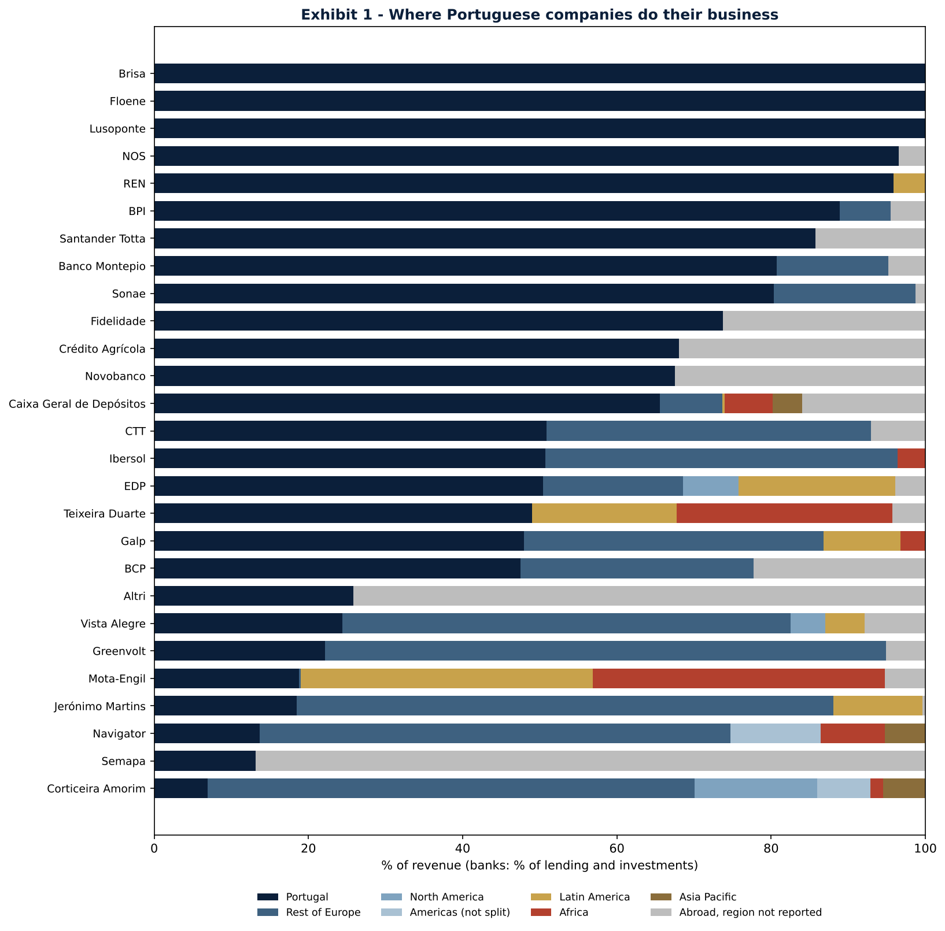
Portugal is no exception. Exhibit 1 maps where each Portuguese company eligible for a Golden Visa fund does its business, taken from the geographic breakdown in its latest annual or interim report, and sorts them from the most international to the most domestic.
The most international end of the chart reads like a list of global businesses. Jerónimo Martins makes about two thirds of its sales at Biedronka in Poland and another 12% at Ara in Colombia, leaving 18.5% in Portugal. Corticeira Amorim, the world leader in cork, sells 93% of its products abroad, The Navigator Company 86% and its parent Semapa 87%. Mota-Engil earns most of its revenue in Africa and Latin America, Greenvolt nearly three quarters in the rest of Europe, and Altri and Vista Alegre around three quarters outside Portugal. Half of EDP’s revenue comes from Spain, Brazil and North America; Ibersol earns almost half of its turnover in Spain, and CTT, through its express and e-commerce business, half outside Portugal. Galp earns about half of its revenue in Portugal, and much of its profit comes from oil production in Brazil. Even Sonae, still mostly Portuguese, earns a fifth of its sales abroad.
Banks are measured differently, by where their loans and investments are, using the standard geographic table that every European bank publishes. On that measure the Portuguese banks are more international than their branch networks suggest. BCP has about half of its book outside Portugal, much of it at Bank Millennium in Poland. Caixa Geral de Depósitos, Novobanco and Crédito Agrícola have about a third abroad, mostly in holdings of foreign government and bank bonds, and Montepio, Santander Totta and BPI between 11% and 19%.
At the other end sit the businesses that are Portuguese by nature: the motorway and bridge concessions, the gas and electricity networks and the incumbent telecom operator. These earn all, or nearly all, of their revenue at home, and several of them can only be reached through their bonds. For a detailed analysis on the Portuguese banking sector please read our recent blog post "Portuguese Banks: Investment Outlook & Opportunities in 2027".
How you own Portugal decides which Portugal you own
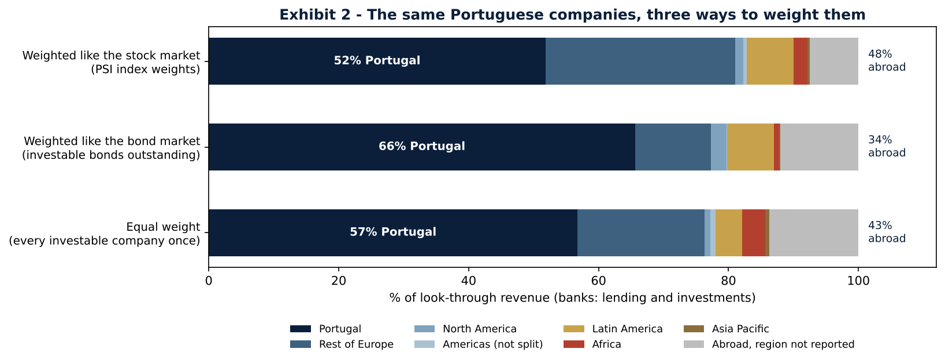
A fund owns a portfolio, not one company, so the next question is how these exposures add up. The answer depends on how the portfolio is built. Exhibit 2 weights the same Portuguese companies three ways: as the stock market weights them, as the bond market weights them, and equally. For the bond market we count only what an investor like us would actually buy: euro bonds of at least €40 million, of every seniority, with covered bonds included only when they were placed with investors rather than kept by the bank that issued them.
Weighted like the stock market, Portuguese companies do 52% of their business in Portugal and 48% abroad. Weighted equally, 57% at home. Weighted like the bond market, 66% at home. Every one of these portfolios is Portuguese by company. None of them is Portuguese by economy alone.
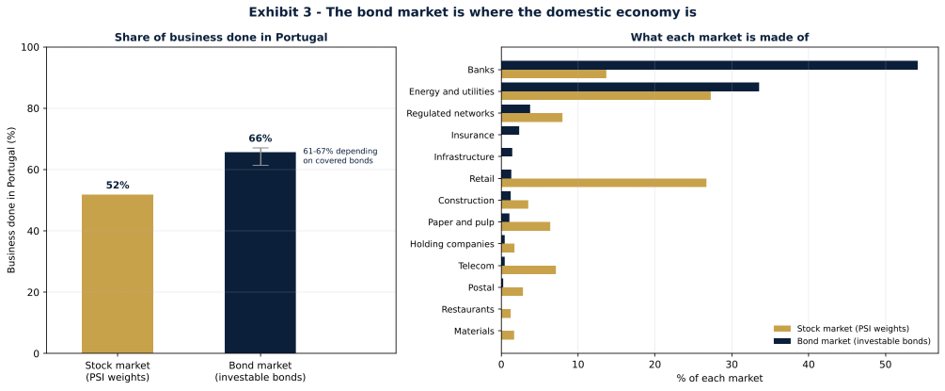
The difference between the stock market and the bond market is the most useful finding in this post, because it shows that the two markets give investors different things. Exhibit 3 explains why. Portugal’s stock market is concentrated in its international champions: retail, energy and utilities make up more than half of it, and banks just 14%. Its bond market is built differently. Of the roughly €43 billion of investable bonds from these companies, banks account for 54% and EDP for a third, with the rest coming from regulated networks, insurers and concessions. Several of the country’s largest domestic franchises, including Caixa Geral de Depósitos, Novobanco and Fidelidade, can only be owned through their bonds, and two of the largest bank issuers, Santander Totta and BPI, are backed by major Spanish banking groups.
The treatment of covered bonds, which banks issue against their mortgage books, moves the bond-market figure only between 61% and 67%. The picture is the same either way: the stock market gives you Portugal’s international companies, and the bond market gives you more of the domestic economy itself.
Why the domestic economy is worth owning
If the bond market is the way to own the domestic economy, the next question is whether that economy deserves to be owned. The evidence says it does.
Portugal grew 1.9% in 2025, and Banco de Portugal now expects 2.3% for 2026, revised up from 1.8% in June. The ECB expects 0.9% for the euro area as a whole. Unemployment is projected at 5.6%, investment is expected to grow 5.6% this year with the support of European funds, and the country runs a surplus on its current and capital accounts, 2.7% of GDP in 2025. The public finances are strong: a budget surplus of 0.7% of GDP in 2025, and public debt that Fitch expects to fall from 89.7% of GDP in 2025 to about 87% this year and below 83% by 2028. Fitch upgraded Portugal to A+ in September, with a stable outlook, as we covered in “Portugal Upgraded to A+: Why Fitch’s Decision Matters for Investors” and in our “Snapshot of the Portuguese Economy: Q4 2026 Update”.
This is the backdrop that matters most for the companies in the bond market. Banks earn more when households and businesses borrow and repay; regulated networks and concessions depend on a stable state and growing activity; insurers grow with incomes. An economy growing faster than its neighbours, with a strengthening sovereign behind it, is a good environment for the credit of exactly these businesses.
What our funds actually own
We applied the same look-through to our own two Golden Visa funds, using their holdings at the valuation of 23 November 2026. Exhibit 4 splits each fund by where the business behind it is done.
The Portugal Golden Income Fund holds 66% in Portuguese companies. Within that allocation we have deliberately concentrated on the domestic economy: regulated networks such as REN and Floene, Fidelidade, and the banks, Montepio, Novobanco, Crédito Agrícola, BCP and Caixa Geral de Depósitos. About two thirds of the business behind it is done in Portugal. The fund as a whole is far from a single-country bet. Some 21% of it is the foreign business of Portuguese companies such as EDP, BCP, Fidelidade and Jerónimo Martins, 25% is invested directly outside Portugal in global equities and credit, and 8% is in gold and digital assets. Only 44% of the fund is tied to business done in Portugal.
The Atlantic Bond Fund is built more conservatively and leans further into domestic credit: 62% in Portuguese companies, three quarters of whose business is in Portugal. Its diversification comes mainly from the rest of the fund, 31% in international credit across European high yield, emerging-market debt, convertible bonds and other segments, and about 3% in gold. Together with the foreign business of its Portuguese issuers, about half of the fund is exposed outside the Portuguese economy, and 47% is tied to business done in Portugal.
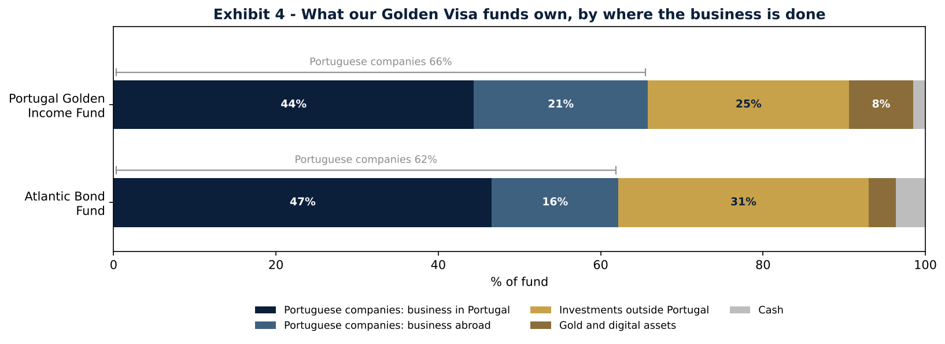
A label of “60% Portugal” therefore describes where the companies are based, not everything an investor owns. What it does not show is either the international reach of Portuguese companies or the global portfolio built around them.
How we do this at 3 Comma Capital
Our approach to the Portuguese allocation rests on three ideas.
First, the Portuguese allocation is a conviction, not just a requirement. We hold Portuguese credit because we believe in the domestic economy behind it: an investment-grade sovereign on an improving path, a banking system that has rebuilt its balance sheets, and regulated businesses with predictable cash flows. We choose issuer by issuer, and the bond market lets us own the domestic economy directly.
Second, we build diversification around it by driver, not by count. As we argued in “When Everything Falls Together”, what matters is how many genuinely different things a portfolio depends on. Global equities, international credit and gold respond to different forces from Portuguese banks and utilities, and that is why they sit alongside them.
Third, we measure what we own, not only where it is registered. The look-through in this post is one we run on our own holdings, and it informs how we build each portfolio. Investors get the chance to understand a bit more in depth what they are investing in.
The bottom line
A Golden Visa fund invests most of its capital in Portuguese companies, but that is not the same as betting everything on one small economy. Portuguese companies, like companies everywhere, do much of their business abroad, and a well-built fund adds a genuinely global portfolio around them. The part that is truly domestic is concentrated where the bond market puts it, in the banks, networks and insurers at the heart of an economy that is growing faster than the euro area and strengthening its public finances. More diversified than it looks, and Portuguese where it counts.
A note on method
- Universe. Portuguese companies eligible for a Golden Visa fund’s Portuguese allocation: members of the PSI index plus the main issuers of corporate bonds whose country of risk is Portugal, including several with no listed equity. EDP Renováveis, which is based in Spain, is excluded. Bonds issued through foreign financing vehicles of Portuguese groups, consolidated into and guaranteed by the Portuguese parent, count toward that parent. Ascendi, whose group accounts are not published online, is not shown.
- Where the business is done. Taken from each company’s latest annual or interim report: full year 2025 where interim reports carry no geographic split, otherwise the most recent interim period of 2026. Industrial companies on revenue by market or destination; CTT by the location of the group company earning the revenue; Fidelidade on gross written premiums; banks on gross exposures by counterparty geography from the EU Pillar 3 table CQ4, which measures where borrowers and bond issuers are rather than revenue. Galp and NOS do not separate Portugal in their accounts and are shown at the midpoint of an estimate built from their own segment and operating data (Galp 44–52%, NOS 95–98% in Portugal). The concessions and gas networks are shown at 100% Portugal, the documented scope of their activity.
- Our funds. Holdings of the Portugal Golden Income Fund and the Atlantic Bond Fund at the valuation of 23 November 2026. Portuguese bonds and shares are looked through to the issuer’s business by region as above. Funds and ETFs investing outside Portugal are shown as such without look-through. Global and European comparisons: FactSet data as reported by Apollo (S&P 500) and STOXX (STOXX Europe 600, March 2026). Economic data: Banco de Portugal Economic Bulletin, October 2026; ECB staff projections, September 2026; Fitch Ratings, September 2026.


