Market Watch
The Investment Triangle: Balancing Return, Risk, and Liquidity

Key Takeaways
- Every investment is defined by three core factors: return, risk, and liquidity, forming the “Investment Triangle.”
- It is impossible to maximize all three simultaneously. Every investment requires a trade-off between them.
- Higher returns typically come with higher risk or reduced liquidity, while more stable investments tend to offer lower but more predictable outcomes.
- Liquidity plays a critical role, particularly in periods of market stress, as it determines how quickly capital can be accessed without loss of value.
- Risk is multi-dimensional and can arise from market conditions, interest rates, economic cycles, and asset-specific factors.
- Successful investing is not about finding a “perfect” asset, but about building a diversified portfolio that balances these three elements.
- Different asset classes naturally occupy different positions within the triangle, making portfolio construction a matter of combining complementary exposures.
- Investor priorities vary, meaning the optimal balance depends on time horizon, objectives, and risk tolerance.
► Bottom line:
There is no perfect investment. The objective is to manage trade-offs intelligently, building a portfolio that balances growth, stability, and liquidity over time.
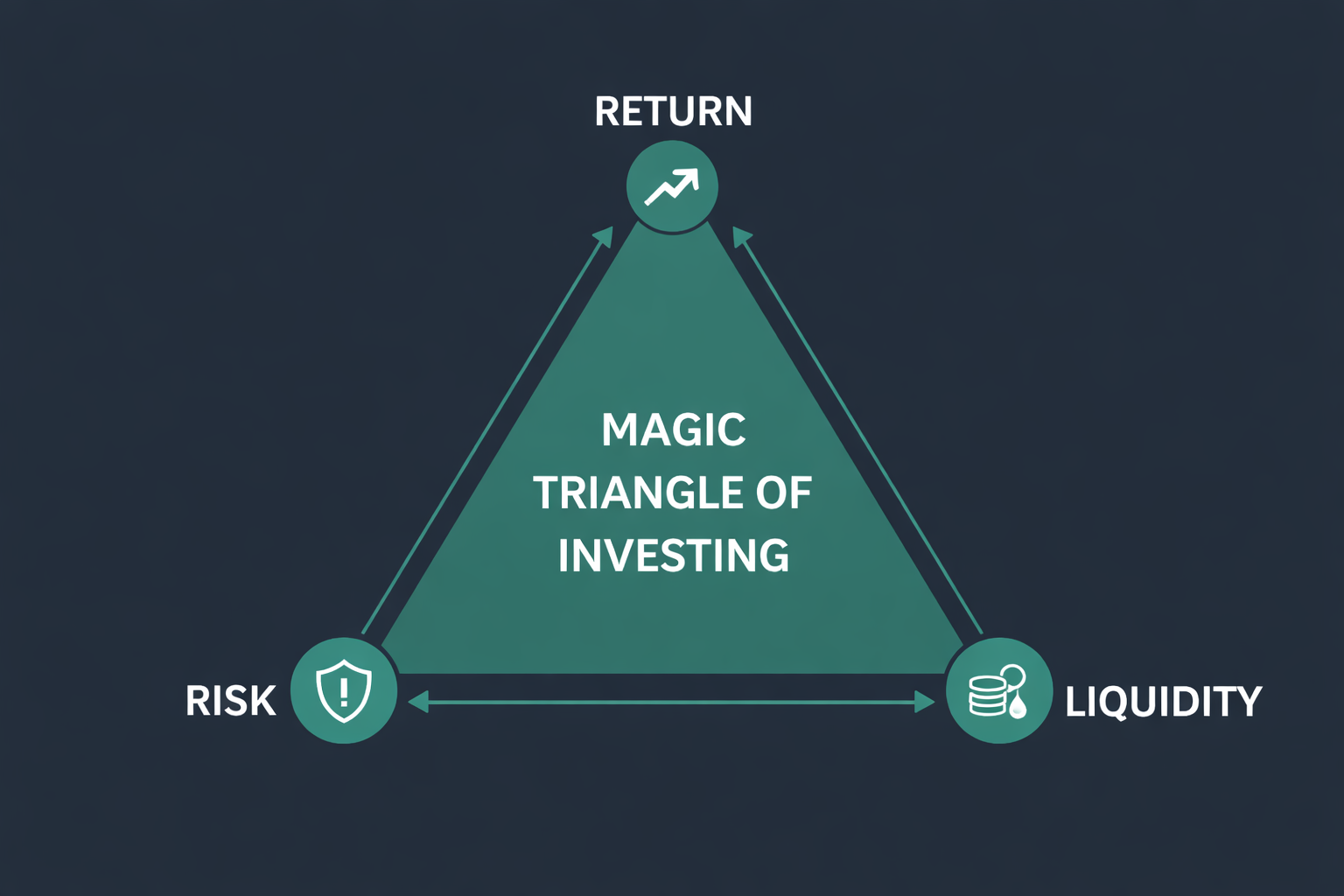
Every investment decision ultimately comes down to three fundamental factors: return, risk, and liquidity. These three pillars form what is often referred to as the “Investment Triangle.”
Understanding this framework is essential for both experienced investors and those just beginning to build their portfolios. The core principle is simple but powerful:
No investment can simultaneously maximize return, minimize risk, and maintain full liquidity.
Every investment opportunity requires a trade-off between these three elements. Recognizing how these trade-offs work allows investors to construct portfolios that align with their financial goals, time horizon, and tolerance for volatility.
1. Return: The Reward for Investing
Return represents the financial gain generated by an investment, typically expressed as a percentage of the capital invested.Returns can come from several sources, including:
- Interest income, such as bond coupons
- Dividend payments from equities
- Capital appreciation, when the value of an asset rises
- Rental income from real estate
- Compounding returns over time
Naturally, investors are attracted to opportunities with the highest potential returns. However, focusing solely on return without considering risk and liquidity is one of the most common mistakes in investing.
Historically, higher expected returns have almost always been associated with higher levels of risk. Venture capital, small-cap equities, and emerging technologies may offer significant upside potential, but they also carry a greater probability of loss.
Conversely, more conservative investments such as high-quality bonds typically generate lower but more predictable returns, making them suitable for investors prioritizing capital preservation.
2. Liquidity: Access to Your Capital
Liquidity refers to how quickly and easily an investment can be converted into cash without significantly affecting its market price.Highly liquid assets include:
- Publicly traded stocks
- Exchange-traded funds (ETFs)
- Government bonds
- Major currencies
- Bitcoin
These assets can typically be bought or sold within seconds during market hours.
In contrast, illiquid investments may require weeks, months, or even years to exit. Examples include:
- Real estate
- Private equity investments
- Private businesses
- Collectibles such as art or rare assets
Liquidity becomes particularly important during periods of financial stress or unexpected cash needs. Investors holding illiquid assets may be forced to sell at unfavorable prices or wait extended periods to access their capital. For this reason, portfolio construction often involves balancing liquid investments for flexibility with less liquid investments that may offer higher long-term returns.
3. Risk: The Uncertainty of Outcomes
Risk represents the possibility that an investment will perform differently than expected, including the potential loss of capital.Investment risk can arise from multiple sources, including:
- Market volatility
- Economic cycles
- Interest rate movements
- Political or regulatory changes
- Currency fluctuations
- Company-specific factors
Some asset classes inherently carry greater uncertainty. For example:
- Early-stage startups
- Cryptocurrencies
- Derivatives
- Small-cap companies in emerging industries
These investments can deliver extraordinary gains, but they can also generate substantial losses.
At the opposite end of the spectrum, high-quality government bonds or investment-grade corporate bonds tend to exhibit much lower volatility, though their return potential is also more limited.
A fundamental rule of investing remains true across all markets:
Lower risk typically leads to lower returns, while higher returns require accepting higher levels of uncertainty.
Why the Investment Triangle Matters for Portfolio Construction
The Investment Triangle highlights an important reality: there is no perfect investment.Instead of searching for a single ideal asset, successful investors focus on building diversified portfolios that balance these three factors.
For example:
- Equities may provide higher returns but come with higher volatility.
- Bonds offer stability and predictable income but lower growth potential.
- Alternative assets may enhance diversification but often increase risk and volatility or reduce liquidity.
By combining different asset classes, investors can create portfolios that achieve a balanced risk-return profile while maintaining sufficient liquidity.
Diversification helps ensure that no single market event or economic shock has a disproportionate impact on overall portfolio performance.
The Role of Investor Profile
Every investor prioritizes the Investment Triangle differently. For example:- Young investors with long time horizons may prioritize return and accept higher volatility.
- Retirees or capital-preservation investors may prioritize stability and liquidity.
- Institutional investors often seek a balance across all three factors.
The optimal balance depends on:
- Investment horizon
- Income needs
- Risk tolerance
- Liquidity requirements
Understanding these priorities is essential when designing a portfolio strategy.
A Practical Perspective
In practice, most professional investors approach portfolio construction by combining assets that occupy different positions within the triangle.For example:
- Equities offer higher potential returns but increased volatility.
- Bonds provide stability and income.
- Alternative assets can improve diversification but may reduce liquidity.
This balanced approach allows investors to benefit from the strengths of each asset class while mitigating their weaknesses.
How the Investment Triangle Applies to 3 Comma Capital Funds
Different investment strategies naturally occupy different positions within the investment triangle.At 3 Comma Capital, our funds are designed to address different combinations of return potential, liquidity, and risk.
A conservative strategy prioritizing capital preservation and income generation, with high liquidity and controlled volatility.
Portugal Golden Income Fund (PGI)
A diversified multi-asset portfolio combining bonds, equities, and alternative assets like Gold and Bitcoin, seeking balanced exposure across the triangle.
Global Crypto Fund (GCF)
A higher-volatility strategy designed for investors seeking long-term growth and exposure to the digital asset ecosystem.
Together, these strategies illustrate how different investment approaches naturally sit at different points within the investment triangle.
► Learn more about our funds:
Final Thoughts
The Investment Triangle is a simple but powerful concept that helps investors understand the trade-offs inherent in every financial decision.There is no investment that simultaneously offers high returns, low risk, and full liquidity. Every opportunity lies somewhere within this triangle.
The goal is not to eliminate these trade-offs, but to manage them intelligently through diversification and disciplined portfolio construction.
For investors, the key takeaway is clear: successful investing is not about chasing the highest possible return. It is about building a portfolio that balances growth, stability, and flexibility in a way that supports long-term financial objectives.
At 3 Comma Capital, this philosophy underpins the design of our investment strategies, where careful portfolio construction seeks to combine return potential with disciplined risk management and appropriate liquidity.
 |
Investments Principal
|
With more than 20 years of experience in financial markets, Duarte specialized in the energy area in the last decade, where he had the opportunity to work with the main European Power and Gas institutions at CIMD Group. Previously, he worked as Market Strategist at IG Markets Iberia.
More about Duarte Caldas


