Market Watch
What Kevin Warsh’s FED Appointment Means for Markets

Key Takeaways
- Kevin Warsh’s appointment signals a shift in policy style rather than a clear shift toward tighter monetary policy.
- His framework emphasizes flexibility and discretion over forward guidance, likely increasing market uncertainty.
- While rhetorically conservative, his approach may create room for lower front-end interest rates, supporting liquidity conditions.
- Warsh’s interpretation of inflation places weight on monetary expansion, but in practice, policy is likely to remain accommodative.
- Balance-sheet reduction is expected to be more narrative-driven than operational, given constraints in the financial system.
- Reduced reliance on forward guidance may lead to higher term premia and steeper yield curves.
- The combination of lower short-term rates, higher uncertainty, and sustained fiscal support is historically supportive of risk assets.
- Potential implications include a weaker U.S. dollar, stronger equities, and continued support for real assets and commodities.
► Bottom line:
Warsh’s appointment points to a regime of “controlled uncertainty with accommodative bias”, where policy remains supportive for markets, even as volatility and unpredictability increase.
The appointment of Kevin Warsh as Chair of the Federal Reserve marks a meaningful shift in the tone and potential direction of U.S. monetary policy. While Warsh is often described as a hawk based on positions he held during the Global Financial Crisis, a closer reading of his recent remarks suggests a more nuanced, and ultimately more market-supportive, framework.
For investors, the critical question is not whether Warsh fits neatly into a hawkish or dovish category, but how his views on inflation, balance-sheet policy, and central-bank communication are likely to shape interest rates, liquidity, and risk premia over the coming quarters.
A Different Diagnosis of Inflation
At the core of Warsh’s thinking is a strong belief that inflation is ultimately a function of money creation. He consistently frames inflation as the outcome of excessive monetary expansion, whether driven by central banks or governments, placing him closer to a classical monetarist. Yet the mechanics of money creation in modern economies are more complex than a simple expansion of central-bank balance sheets. Inflationary pressures tend to emerge through a broader transmission channel that includes sustained fiscal deficits and the expansion of private-sector credit, which directly increase spending power in the real economy. That distinction matters academically, but markets do not trade theory. They trade policy incentives and narratives.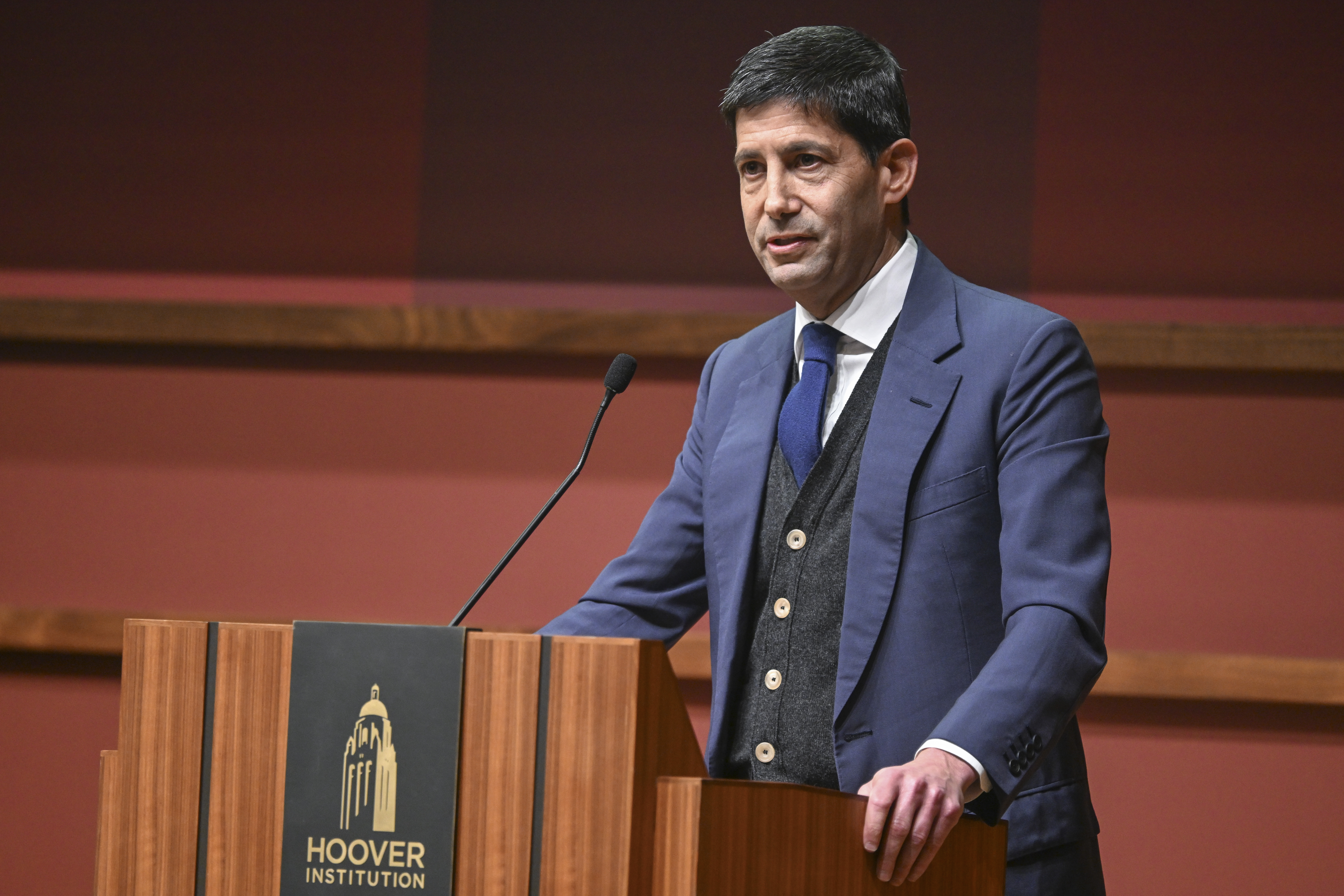
Image: Kevin Warsh speech at Hoover Institution
Compared with the Powell-era Federal Reserve, a Warsh-led Fed will likely place less emphasis on managing expectations through communication and more on discretionary judgment. Powell’s tenure institutionalized forward guidance as a stabilizing tool; Warsh appears inclined to tolerate higher uncertainty as the price of policy flexibility. This does not imply tighter policy, but rather a different transmission mechanism, one that shifts volatility from the front end to the curve and from words to markets.
In practice, Warsh’s framing creates institutional cover for easier policy. Emphasizing balance-sheet discipline and pointing to productivity-driven disinflation, particularly from artificial intelligence, allows the Federal Reserve to justify lowering policy rates without appearing complacent on inflation. It is important to note that this AI related productivity boom, while a nice narrative, remains uncertain. Regardless of whether the diagnosis is fully accurate, the policy bias it creates is clear: pressure toward lower front-end rates.
Balance-Sheet Reduction as a Policy Narrative
Warsh has repeatedly expressed concern about the size of the Federal Reserve’s balance sheet, arguing that it distorts capital allocation and crowds out private-sector activity. While this interpretation is contested by many economists, its relevance lies in how it shapes policy preferences rather than its technical accuracy.In reality, the scope for aggressive balance-sheet reduction is constrained, and after all, the FED has just ended its quantitative tightening program last year. Bank reserves are already approaching levels that historically have coincided with funding stress, particularly in the repo market. The 2019 repo disruption demonstrated that reserves can become scarce well before headline liquidity indicators flash warning signs. This risk was implicitly acknowledged when the Fed resumed Treasury bill purchases in late 2025 to stabilize funding conditions.
As a result, balance-sheet reduction is more likely to function as a rhetorical tool than as a binding constraint. It provides justification for rate cuts under the guise of restoring discipline, while preserving enough liquidity to avoid systemic stress.
Less Guidance, More Uncertainty
Another defining feature of Warsh’s framework is his skepticism toward forward guidance. He has questioned the usefulness of dot plots, formal economic projections, and strict data dependence, arguing that economic data are frequently revised and unreliable in real time.This marks a potential shift in how the Federal Reserve communicates with markets. Since the early 2010s, when the Fed introduced formal forward guidance, economic projections, and the dot plot as tools to anchor expectations after the Global Financial Crisis, markets have become increasingly conditioned to trade not just on policy decisions, but on the perceived trajectory of future policy. This framework compressed volatility, flattened yield curves, and amplified the market impact of any deviation from guidance.
Reducing reliance on these tools would increase uncertainty. Less guidance typically raises term premia and mechanically biases yield curves toward steepening. While this may create discomfort in rates markets, it often supports risk assets by loosening financial conditions at the front end while allowing longer-term inflation expectations to remain anchored.
Market Implications
Taken together, Warsh’s framework points to a regime defined by easier front-end monetary conditions, higher policy uncertainty, and sustained fiscal support. This combination is historically supportive of equities and real assets, particularly outside the United States and also a weaker U.S. dollar.In practical terms, the emerging landscape suggests:
- A Federal Reserve with a dovish inclination despite conservative rhetoric
- Policy rates trending lower at the front end
- Yield curves biased toward steepening
- A U.S. dollar that trades flat to weaker
- Continued upside convexity in equities and commodities
- More volatile FOMC meetings - back to the old days.
The most likely mispricing in this regime is an underestimation of how accommodative front-end policy can coexist with elevated uncertainty. Markets tend to associate reduced guidance with tighter conditions, when historically the opposite has often been true. Less communication, combined with proactive rate cuts, has tended to favor risk assets rather than suppress them. Within this environment, international value-oriented equity markets, including Europe, Japan, and selected emerging markets, alongside precious metals and industrial commodities, appear best positioned to deliver attractive risk-adjusted returns over the coming quarters.
Conclusion
Kevin Warsh’s appointment does not signal a return to restrictive monetary orthodoxy. Instead, it reflects an attempt to reconcile political, fiscal, and market realities through a framework that emphasizes credibility, uncertainty, and flexibility. While the language may sound conservative, the practical outcome is likely to be continued accommodative financial conditions, sustained support for risk assets, and an environment in which real assets and international equities remain well positioned.In that sense, Warsh should be viewed less as a traditional inflation hawk and more as a narrative manager, using discipline and uncertainty as tools to justify policies that, in practice, remain supportive of growth, liquidity, and risk-taking.
For investors, the message is clear. The macro regime remains one of abundance rather than scarcity, even if the path forward becomes less predictable.
 |
Investments Principal
|
With more than 20 years of experience in financial markets, Duarte specialized in the energy area in the last decade, where he had the opportunity to work with the main European Power and Gas institutions at CIMD Group. Previously, he worked as Market Strategist at IG Markets Iberia.
More about Duarte Caldas


