Market Watch
Crypto ETFs in 2025: From Breakthrough to Market Infrastructure

2025 marked a decisive evolution in the role of exchange-traded funds within the digital asset ecosystem. What began in 2024 as a breakthrough moment for spot Bitcoin ETFs matured into something more structural. Crypto ETFs are no longer novelty products. They are increasingly becoming core market infrastructure and the primary access point for institutional and sophisticated retail exposure.
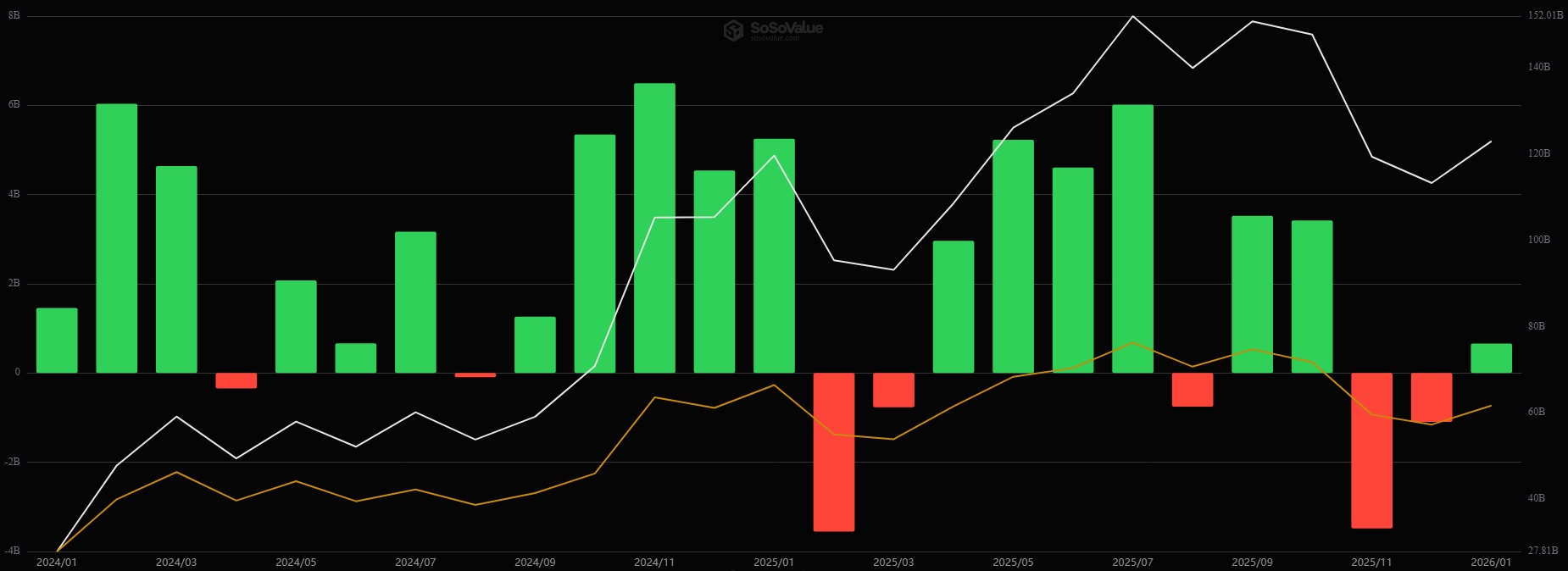
Bitcoin ETF's Monthly Flows:
Source: Sosovalue.com
At the center of this transition was a clear regulatory shift. The U.S. Securities and Exchange Commission moved away from reactive, case-by-case enforcement and toward standardized listing frameworks. The approval of generic listing standards for commodity-based ETF's, alongside clearer guidance on custody, surveillance, and staking mechanics, materially reduced uncertainty and expanded the investable universe.
Since their launch in January 2024, spot Bitcoin ETFs have accumulated approximately USD 57 billion in net inflows, making them the fastest-growing ETF category ever recorded. For context, gold ETFs took more than five years to reach comparable asset levels following their introduction in 2004.
Spot Bitcoin ETFs surpassed USD 10 billion in assets within weeks, regularly posted multi-billion-dollar daily trading volumes, and rapidly became one of the most liquid ETF segments globally. Importantly, demand was not limited to retail investors. Registered investment advisors, private banks, family offices, and institutional allocators accounted for a significant share of flows, underscoring Bitcoin’s transition into a recognized institutional asset.
While flows remained sensitive to price action and macro conditions, the durability of demand reinforced the role of Bitcoin ETFs as long-term allocation vehicles rather than purely tactical instruments.
Beyond Ethereum, 2025 marked the expansion of ETFs into additional digital asset networks. Products tracking assets such as Solana reached the market following years of regulatory uncertainty, validating investor demand for broader crypto exposure within regulated structures. Solana ETFs accumulated more than USD 800 million in lifetime inflows within months of launch, with early 2026 data showing continued net inflows despite mixed market conditions.
In parallel, the first generation of staking-enabled ETFs emerged, allowing a portion of protocol rewards to be passed through to investors. Updated regulatory and tax guidance in the U.S. helped legitimize these structures and opened the door to yield-bearing crypto ETFs.
Index ETFs provide diversified exposure, systematic rebalancing, and reduced reliance on asset-specific expertise. Several products are now live in the U.S., offering exposure to baskets of 15–20 digital assets. This approach aligns well with institutional portfolio construction, particularly for investors seeking broad participation in the asset class without managing individual positions.
The Global Crypto Fund provides:
For investors seeking more than directional exposure, an active fund structure allows for tactical adjustments, capital preservation during drawdowns, and selective participation in emerging opportunities. In this sense, ETFs and active crypto funds should be viewed not as substitutes, but as complementary building blocks within a broader digital asset allocation.
For more information on the Global Crypto Fund, click here.
Flows remain cyclical and sensitive to macro conditions, but the longer-term direction is clear. Exchange-traded funds are becoming the dominant access point for regulated crypto exposure. As regulatory clarity improves and institutional participation deepens, ETFs will play an increasingly central role in shaping both investor behavior and the evolution of digital asset markets.
Bitcoin ETF's Monthly Flows:
Source: Sosovalue.com
At the center of this transition was a clear regulatory shift. The U.S. Securities and Exchange Commission moved away from reactive, case-by-case enforcement and toward standardized listing frameworks. The approval of generic listing standards for commodity-based ETF's, alongside clearer guidance on custody, surveillance, and staking mechanics, materially reduced uncertainty and expanded the investable universe.
Bitcoin ETFs: The Most Explosive ETF Launch in History
Bitcoin ETFs were not only successful. They were historically exceptional.Since their launch in January 2024, spot Bitcoin ETFs have accumulated approximately USD 57 billion in net inflows, making them the fastest-growing ETF category ever recorded. For context, gold ETFs took more than five years to reach comparable asset levels following their introduction in 2004.
Spot Bitcoin ETFs surpassed USD 10 billion in assets within weeks, regularly posted multi-billion-dollar daily trading volumes, and rapidly became one of the most liquid ETF segments globally. Importantly, demand was not limited to retail investors. Registered investment advisors, private banks, family offices, and institutional allocators accounted for a significant share of flows, underscoring Bitcoin’s transition into a recognized institutional asset.
While flows remained sensitive to price action and macro conditions, the durability of demand reinforced the role of Bitcoin ETFs as long-term allocation vehicles rather than purely tactical instruments.
Ethereum and the Expansion of the ETF Universe
Ethereum ETFs, which began trading in July 2024, continued to build steadily throughout 2025. By year-end, lifetime inflows stood near USD 12.5 billion. These products increasingly served as strategic exposure to on-chain settlement, decentralized finance, and tokenization rather than short-term beta trades.Beyond Ethereum, 2025 marked the expansion of ETFs into additional digital asset networks. Products tracking assets such as Solana reached the market following years of regulatory uncertainty, validating investor demand for broader crypto exposure within regulated structures. Solana ETFs accumulated more than USD 800 million in lifetime inflows within months of launch, with early 2026 data showing continued net inflows despite mixed market conditions.
In parallel, the first generation of staking-enabled ETFs emerged, allowing a portion of protocol rewards to be passed through to investors. Updated regulatory and tax guidance in the U.S. helped legitimize these structures and opened the door to yield-bearing crypto ETFs.
The Rise of Crypto Index ETFs
Another structural trend gaining traction is the emergence of multi-asset crypto index ETFs. As professional investors move beyond the question of whether to allocate to digital assets and focus instead on implementation, index-based exposure has become increasingly attractive.Index ETFs provide diversified exposure, systematic rebalancing, and reduced reliance on asset-specific expertise. Several products are now live in the U.S., offering exposure to baskets of 15–20 digital assets. This approach aligns well with institutional portfolio construction, particularly for investors seeking broad participation in the asset class without managing individual positions.
3 Comma Capital's Global Crypto Fund
While ETFs have transformed access to digital assets, they are not the only institutional-grade solution. ETFs are, by design, passive instruments, offering exposure but limited flexibility in navigating volatility, liquidity cycles, or relative value across the crypto ecosystem.This is where actively managed vehicles, such as the 3 Comma Capital Global Crypto Fund, play a complementary role.The Global Crypto Fund provides:
- Active asset allocation across Bitcoin, Ethereum, and selected high-conviction digital assets
- Dynamic risk management, including cash management and volatility-aware positioning
- Exposure beyond ETF constraints, including assets or strategies not yet accessible through listed products
- Professional portfolio construction, designed to navigate liquidity cycles rather than simply mirror them
For investors seeking more than directional exposure, an active fund structure allows for tactical adjustments, capital preservation during drawdowns, and selective participation in emerging opportunities. In this sense, ETFs and active crypto funds should be viewed not as substitutes, but as complementary building blocks within a broader digital asset allocation.
For more information on the Global Crypto Fund, click here.
Conclusion: ETFs as the Backbone of Crypto Markets
By the end of 2025, crypto ETFs had evolved from headline-driven innovations into foundational market infrastructure. Bitcoin ETFs delivered one of the most successful product launches in ETF history. Ethereum ETFs added depth and diversification. New asset-specific products broadened access. Index ETFs began bridging the gap between crypto markets and traditional portfolio frameworks.Flows remain cyclical and sensitive to macro conditions, but the longer-term direction is clear. Exchange-traded funds are becoming the dominant access point for regulated crypto exposure. As regulatory clarity improves and institutional participation deepens, ETFs will play an increasingly central role in shaping both investor behavior and the evolution of digital asset markets.
 |
Duarte Caldas
Investments Principal
|
With more than 20 years of experience in financial markets, Duarte specialized in the energy area in the last decade, where he had the opportunity to work with the main European Power and Gas institutions at CIMD Group. Previously, he worked as Market Strategist at IG Markets Iberia.


